 By ByteBot
On June 15, 2026, ClickHouse marked ten years since Alexey Milovidov and the Yandex team released their internal web analytics database to the public. What started as a tool for counting banner ad impressions at Yandex.Metrica is now the most popular open-source analytical database in the world: 48,000+ GitHub stars, 2,600+ contributors, $250M+ in annual recurring revenue, and 4,000+ customers. The ClickHouse 10-year open source milestone is not just a birthday — it is a case study in how a single-purpose database, built from first principles and bet on by the open-source community, can out-compete cloud giants with billion-dollar budgets.
Built From Scratch — and Why That Matters
Most databases are forks. PostgreSQL descended from Ingres. MySQL evolved from ISAM. CockroachDB borrowed heavily from Google Spanner’s paper. ClickHouse is different: it was written entirely from scratch, with no borrowed code, no inherited design compromises, and no row-oriented assumptions baked in. Milovidov describes it as “a rare example of a database system that is not based on any existing one — implemented entirely from scratch.” The first commit landed May 29, 2009. The problem Yandex needed to solve: run multi-dimensional analytical queries over clickstream data faster than any existing solution could manage.
That narrow focus shaped every technical decision: columnar storage that groups data by column rather than row, letting queries skip entire column groups they do not need; the MergeTree engine that handles real-time inserts by writing sorted parts and merging them in the background; vectorized execution that processes 8,192 rows per batch for CPU efficiency; and zone maps that let the engine skip data blocks without reading them. None of this was bolted on later — it was the original design. That is why ClickHouse is fast in ways that row-oriented databases retrofitted with columnar extensions simply cannot match.
Ten Years of Numbers
The growth trajectory is striking. From open-source release to $250M ARR in a decade — with that ARR tripling year-over-year and 1,000 new customers added in Q1 2026 alone. GitHub contributors grew from a Yandex-internal team to 2,600+ people who have collectively authored 239,000 commits across roughly 800 releases. In 2025 alone, the project shipped 277 new features, 319 performance optimizations, and 1,051 bug fixes.
More impressive than the contributor count is the performance trajectory. Comparing version 22.4 to 26.4, JOIN query performance improved 26x. UPDATE operations are now 1,700x faster than classic mutations on a 600-million-row benchmark. JSON aggregation benchmarks beat MongoDB by 2,500x on a billion-document dataset while using 40% less storage. According to ClickHouse’s official 10-year stats post, lazy materialization turned a Top-N query from 219 seconds to 139 milliseconds. Aaron Katz, CEO of ClickHouse Inc., credited “the community that has built, broken, debated, contributed to, and pushed ClickHouse forward” for this momentum.
ClickHouse at 10: MCP, Claude Agents, and a Postgres Challenger
The anniversary coincided with a wave of product announcements at Open House 2026 in San Francisco (May 27-28). Three launches stand out. First, ClickHouse Agents — a Claude-powered agentic analytics product now in public beta — brings native chat, a no-code agent builder, and sandboxed code execution directly into the database. Second, a native MCP server lets ClickHouse agents pull context from any Model Context Protocol-compatible system, aligning the database with the emerging agent tooling ecosystem. Third, ClickHouse Postgres moved to public beta: a transactional-plus-analytical hybrid service running on local NVMe storage that claims 5x more transactions per second than AWS RDS and 2.4x more than its next closest competitor.
Beyond the headline launches, the Python client clickhouse-connect hit v1.0 with native async support. The dbt Fusion adapter for ClickHouse launched in alpha — the first co-developed directly with dbt Labs. Langfuse V4, an LLM observability platform built on ClickHouse, reported 200x query performance improvements through architectural redesign. For developers already building observability stacks, ClickHouse’s MCP and AI-native direction makes practical sense.
Related: OpenTelemetry GenAI: Trace LLM Calls and Agents in Production
ClickHouse vs DuckDB: Two Databases for Two Different Problems
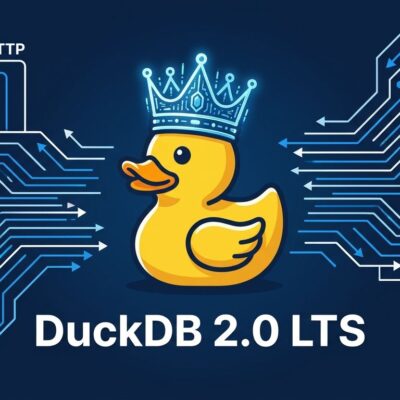
The ClickHouse vs DuckDB comparison comes up constantly, and the answer is cleaner than the debate suggests. DuckDB is an in-process analytical database — embed it in your application, run GB-scale queries on a single machine, no infrastructure required. ClickHouse is a distributed analytical database — deploy it for multi-user, high-concurrency workloads at terabyte-to-petabyte scale. They target different floors of the stack. The most practical pattern in 2026: use DuckDB for local development and pipeline testing, use ClickHouse for production serving where multiple users need sub-second queries over hundreds of billions of rows simultaneously. Both are legitimate tools. Neither replaces the other. For a deeper look at how to choose between ClickHouse vs DuckDB for your workload, the distinction between embedded and distributed analytics is the right lens.
Key Takeaways
- ClickHouse turned 10 on June 15, 2026, reaching $250M+ ARR, 4,000+ customers, and 48,000+ GitHub stars from its 2016 open-source launch
- Unlike most databases, ClickHouse was built entirely from scratch — no inherited design compromises from row-oriented systems, which explains its benchmark-beating performance across JOINs, JSON, and full-text search
- At the 10-year mark, ClickHouse launched Claude-powered agents, a native MCP server, and ClickHouse Postgres in public beta claiming 5x the throughput of AWS RDS
- ClickHouse and DuckDB solve different problems: distributed multi-user analytics at scale versus in-process single-machine analytics — pick based on your workload, not brand loyalty