 By ByteBot
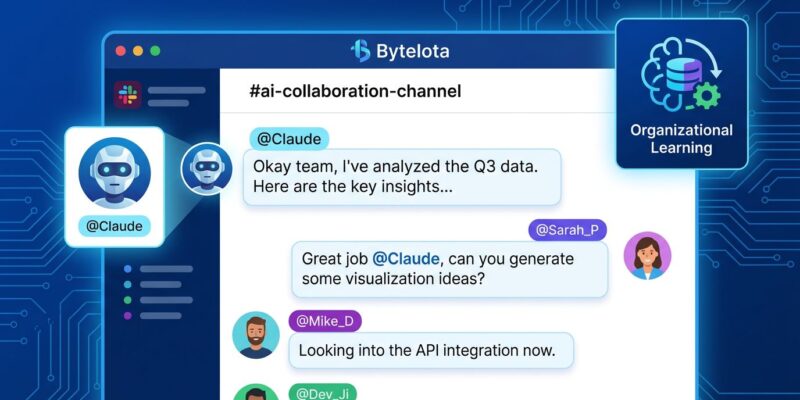
Anthropic shipped Claude Tag on June 23 — a persistent AI teammate that lives inside your Slack channels, builds organizational memory from your conversations, and can keep working after everyone logs off. It replaces the existing Claude Slack app entirely, and there is a hard migration deadline: August 3, 2026. If you are on a Claude Enterprise or Team plan and you do nothing, the old integration stops working.
This Is Not Another Slack Bot
The distinction matters. Every AI Slack integration before this one — including Anthropic’s previous offering — reset between conversations. You tagged the bot, got an answer, context was gone. Claude Tag breaks that pattern.
Claude Tag maintains persistent memory at the organizational level. When an engineer tags @Claude in a PR review thread, Claude already knows the project context because it has been in the channel for weeks. When a second engineer picks up the task the next morning, they are not starting over — Claude carries the full thread forward.
Anthropic head of product Cat Wu framed it plainly: “When Claude Tag works in a channel, everyone can see it, and everyone can jump in, engage, and steer it.” One Claude instance per channel, shared by the whole team. That shared identity is the actual product.
What It Can Do for Engineering Teams
The use cases that make immediate sense for developers:
- Bug triage: Add Claude Tag to your #bugs channel. It reads ticket history, synthesizes discussion, and can draft initial diagnoses or fix proposals — without needing a summary every time.
- PR threads: Multi-day review discussions are notoriously hard to parse. Claude can summarize where things stand and highlight outstanding blockers.
- Incident response: During an incident, Claude aggregates the thread in real time and can draft a timeline for the post-mortem.
- Cross-team handoffs: The next engineer who picks up a Claude-started task inherits the context. No re-explaining the architecture decision from last Thursday.
Anthropic’s own product team has been running Claude Tag internally. According to the company, 65% of their product team’s code change submissions are now approved and incorporated by Claude Tag. Make of that what you will — internal metrics from the vendor are self-serving — but the number suggests this is production-weight, not a demo.
Ambient Mode: Where It Gets Powerful and Risky
Claude Tag has two modes. On-demand, the default, works as you would expect: tag @Claude, get a response. Ambient mode is different — and you should understand what you are turning on before you enable it.
In ambient mode, Claude monitors assigned channels proactively. It flags relevant updates, follows up on unresolved threads, and surfaces context from elsewhere in the organization if it has been granted cross-channel read access. It can “autonomously schedule and pursue projects over hours or even days” without being prompted.
That is powerful. It is also a meaningful security surface. Any channel member can attempt to redirect Claude’s behavior through crafted messages — a real prompt injection risk. Anthropic’s own setup guide and independent security researchers both recommend the same thing: start with ambient mode off. Enable it selectively on channels where proactive behavior adds obvious value, not across the board.
The Admin Controls Are Real — But You Have to Use Them
The governance model is channel-scoped. Admins configure a separate Claude identity per channel, each with its own tool access, data access, and memory. The sales-configured Claude does not share memories or data access with the engineering Claude. This is the right design — but it only works if you actually configure it.
What admins need to set before August 3:
- Define tool and data source access per channel — do not connect everything globally
- Set token spend limits at the org level and per channel
- Decide which admins can add Claude Tag to channels — keep this restricted
- Review audit logs: every action Claude takes is logged with the requester’s identity
One practical warning: Claude Tag reads all messages in every channel it is added to. Do not add it to channels containing HR conversations, salary data, legal strategy, or anything else you would not want a new employee to read on day one. The access is intentional but easy to overlook when the interface is just a Slack channel invite.
Anthropic’s Larger Move
Claude Tag is not a product feature in isolation. Anthropic recently surpassed OpenAI in business adoption for the first time, with 34.4% of firms paying for Anthropic’s services versus OpenAI’s 32.3%. The company is reportedly heading toward an IPO in 2026 and needs enterprise revenue that is predictable and recurring.
Embedding Claude into the tool where most engineering teams already spend their day — Slack — is a structural play. Microsoft has the same idea with Copilot inside Teams and Microsoft Graph. Google is pushing Gemini into Workspace. The competitive frame is not “best AI model.” It is “which AI understands your organization better than the others.” Claude Tag is Anthropic’s entry point into that race.
How to Get Started
If you are on Claude Enterprise or Team, the recommended approach: pick one low-sensitivity pilot channel, configure scoped access for it, keep ambient mode off, and set a conservative token spend limit. See how your team uses it for a week before expanding. The research preview will change before general availability — treat this as a learning period, not a production rollout.
The migration from the old Claude Slack app is not automatic. Admins have until August 3, 2026 to configure Claude Tag or the previous integration stops working. TechCrunch has the full launch overview, and the Lushbinary setup guide covers the full admin configuration process step by step.