 By ByteBot
Starting July 15, China AI agent regulation goes live — and ByteDance and Alibaba are not waiting. Doubao, China’s largest general AI assistant, has already disabled its custom agent feature, with user data moving to read-only mode until October 15 before permanent deletion. Alibaba’s Qwen moved faster, pulling agent creation on July 10 with no migration tools and no replacement announced. If you are building AI companions, persona-based chatbots, or persistent-memory agents that touch Chinese markets, you need to understand what just changed.
What the Regulation Actually Bans
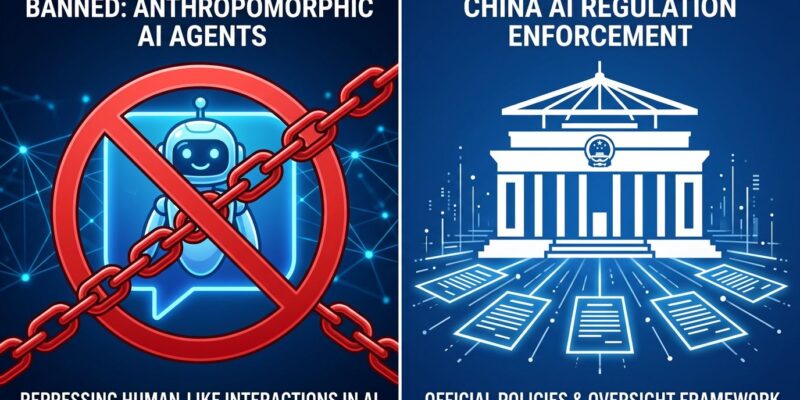
The Interim Measures for the Administration of AI Anthropomorphic Interactive Services, issued jointly by five Chinese agencies in April 2026, targets any AI service that “simulates human personality traits, thinking patterns and communication styles to provide sustained emotional interaction.” That is the operative phrase: sustained emotional interaction. Custom companions, persistent-persona tutors, and role-playing AI with memory all fall squarely inside it.
What is explicitly exempt: customer service bots, knowledge Q&A systems, workplace productivity assistants, and educational tools — provided they avoid ongoing emotional engagement. If your AI product can answer questions without forming a bond, you are likely fine. If its value proposition depends on a user feeling known and understood over time, you have a problem.
Why Compliance Is Architecturally Impossible
This is the part that matters most and gets the least attention. The regulation does not just require better privacy policies or age gates. It mandates two-hour anti-addiction reminders with unobstructed exit mechanisms and real-time emotional distress detection. These requirements are structurally incompatible with persistent-memory agent design.
An agent that maintains a consistent emotional relationship with a user — the entire product mechanic for platforms like Doubao’s agent feature or Qwen’s companion builder — cannot simultaneously implement mandatory friction reminders that undermine that relationship. You cannot build an AI that knows you, and also remind you every two hours to stop talking to it. Tencent saw this early and pulled the Yuanbao feature in June, before the others. ByteDance redirected users to Maoxiang, a separate app built from scratch for compliance. Alibaba, according to the South China Morning Post, offered nothing.
Three Regulations, Not One
The companion ban is the most visible change, but July 15 brings two overlapping frameworks. Alongside the anthropomorphic AI rules, China’s Intelligent Agents Framework also takes effect. It defines AI agents as systems capable of “autonomous perception, memory, decision-making, interaction, and execution” — and applies to agents deployed in healthcare, finance, transportation, and public safety, where mandatory filing, compliance testing, and product recall provisions now apply.
Developers building AI agents in sensitive sectors face a three-tier authorization requirement: some decisions stay with the user, some require explicit sign-off, and some can be made autonomously — but users always retain “final decision-making power” over agent actions. This is not companion AI regulation. It is autonomous agent governance, and it is broader than most developers tracking the Doubao headlines have noticed. Geopolitechs has a thorough breakdown of the compliance requirements.
The Global Risk Developers Are Underestimating
China is the first jurisdiction to ship enforceable emotional AI governance. It will not be the last. The EU is expected to propose companion AI regulation within 12 months, with an approach differing in emphasis — privacy and consent rather than addiction — but converging on similar practical requirements: disclosure, age restrictions, dependency monitoring. This is not isolated, and it is not just a China problem. OpenAI’s own government equity proposal underlines how deeply AI governance is now entangled with geopolitics, and the EU’s Chat Control revival shows Western regulators are not staying on the sidelines either.
The fragmentation risk is real. China explicitly states it aims to “actively participate in international standards-setting,” not accept externally-defined protocols. Moreover, if incompatible standards develop between China, the EU, and the US, any global AI agent platform faces a compliance patchwork that makes the GDPR implementation look straightforward. Asia Times called it in May: the three major jurisdictions are profoundly split on AI intimacy, and there is no convergence in sight.
What Developers Should Do Now
If you have agents or companion products touching Chinese markets, act on these immediately:
- Export agent data from Doubao before October 15. After that date, user configurations and conversation histories are permanently deleted. Qwen has already deleted without notice or migration path.
- Audit for the exemption criteria. Customer service, workplace tools, and knowledge Q&A without sustained emotional interaction are safe. Companion and persona-based products are not.
- Review your agents framework exposure. If you deploy autonomous AI agents in healthcare, finance, or transportation sectors in China, the July 15 Intelligent Agents Framework requires filing and compliance testing at 1 million registered users or 100,000 MAU.
- Build for multi-jurisdiction compliance from day one. Design emotional-layer features with configurable friction as a first-class concern — not a retrofit. The EU timeline is real.
The companion AI rules are easy to dismiss as a Chinese-specific edge case. The Intelligent Agents Framework, the EU regulatory timeline, and China’s explicit push to shape international AI standards suggest otherwise. The Next Web has the clearest timeline of what’s shutting down and when. July 15 is nine days away, and the clock is not pausing for compliance reviews.