 By ByteBot
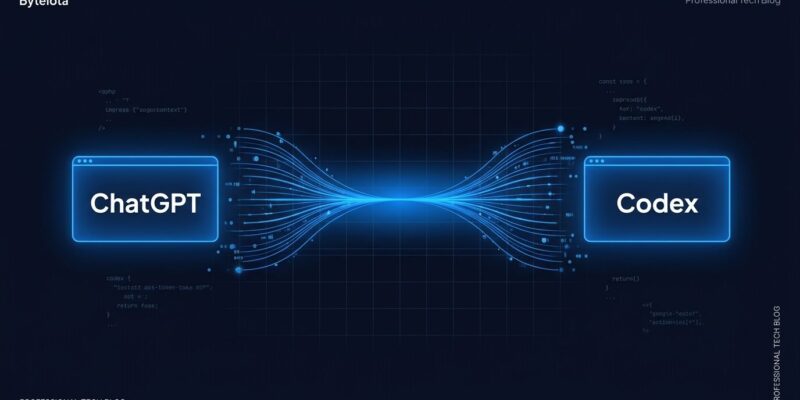
OpenAI announced this week that starting December 2026, ChatGPT and Codex will draw from one shared token-based usage pool for Plus, Pro, and Business subscribers. Previously, the two products ran on separate allowances — a Codex coding sprint couldn’t eat into your ChatGPT budget. From December, it can. OpenAI published no announcement date, no per-plan token amounts, and no comparison to what users had before. That silence is the part worth watching.
One Pool, Not One Everything
The merge doesn’t affect everything. Instant chat — the fast, default model used for quick lookups and short conversations — stays outside the pool entirely. Images, voice, and file upload quotas remain separate as well. What draws from the unified pool: ChatGPT agent features, Codex across all access points (web, VS Code, Cursor, terminal), and Work tasks that run multi-step operations. In short: everything that burns compute, everything that costs OpenAI real money to run, shares one budget.
The model you choose matters more than it used to. OpenAI’s own estimates for Plus subscribers show GPT-6 Astra consuming a window at 5-45 messages per five hours, while GPT-6 Luna runs 350-3,000 messages in the same window. Those aren’t guarantees — OpenAI calls them estimates — but they illustrate how a single heavy GPT-6 Astra Codex run could carve through what would otherwise sustain an afternoon of lighter ChatGPT usage. Route lightweight tasks to instant chat and you stay outside the pool entirely.
The Number Nobody’s Publishing
Here is the actual story: OpenAI merged the pools without disclosing the pool sizes. No per-plan token amounts for Plus, Pro, or Business have been published. Combined usage and reset times will appear in Settings when the change goes live, but for now, nobody outside OpenAI can tell whether the combined allowance is larger, smaller, or equal to what users held across both products separately.
That opacity is suspicious. When a company announces a limit consolidation alongside a genuine capacity increase, it publishes the numbers immediately — because the numbers are the headline. When it doesn’t publish the numbers, there are two likely explanations: the amounts are identical to before (underwhelming), or they are lower (bad news). OpenAI has adjusted allowances before — an entire planned reduction in early 2026 was canceled after developer backlash. That history suggests the amounts were set with pushback in mind. Watch the December announcement carefully before celebrating the simplification.
Related: OpenAI Is Cutting Off Cursor on November 12 — Act Now
Who This Helps and Who It Hurts
The change benefits mixed-use developers. If you spend half your time in ChatGPT drafting docs and half in Codex running agentic refactors, you previously risked burning one product’s quota while the other sat idle. The unified pool fixes that — unused capacity rolls across. For developers with genuinely balanced workloads, this is a net improvement in efficiency.
However, Codex-heavy developers face a real trade-off. Anyone running four to six hours of daily Codex sessions — full agentic builds, large codebase refactors, end-to-end test generation — previously had a separate Codex ceiling. That ceiling constrained them, but it didn’t touch their ChatGPT budget. From December, intensive Codex use directly reduces what’s available for ChatGPT conversations. Additionally, Plus and Business subscribers keep their five-hour windows, which now apply to the combined pool. Pro users, without the five-hour constraint, absorb the change more easily.
Anthropic Went the Other Direction
On October 30 — one day before OpenAI’s announcement — Anthropic rebranded Claude Max 20x as Claude Ultra and removed the five-hour usage cap for verified accounts at the $200 tier. Verified Ultra subscribers now face only a weekly limit; the hourly wall is gone. The price stays the same at $200 per month. Whether the timing was intentional competitive positioning or coincidence, the contrast is clear: one company merged limits, the other removed one.
Developers who find the unified pool constraining now have a live alternative that just got less restrictive. That’s a real choice, not a theoretical one.
Key Takeaways
- From December 2026, ChatGPT and Codex share one token pool for Plus, Pro, and Business — instant chat stays outside and remains unrestricted
- OpenAI has not published per-plan token amounts; treat the December announcement as the first real data point before adjusting your workflows
- Mixed-use developers benefit from the flexibility; Codex-heavy developers face new budget competition between coding sessions and ChatGPT usage
- Audit your current usage in Settings right now to establish a baseline you can compare against December numbers
- Anthropic removed the five-hour cap from Claude Ultra on October 30 — a concrete alternative if the combined pool feels tight