 By ByteBot
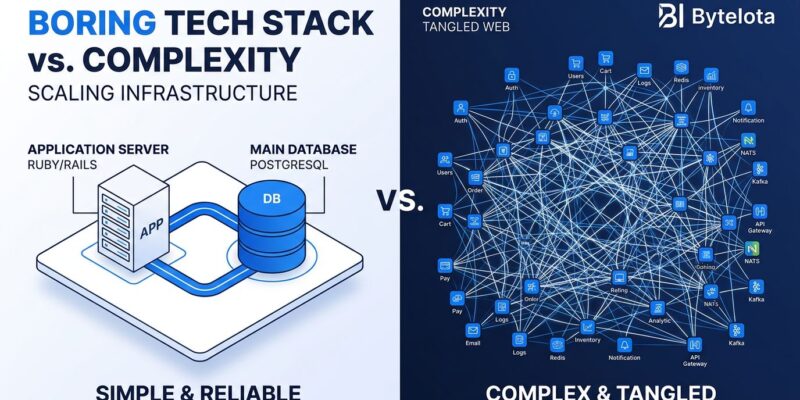
In 2026, the most controversial architectural choice you can make is choosing a monolith, PostgreSQL, and a single VPS. While the tech industry celebrates AI agents, edge computing, and distributed systems, 42% of organizations are quietly consolidating their microservices back into larger deployable units. The boring tech stack has become a counter-cultural statement—not because it’s outdated, but because it challenges the complexity industrial complex that profits from over-engineering.
The Complexity Industrial Complex
Multiple parties profit from complexity, creating a self-reinforcing hype cycle that prioritizes resume-building over solving actual problems. Conference organizers need new topics every year. Course creators sell training on the latest frameworks. Consultants bill hours architecting distributed systems. Cloud vendors monetize additional services. Tech influencers build credibility by adopting bleeding-edge technologies before they mature.
This isn’t conspiracy—it’s incentives. When everyone giving architectural advice profits from complexity, the advice skews toward complexity. Developers adopt cutting-edge technologies for resume-building, creating maintenance burdens that outlast the initial excitement. “Complexity is a tax you keep paying forever,” as one developer put it in a viral post advocating for boring stacks.
Real-World Proof at Internet Scale
The “you can’t scale with monoliths” argument dies when confronted with actual numbers. Shopify processes 20+ terabytes of data per minute using a modular monolith. During Black Friday, it handled 1.27 million requests per second. The codebase has 2.8 million lines of Ruby and 500,000 commits, maintained through disciplined modularity using Packwerk to enforce boundaries.
Stack Overflow serves 6,000 requests per second and 2 billion page views monthly with a 15-year-old monolithic application running on-premise. Page render time: 12 milliseconds. Architecture: Single SQL Server, nine web servers. No microservices, no NoSQL, no serverless—just proven technology executed well.
Amazon Prime Video consolidated its microservices-based monitoring system back into a monolith and cut infrastructure costs by over 90%. When AWS itself chooses monoliths for cost and operational simplicity, the “microservices or bust” narrative collapses.
A well-designed monolith, guided by hexagonal architecture and disciplined modularity, can outperform a tangled web of microservices even at internet scale. Most businesses never approach this scale anyway—a single VPS can handle 700-1000 requests per second, far exceeding typical application demands.
AI Makes Boring More Critical, Not Less
In 2026, AI code generation doesn’t make architectural complexity acceptable—it makes simplicity essential. AI multiplies your architectural decisions. Simple architecture multiplied by AI equals manageable code. Complex architecture multiplied by AI equals chaos.
Current evidence supports this: developers clean up 60% of AI-generated code in recent studies. Apps that used to be 10,000 lines now balloon to 50,000 lines with AI-generated boilerplate. “AI ships code with no effort and ignores trade-offs, while maintenance becomes the problem” for engineering teams dealing with coupling, cohesion, and reliability.
Debugging AI-generated code in distributed systems becomes a nightmare. Distributed tracing across microservices can’t compete with Ctrl+F in a monolith when you’re trying to understand what AI produced. When AI generates the code, you need architectures you can reason about.
The Quality Crisis Nobody Addresses
Software quality has declined measurably while complexity increased. Analysis of vendor status pages shows outages steadily rising since 2022. The decline in software quality and productivity is “real and measurable—and being actively ignored by people with the power to address it,” according to industry observers.
The 2025 CNCF survey revealed 42% of organizations consolidating microservices back into larger units. Primary drivers: debugging complexity, operational overhead, and network latency impacting user experience. Surveys confirm maintenance costs increase after microservices migration, despite companies originally migrating to “facilitate maintenance.” Technical debt for dozens of microservices compounds faster than in monoliths.
Common architectural debt in distributed systems includes shared databases breaking services on schema changes, bad API designs creating team coupling, and coordination overhead that Ctrl+F in a monolith sidesteps entirely.
PostgreSQL: The Boring Database Winning on Merit
PostgreSQL hit 55.6% developer adoption in the 2025 Stack Overflow survey, surpassing MySQL’s 40.5%. Among professional developers, the gap widened to 58.2% versus 39.6%. This isn’t hype—it’s boring technology winning on reliability, features, and proven architecture.
ACID-compliant since 2001, PostgreSQL offers JSONB support for document flexibility without sacrificing relational integrity. “The old SQL vs NoSQL wall is much lower now”—you get schema enforcement when you need it, flexible JSON when you don’t. Migration stories like “Why We Moved Back to Postgres After 4 Years of MongoDB” reflect developers choosing maturity over novelty.
When Boring is Wrong
Honesty requires acknowledging edge cases where complexity delivers value. Netflix-level scale with billions of users justifies distributed systems. Organizations with distributed teams requiring independent deploy cycles benefit from service separation. Polyglot persistence needs—truly different data models requiring different storage engines—can justify database diversity.
The key: prove complexity adds value before adopting it. Default to boring, complexity when demonstrated necessary—not the reverse.
Users Reward Reliability Over Architectural Purity
End users don’t care about your microservices. They care whether the application works, loads fast, and doesn’t break. Developer sleep matters too—pager duty at 3 AM debugging network partitions between services destroys quality of life.
Choose boring by default: monoliths, relational databases, predictable deployments. You can always add complexity later when actual constraints demand it. You can’t easily subtract complexity once embedded. The most controversial architectural choice in 2026 isn’t adopting the latest hype—it’s having the discipline to say no to complexity you don’t need.