 By
By AWS shipped Kiro at Summit New York last week — and unlike every other AI coding tool fighting over autocomplete benchmarks, Kiro is making a structural argument: vibe coding is creating a technical debt bomb, and the fix is writing a spec before writing a single line of code. That is either disciplined engineering or AWS trying to retrofit process onto a workflow developers never asked for. Here is what it actually does.
What Kiro Is, Without the Marketing
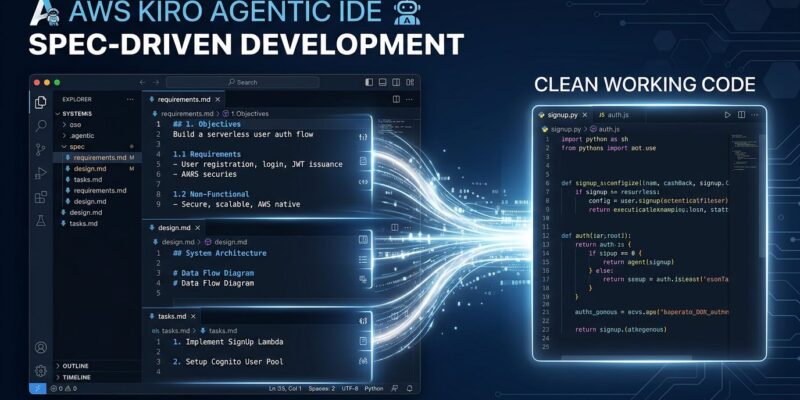
Kiro is an agentic IDE built on Amazon Bedrock that converts prompts into structured specifications first, then into working code. The core mechanic is a three-file workflow that sits between your initial prompt and your first commit.
When you describe a feature, Kiro generates three Markdown documents in sequence:
- requirements.md — User stories and acceptance criteria in structured notation. Who needs what, and why. Written in natural language but formatted for traceability.
- design.md — Technical architecture: data models, API shapes, TypeScript interfaces, sequence diagrams. Kiro generates this by analyzing your existing codebase plus the approved requirements.
- tasks.md — Granular, sequenced implementation tasks with dependency mapping. Independent tasks run in parallel when you trigger execution.
The gating is the point. You approve each document before the next one generates. You can edit, reject, or regenerate any spec. The AI does not touch your code until all three docs are signed off. For developers who have spent weeks untangling AI-generated code that solved the wrong problem, this is the entire value proposition.
Agent Hooks: Where Kiro Earns Its Keep
The spec workflow explains Kiro’s philosophy. Agent Hooks explain why developers who try it tend to stay.
Hooks are event-driven triggers stored as JSON files in .kiro/hooks/ and version-controlled with your project. Every developer on the team shares the same hooks. A hook fires when something happens in the IDE and runs a predefined agent action without requiring a manual prompt.
A hook that updates tests automatically when you save a TypeScript file:
{
  "hooks": [
    {
      "name": "update-tests-on-save",
      "event": "file:save",
      "pattern": "src/**/*.ts",
      "prompt": "Update the test file for the saved component to reflect any interface or behavior changes."
    }
  ]
}
Common hook patterns: update documentation when implementation changes, cascade spec revisions when requirements.md is edited, run security lint on any file touching authentication paths, regenerate database fixtures when a schema file changes.
Every developer has experienced the moment where they update a component but forget the tests, or change an API contract but leave the docs stale. Hooks close that gap at the project level — team-level discipline that does not require anyone to remember.
What Is Running Under the Hood
Kiro uses Amazon Bedrock and routes between two model families depending on task type:
- Claude Sonnet / Opus for reasoning-heavy work: spec generation, architectural decisions, complex debugging, code review
- Amazon Nova for high-throughput generation: scaffold code, boilerplate, repetitive transformations
This routing is transparent to the user. Teams can configure per-Hook overrides to pin specific workflows to a model family for cost predictability. Kiro’s spec-driven development approach with Kiro Pro Max, announced at AWS Summit on June 17, adds access to Claude Opus 4.8 at $100 per month with 5,000 credits included.
Kiro vs. Cursor vs. GitHub Copilot
The comparison developers actually want:
| Tool | Workflow | Best For | Billing |
|---|---|---|---|
| Kiro | Spec-first, then code | Team projects, regulated industries | Credit-based ($0–$200/mo) |
| Cursor | Prompt-first | Cross-file editing, fast refactoring | $20/mo flat |
| GitHub Copilot | Autocomplete-first | Individual developers, multi-IDE | Token-based (unpredictable) |
The honest assessment: Cursor and Copilot are faster to start with. Kiro’s value proposition does not show up on day one of a project. It shows up on week two, when the absence of spec starts creating friction for everyone who is not the original developer. A real developer comparison from DEV Community confirms: Kiro wins on structure and team alignment, Cursor wins on individual speed, Copilot wins on low-friction entry.
Who Should Try Kiro Right Now
Kiro is well-suited for teams on greenfield projects where documentation is required anyway — the spec files replace work that would otherwise go into Confluence. It is a natural fit for regulated industries (healthcare, fintech, aerospace) where requirements traceability is non-negotiable. With 45% of vibe-coded projects containing security vulnerabilities, Kiro’s spec gate catches requirements gaps before they become production problems. Non-engineering contributors — product managers, domain experts — can write requirements.md without touching code.
Kiro is a poor fit for solo developers on short projects, teams that need full open-source or BYO-model privacy (OpenCode is the right tool there), and developers whose best work happens through unstructured prompting.
Getting Started
Kiro‘s free tier starts with 50 credits — enough to run the spec workflow on one mid-size feature and assess whether it fits your team’s process. Desktop app available for macOS, Windows, and Linux. CLI install on Mac/Linux:
curl -fsSL https://cli.kiro.dev/install | bashThe spec-driven approach is opinionated. If your team’s current pain point is AI-generated code that nobody understands a month later, that opinion is worth evaluating.