 By ByteBot
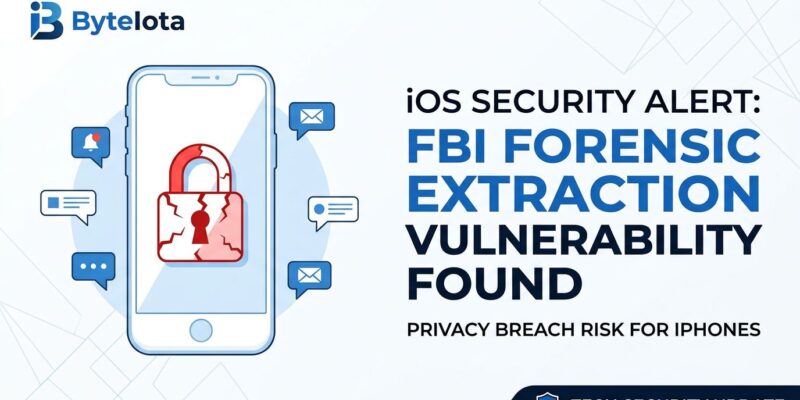
Apple released iOS 26.4.2 on April 22, 2026, patching CVE-2026-28950—a critical bug that let law enforcement extract deleted Signal messages from iPhones. The FBI exploited this flaw to recover incoming messages from a defendant’s device even after Signal was deleted, by accessing iOS’s push notification database that secretly retained message previews for up to 30 days. The vulnerability came to light after 404 Media reported the FBI’s extraction technique in the Prairieland terrorism case, prompting Apple to ship an emergency fix 13 days later. This undermines trust in secure messaging—users who relied on Signal’s disappearing messages or deleted the app entirely had no idea iOS was keeping unencrypted copies of their private communications.
How the Vulnerability Worked
iOS’s Notification Services framework stored message preview snapshots in an internal database (KnowledgeC.db) and retained them for up to 30 days, even after users deleted notifications or uninstalled apps. This created an OS-level privacy gap that encrypted messaging apps couldn’t control. When forensic tools like Cellebrite extracted the device’s file system, they could pull these notification snapshots and recover “deleted” message content.
The 30-day retention period was completely undocumented. Users had no idea iOS kept this data. End-to-end encryption protects messages in transit and inside the app, but it’s useless if the operating system creates unencrypted copies elsewhere. Moreover, app developers are helpless—they can’t prevent iOS from logging notification content.
According to CVE-2026-28950 documentation, “notifications marked for deletion could be unexpectedly retained on the device.” Apple’s fix addresses the issue “with improved data redaction.” Indeed, the notification database survived even after Signal was completely removed from the device, revealing a fundamental architectural problem: privacy requires cooperation from the entire stack, not just the messaging app.
All Messaging Apps Affected, Not Just Signal
While the FBI case involved Signal, the notification database bug affects every messaging app that displays content in lock screen notifications: WhatsApp, Telegram, iMessage (Apple’s own app), SMS, and email apps. The vulnerability is platform-level, not app-specific. Consequently, any developer relying on iOS for privacy was vulnerable to OS-level data leakage.
This isn’t a Signal problem—it’s an Apple problem. Signal gets blamed because the FBI case was high-profile, but developers using WhatsApp, Telegram, or even iMessage for confidential communications were equally vulnerable. For journalists protecting sources, whistleblowers, security researchers discussing vulnerabilities, or anyone in a sensitive situation, the messaging app choice didn’t matter. iOS betrayed them all.
Apple markets iPhones on privacy (“What happens on your iPhone, stays on your iPhone”), yet iOS was silently keeping deleted message previews for 30 days. The irony is rich.
The FBI Prairieland Case
The vulnerability became public through court testimony in a Texas terrorism prosecution (the “Prairieland” case), where defendants allegedly vandalized an ICE detention facility. FBI forensic analysts testified that they extracted Signal message content from a defendant’s iPhone using Cellebrite tools, even though the Signal app had been deleted and disappearing messages were enabled.
The FBI used Cellebrite UFED for full file-system extraction and recovered incoming Signal messages (not outgoing) from the notification database. Furthermore, the timeline shows Apple can move quickly when privacy violations become public: early April 2026 court testimony, April 9 when 404 Media exposed the technique, and April 22 when Apple released the patch—just 13 days.
However, this raises uncomfortable questions. How many other undisclosed forensic techniques exist? Law enforcement has been using Cellebrite and similar tools to extract iOS data for years. This bug likely existed for years before public disclosure forced Apple’s hand.
What to Do Now
Apple fixed the bug in iOS 26.4.2 and iOS 18.7.8 (backported to older devices). The patch automatically deletes all retained notifications and prevents future retention. However, users must take two immediate actions.
First, update to iOS 26.4.2 now. The patch affects iPhone 11 and later, iPad Pro, iPad Air, and iPad mini (5th generation and later). Second, disable notification previews for sensitive apps to prevent future OS-level leaks if similar bugs exist. To disable globally: iOS Settings > Notifications > Show Previews > “Never.” For Signal specifically: Signal Settings > Notifications > Notification Content > “No Name or Content.”
Signal praised Apple’s response but emphasized a critical point: “It takes an ecosystem to preserve the fundamental human right to private communication.” Privacy isn’t just about the app—the OS layer matters just as much.
Security expert Bruce Schneier highlighted that forensic extraction “can yield sensitive data derived from secure messaging apps in unexpected places.” The threat model has changed. If someone gains physical access to your device (law enforcement with a warrant, thieves, adversaries), forensic tools can extract data from unexpected places. Consequently, defense-in-depth means assuming the OS might leak data and configuring apps defensively.
Key Takeaways
Update to iOS 26.4.2 immediately. Disable notification previews for sensitive apps. Understand that encryption isn’t enough if the OS leaks data—privacy requires OS cooperation, not just app encryption. Physical access to devices changes everything. Without proper defenses, encryption means nothing.
Question what other data iOS retains silently. Notification database is just one example. What about Siri voice recordings? Spotlight search indexes? iCloud backups of notification data? This bug likely isn’t unique. Platform vendors must be transparent about data retention policies, and users must demand that transparency.
The lesson is broader than this single bug. Choose platforms with privacy-by-design, not privacy-by-marketing. Use apps with minimal data exposure. Configure devices defensively. Understand your threat model. And never assume encryption alone solves privacy when the platform can undermine it at the OS level.