 By ByteBot
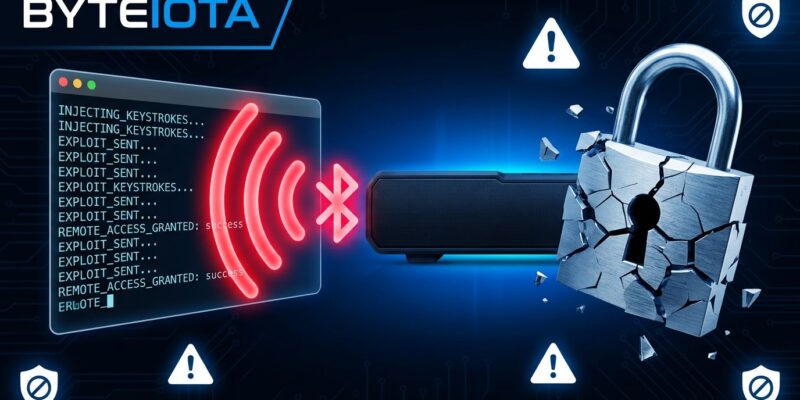
A security researcher has turned the Creative Sound Blaster Katana V2X — a popular $279 PC soundbar — into a remote keystroke injector. No physical access. No Bluetooth pairing. And no patch coming from Creative. Anyone within 15 meters can silently flash custom firmware onto the device over Bluetooth, after which the speaker begins injecting arbitrary commands into the connected PC on every boot. The full disclosure dropped June 3, 2026, landing at the top of Hacker News with over 600 points.
Three Flaws, One Working Exploit
The attack chains three separate weaknesses. None of them alone is catastrophic. Together, they hand an attacker complete control of your PC through a device it already trusts.
First: The Katana V2X uses Creative Transport Protocol (CTP) internally. Over USB, CTP requires AES-256-GCM challenge-response authentication. Over Bluetooth Low Energy, however, CTP is completely unauthenticated — anyone nearby can send the firmware version read command 5a 09 01 02 and get a full response without pairing. The entire command surface is exposed: settings, firmware upgrades, diagnostics.
Second: Firmware updates have no cryptographic signing. The device validates updates using only a SHA-256 checksum. Patch the checksum, and the device accepts whatever firmware you send. “Besides this checksum, which was trivial to patch, there was no other protection in place,” the researcher wrote.
Third: The speaker already registers as a USB HID Consumer Control device for its volume buttons. The researcher modified the HID report descriptor to add keyboard capability, then overwrote a diagnostic task with roughly 100 bytes of ARM assembly that injects keystrokes at startup. The PC sees a trusted USB peripheral announcing itself as a keyboard. It complies.
The attack takes roughly ten minutes to execute over Bluetooth and survives every reboot. The researcher demonstrated typing echo pwned. In a real attack, that becomes powershell.exe followed by whatever payload the attacker wants — exfiltration, persistence, a reverse shell. Moreover, the firmware modification is invisible to the user: the speaker still plays audio normally.
Creative Says It’s Fine. It Is Not.
The researcher submitted the findings to SingCERT on April 9, 2026. Creative’s response, delivered June 3 via SingCERT: “we do not consider this to be a vulnerability, as it does not present a cybersecurity risk.”
That position is indefensible. The attack is fully documented with working proof-of-concept code. The firmware can be reflashed remotely. The speaker then injects keystrokes into the host PC. There is no credible interpretation of “no cybersecurity risk” that fits those facts. No CVE will be assigned because Creative refused to acknowledge the issue. No patch is coming.
There is also no escape valve for users: the Katana V2X’s Bluetooth radio has no off switch. It broadcasts and accepts connections even when the speaker is in sleep mode. Furthermore, the affected firmware version — 1.3.230619.1820 and all prior versions — remains the only official firmware available.
Why Developers Should Take This Seriously
This is not a theoretical risk for home theater setups. Developer workstations are the highest-value targets in any organization. SSH private keys, AWS credentials, API tokens, code signing certificates, GitHub access — everything that matters lives there. One compromised developer machine cascades to CI/CD pipelines, cloud infrastructure, and team repositories.
Developers also disproportionately own this kind of hardware. The Katana V2X occupies the “serious gaming audio” category that overlaps heavily with WFH setups and open-plan offices. Additionally, an attacker in a co-working space, a hotel lobby, or a coffee shop within 15 meters of your bag doesn’t need to touch anything. This is essentially a USB Rubber Ducky attack — except the attacker never has to approach the machine. This attack class joins a growing pattern of Bluetooth audio hardware being used as an attack vector, as we saw with the WhisperPair headphone hijacking disclosed late last year.
What to Do Now
The community has produced a patch. v2x-patcher, available on the researcher’s Gitea instance, downloads the official firmware, patches it to block CTP-over-Bluetooth, and uploads it via USB. This likely breaks the Creative mobile app — but the mobile app requires the same BLE CTP interface that enables the attack. You cannot have both.
If you’d rather not apply a third-party firmware patch, your realistic options are to disconnect the USB cable when you step away from your desk, or to replace the device entirely. There is no official mitigation, and Creative has declined to create one.
The broader lesson here extends well beyond this specific speaker. Consumer peripherals — mice, keyboards, audio devices — operate under implicit OS trust because they present as HID devices. Many ship with Bluetooth radios that never fully power down. Firmware signing is still far from universal in consumer hardware. The Hacker News thread is full of people naming other devices with similar exposure. The Katana V2X is one confirmed case with a working exploit. It will not be the last.