 By ByteBot
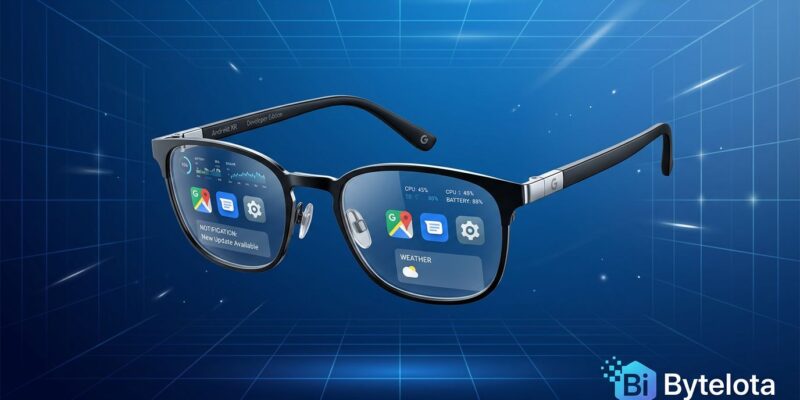
Google’s Android XR glasses launch on October 14. Warby Parker frames, $799, 30-degree monocular display, shipping in the US, UK, and Canada simultaneously. As of today, you have 21 days to apply for free hardware, a non-recoupable development grant up to $250K, and direct technical support to build for that launch. The program is the Android XR Developer Catalyst Program, the deadline is June 30, and the application is at g.co/dev/catalyst. If you are an Android developer and this is news to you, you are already behind.
What the Catalyst Program Actually Offers
Google is running the Catalyst Program to seed the Android XR app ecosystem before the October hardware launch. Accepted developers get three things: hardware, money, and support.
Hardware. You pick one of three form factors from the application. XREAL Project Aura are wired XR glasses with a 70-degree field of view and an optical see-through OLED display, tethered to an external compute puck running Qualcomm Snapdragon XR. Audio glasses have no display — Gemini speaks into your ear. Display glasses are the Warby Parker form factor: a 30-degree monocular in-lens overlay, designed for all-day wear.
Grants. Google set aside $30 million for the first six months post-launch. Studios building original spatial experiences for the in-lens display are eligible for grants up to $250,000. Grants are non-recoupable — you do not pay them back.
Support. Selected developers get specialized technical support channels and early SDK resources. Apply by June 30, get a decision by July 15 — that leaves three months before the Warby Parker launch to build something meaningful.
Three Hardware Targets, One SDK
The strategic advantage of the Android XR platform is a unified toolchain. One Jetpack XR SDK covers audio glasses, display glasses, and the XREAL Project Aura wired XR form factor. You are not managing three separate dependency trees.
Audio glasses launch first, in fall 2026. No display code, no Compose Glimmer — just Gemini integration and audio output. For developers who want to ship something fast, audio glasses are the path.
Display glasses — Warby Parker on October 14, Gentle Monster and Samsung's own line to follow — use Jetpack Compose Glimmer, Google's UI toolkit designed for optical see-through displays. It includes Google Sans Flex for legibility at small sizes and components like Stacks (touchpad-optimized card groups) and Title Chips. The in-lens display is monocular and 30 degrees, so constraint design is mandatory.
XREAL Project Aura has a 70-degree field of view and the full ARCore Geospatial API: you can anchor digital content to real-world locations across 87 countries. For developers targeting enterprise use cases — field service, healthcare, manufacturing — Aura is the right hardware to request.
You Can Start Building Before You Get Hardware
The Android XR SDK Developer Preview 4 (May 2026) is the current release. Core libraries — XR Runtime, Jetpack SceneCore, ARCore for Jetpack XR — moved to Beta. Android Studio ships with an AI Glasses emulator that simulates touchpad and voice input, so you can build and test without a physical device.
The development model for glasses is straightforward: extend your existing Android app. You create a new Activity that runs on the phone and projects to the glasses via the Jetpack Projected library. Business logic stays in your existing codebase. The glasses experience is an extension, not a rewrite.
// build.gradle
implementation("androidx.xr.projected:projected:1.0.0-beta01")

// AndroidManifest.xml
<activity android:name=".GlassesActivity">
    <intent-filter>
        <action android:name="androidx.xr.projected.PROJECTED_ACTIVITY" />
    </intent-filter>
</activity>
Unity, Unreal Engine, and Godot are all officially supported in DP4 through a new Engine Hub. Game developers and 3D toolchain shops are fully covered.
The Real Opportunity Here
Meta's Ray-Ban smart glasses launched with roughly 50 third-party apps. Android XR launches with existing Android app compatibility — apps that already exist can be extended without a full rewrite. But that also means the differentiated opportunity is building something that uses the glasses hardware uniquely: turn-by-turn navigation with in-lens overlays, real-time translation of text in the field of view, hands-free interfaces for physical work.
Uber is confirmed at launch. Mondly is confirmed for language translation. The rest of the October ecosystem is still being built. The Catalyst Program is Google's way of closing that gap before day one. If your app has any relevance to navigation, productivity, fitness, or real-time information display, and you are not applying for this program, you are handing that launch window to someone else.
How to Apply
The application is at developer.android.com/develop/xr/catalyst. The deadline is June 30, 2026 at 11:59 PM PDT. Hardware ships to developers in the United States, Japan, the United Kingdom, and the European Union. Notifications go out by July 15.
Google is looking for developers planning to publish for Android XR within the next 6 to 12 months. If you are building something original for the in-lens display and need hardware to develop against, the grants program exists specifically for that. Submit the application, state your use case, and request the form factor that matches your target market. The October 14 launch window will not wait.