 By ByteBot
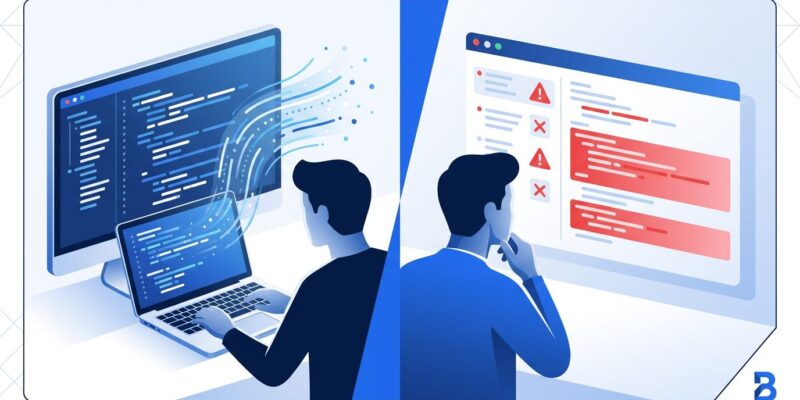
Developers are living a contradiction. SonarSource’s 2026 State of Code survey of 1,100+ professionals reveals that 72% use AI coding tools daily, 96% don’t fully trust the output, yet only 48% always verify it before committing. This gap between adoption and oversight exists while AI accounts for 42% of all committed code—a share expected to hit 65% by 2027. The result: a verification bottleneck reshaping software development and creating hidden technical debt at scale.
The Trust Paradox: Use It, Don’t Trust It, Ship It Anyway
Stack Overflow’s 2025 survey found 84% of developers use AI tools, but only 29% trust them. In fact, 46% actively distrust AI tool accuracy. So why are they using something they don’t trust? Career pressure and competitive advantage. In 2026, NOT using AI feels riskier than code quality concerns. Developers face productivity expectations, management pressure, and fear of falling behind. The calculation is brutal but simple: using flawed tools beats not using them at all.
The distrust isn’t paranoia. It’s backed by measurement.
The Quality Reality: 68% More Issues Per Pull Request
CodeRabbit’s December 2025 analysis of 470 open-source pull requests found AI-authored PRs averaged 10.83 issues each versus 6.45 in human-authored code. That’s 68% more problems. Logic and correctness errors jumped 75%, and security findings were 57% more prevalent in AI-generated code. GitClear found code duplication increased 4x with AI usage.
But the problems don’t stop at the PR stage. Even after passing QA and staging tests, 43% of AI-generated code changes require manual debugging in production. Not a single team in one study could verify an AI-suggested fix with just one redeploy cycle—88% needed two to three attempts.
These aren’t anecdotes. They’re patterns emerging across thousands of pull requests and production deployments. AI generates code faster, but that code breaks more often.
The Verification Bottleneck: Faster Generation, Slower Delivery
Here’s where the productivity story gets complicated. While AI tools promise speed, 38% of developers in the SonarSource survey reported that reviewing AI-generated code requires more effort than reviewing human-written code. The recommendation now: 85-90% test coverage for AI code versus 70-80% for human code.
A randomized controlled trial by METR revealed a startling perception gap. Developers using AI felt 20% faster but were actually 19% slower when measured. The productivity gains from faster code generation were consumed by verification overhead. One developer put it bluntly: “While AI hasn’t eliminated toil, it has simply focused that toil on a new, critical skill: verification.”
The bottleneck has shifted, not disappeared. Teams using verification tools like SonarQube reported 44% fewer outages from AI-generated code, showing that structured verification processes help—but they require investment and discipline most teams haven’t built yet.
The Stakes: 73% in Customer-Facing Apps, 58% in Business-Critical Systems
This isn’t experimental technology confined to side projects. The SonarSource survey found 73% of teams deploy AI-generated code in customer-facing applications, and 58% use it in business-critical services. Another 83% have it running in internal production software.
The volume is accelerating. AI code has grown from negligible to 42% of all commits, and developers expect it to reach 65% by 2027. That’s a 23% increase in one year. The verification gap—where 96% distrust but only 48% verify—affects code already live in systems handling real users and real business operations.
AI creates a technical debt paradox. It helps clean up old messes like documentation gaps and missing tests. But it simultaneously introduces new, subtler problems: unreliable logic, duplicated code, and security vulnerabilities that slip through because developers assume the AI “probably got it right.” Probably isn’t good enough for production, but that’s what teams are shipping.
The Path Forward: Verification Becomes the New Frontier
The industry is responding. Qodo raised $70 million in March 2026 specifically for code verification as AI coding scales. Meta Engineering published research in February on Just-in-Time Tests (JiTTests), which generate fresh tests for every code change. Analysis of 22,126 generated tests showed code-change-aware test generation produced 4x more useful results than traditional testing approaches.
SonarSource, analyzing 750 billion lines of code daily, is positioning verification as the critical missing piece in AI coding workflows. The teams winning in 2026 aren’t the ones generating the most code—they’re the ones building processes to ship reliable code despite elevated defect rates.
AI coding tools aren’t disappearing. Adoption will accelerate as 42% of code becomes 65%, then likely higher. But the free productivity lunch is over. Success now requires acknowledging the verification bottleneck, investing in better testing infrastructure, and treating AI-generated code as inherently higher-risk until proven otherwise. The 96% who don’t trust their tools are right to be skeptical. The question is whether the 48% who verify will become 80%—or whether the gap will widen further as volume overwhelms oversight.