 By ByteBot
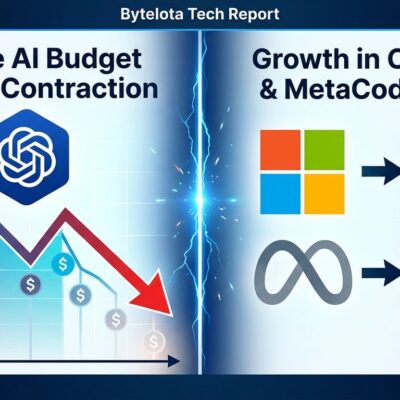
In three weeks, OpenAI cut its frontier API prices twice, Google launched a new coding model at half the cost of its predecessor, and DeepSeek — the company that forced the whole race to the bottom — quietly raised its rates by up to 355%. August 2026 has been a whiplash month for anyone building with AI APIs. Here’s what changed, what it signals, and what you should actually do about it.
The Numbers: What Changed and When
Let’s start with the facts. On July 30, OpenAI cut GPT-5.6 Luna by 80%, dropping input from $1.00 to $0.20 per million tokens and output from $6.00 to $1.20. Luna was already the cheapest tier of the GPT-5.6 family — positioned for high-volume, low-latency work like summarization, classification, and routing. At $0.20/M input, it now costs less than some models that aren’t anywhere near its capability level.
On August 21, GPT-5.6 Sol — the reasoning-heavy, agentic tier — got its own cut: input down 20% to $4/M, output down 33% to $20/M. The reduction applies to the API and to Codex credit-based plans, and runs through November 21. Promotional pricing has a way of feeling permanent until it isn’t.
Meanwhile, on August 13, Google dropped Gemini 3.7 Flash at $0.75/M input — half the previous generation’s rate — with an introductory rate through year-end targeted at coding and agents. The benchmarks back up the launch: DeepSWE v1.1 jumped from 49% to 65.3%, and the agentic completion rate on Automation Bench nearly doubled from 17% to 30%.
DeepSeek Blinked
Here’s the part that actually matters: DeepSeek raised its prices. Effective August 16, the flat-rate structure for V4 Flash and V4 Pro was replaced with dynamic peak/off-peak billing. At peak hours, output tokens now cost up to 4.7x what they did a week earlier. Off-peak rates are more reasonable — $0.22 input, $0.66 output — but that’s still a 136% jump on output from the old flat rate.
DeepSeek was the company that started this whole cascade. When it priced V4 Flash at near-zero margins last year, it forced OpenAI, Anthropic, and Google to compete on price in ways they hadn’t before. Now it’s retreating. That’s not a minor footnote — it’s a signal that subsidized near-zero pricing has a shelf life, and the floor may be higher than any infrastructure planning accounted for.
Teams that built pipelines explicitly around DeepSeek’s near-zero costs are now facing a real architecture rethink. The practical guidance post-hike is consistent across analysis: audit your token usage, model at 2-3x current rates, and build multi-provider routing before you’re forced to.
Does Tiered Routing Still Make Sense?
The standard advice for the last two years has been: use small, cheap models for simple tasks, reserve frontier for the hard stuff. That calculus looks different with Luna at $0.20/M input.
If you’re routing basic summarization or classification through models priced in the $0.50–$1 range, Luna is the obvious move. The capability argument for non-frontier budget models evaporates when the frontier itself costs less. But tiered routing still produces dramatically different outcomes at scale. Production data puts blended cost at $2.31/M for organizations using smart routing versus $18.40/M for teams routing everything to frontier — an 8x difference that holds even when “frontier” is cheaper than ever.
The routing logic shouldn’t be pure price optimization, though. The right question for each task isn’t “what’s the cheapest model?” — it’s “what’s the cheapest model that gets this right?” A wrong answer that costs $0.05 to generate but $200 to diagnose and fix isn’t actually cheap. Build routing on quality signals, not just token rates.
What Developers Should Do Today
- Re-route existing DeepSeek pipelines. If you’re using V4 Flash for high-volume tasks, the economics changed on August 16. GPT-5.6 Luna is now a competitive alternative at similar or better capability for many workloads. Tencent Hy3 and Qwen 3.8 are also worth evaluating.
- Don’t build on promotional rates as a baseline. Sol’s $20/M output is good through November 21. Plan for the rate that follows — not the temporary one in effect now.
- Set up multi-provider routing now, not later. Both the GPT-5.6 cuts and the Gemini 3.7 Flash launch happened within the same month. This pace is not slowing. A single-provider dependency is a pricing risk dressed up as simplicity.
The AI pricing environment is genuinely better for developers than it was six months ago. But DeepSeek’s reversal is a reminder that “cheap” isn’t always permanent. Building around the floor price of a company operating at negative margin isn’t a strategy — it’s a liability with a future invoice attached. Read the full OpenAI Sol announcement in the developer community forum for the technical details on what’s covered.