 By ByteBot
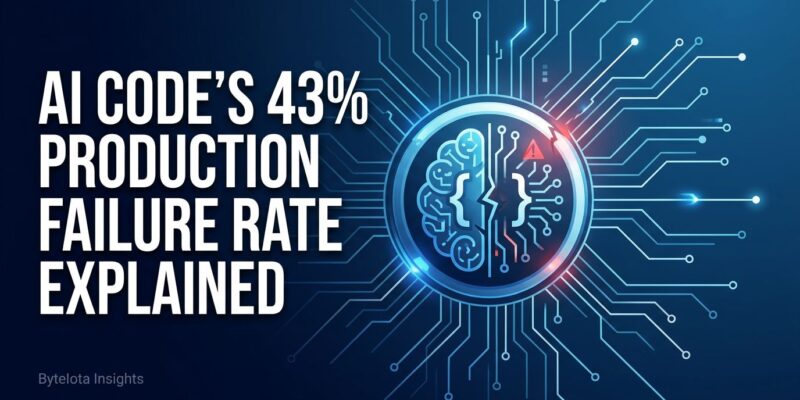
Almost half of AI-generated code requires manual debugging in production despite passing QA and staging tests, according to Lightrun’s 2026 State of AI-Powered Engineering Report. The 43% failure rate exposes a critical “verification bottleneck” undermining AI coding’s productivity promise: while AI tools accelerate code generation, they’ve created a debugging crisis that consumes the gains. Developers now spend 38% of their week—two full days—on verification and troubleshooting, and 88% of teams need 2-3 manual redeploy cycles just to confirm an AI-suggested fix actually works.
The Verification Bottleneck
The Lightrun report surveyed 200 SREs and DevOps leaders across US, UK, and EU enterprises. The findings reveal why AI’s promised 35% productivity boost hasn’t materialized: the bottleneck shifted from writing code to verifying it.
AI-generated code fails in production for a simple reason—it looks right and passes tests, but breaks silently under real-world conditions. Lightrun’s data shows 60% of SRE and DevOps leaders cite lack of runtime visibility as the primary bottleneck in resolving incidents. 97% say AI SREs operate without meaningful visibility into production behavior.
The trust gap is stark: 96% of developers don’t trust AI-generated code, yet 84% use AI coding tools daily. Every AI-generated line requires human verification. The result is developers spending nearly 40% of their week debugging and troubleshooting—time that negates the speed gains from faster code generation.
The Productivity Paradox
Here’s the disconnect: developers feel 20% faster with AI tools, but data shows they’re actually 19% slower. That’s a 39-point perception gap between how fast developers think they are and how fast they actually ship.
LinearB’s analysis of 8.1 million pull requests across 4,800+ organizations tells the story. Teams using AI merge 98% more pull requests, but review time increases 91%. PR size grows 154%. DORA metrics—the industry standard for delivery performance—remain unchanged despite widespread AI adoption.
Six independent research efforts converge on roughly 10% organizational productivity gains from AI coding tools, not the 35% promise. The gap? Verification. Code review capacity doesn’t scale with AI-accelerated code generation. Teams generate 200 pull requests per week instead of 100, but still have the same number of reviewers. The math doesn’t work.
Experienced developers bear the brunt—they’re 19% slower with AI because they must verify everything. Junior developers see gains because they have less to unlearn, but the organizational impact is modest at best.
The Quality Crisis
The verification bottleneck exists for good reason—AI code quality lags human code significantly. Analysis of 470+ pull requests shows AI-generated code averages 10.83 issues per PR compared to 6.45 for human-written code. That’s 1.7x more issues per pull request.
Logic errors are up 75%. Security vulnerabilities increase 1.5-2x. Research shows 40-62% of AI-generated code contains security vulnerabilities, with 45% introducing OWASP Top 10 flaws. Common issues include hardcoded secrets, improper input validation, and insufficient error handling—basic mistakes that AI tools consistently make.
The long-term implications worry tech leaders: 75% expect moderate to severe technical debt by 2026 due to rapid AI-assisted development. With 60% of new code AI-generated in 2026, teams are accumulating “zombie code” that works now but may fail later. The future maintenance costs are unknown, but the trend is concerning.
Why This Matters
The industry hit 92.6% AI coding tool adoption in 2026. That’s not reversing. But the productivity narrative needs an honest reckoning. AI coding tools don’t make you ship faster—they make you write faster. Shipping requires verification, and verification is where the bottleneck sits.
The review time crisis illustrates the problem. When your team merges 98% more PRs but review time increases 91% and PR size grows 154%, you haven’t improved delivery speed—you’ve just shifted the constraint from writing to reviewing. DORA metrics don’t budge because the bottleneck moved, it didn’t disappear.
What teams need isn’t faster code generation—it’s better verification tooling. Runtime context, production visibility, automated security scanning. Tools that help verify AI-generated code, not just generate more of it. The winners in 2026 won’t be teams that blindly adopt every AI tool, but teams that thoughtfully integrate AI where it helps and skip it where it doesn’t.
The Bottom Line
Lightrun’s 43% production failure rate isn’t an indictment of AI coding—it’s a reality check. The verification bottleneck is real, the productivity paradox is measurable, and the quality gap is concerning. The 39-point perception gap between feeling faster (20%) and being slower (19%) reveals how seductive these tools are despite their limitations.
The shift from “AI makes you faster” to “AI requires different workflows” is the 2026 inflection point. Teams still spending 38% of their week debugging AI-generated code need to question whether the speed gains are real or illusory. Until the industry solves the verification bottleneck, faster code generation just means more code to review—not faster delivery.