 By
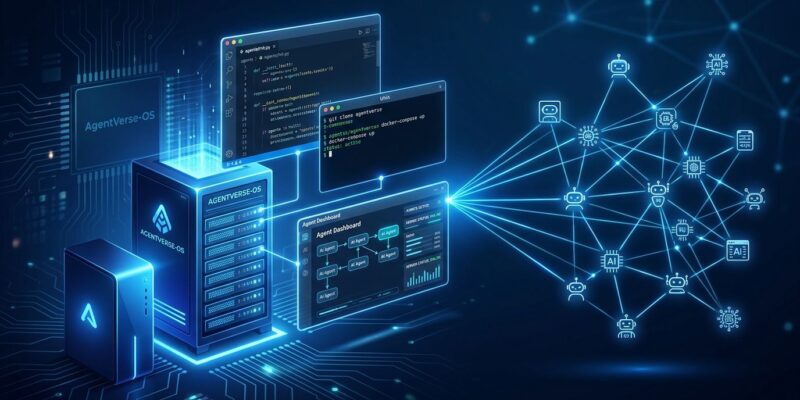
By A new open-source project called AgentVerse-OS takes a position you don’t hear often enough: your development environment should run on hardware you own. Released September 15 on GitHub, it turns a single Ubuntu server into a complete developer cloud — browser-based desktop, isolated VS Code workspaces, AI coding agent support for Claude Code and Codex, and a curated catalog of 944 self-hosted apps. Everything communicates through Tailscale. Nothing is exposed to the public internet.
The project is three days old, already has community discussion underway, and fills a gap that has been sitting open for a while: the self-hosted stack for AI-assisted development has never had a one-command installer that handles the full layer cake — networking, workspaces, container management, and the desktop itself. AgentVerse-OS is that installer.
What You Get After One Command
Run the bootstrap script and the installer walks through the full stack automatically: ZFS storage setup, Docker and Incus container runtime, Tailscale authorization (it stops, shows you a QR code, and waits for you to approve the node), then Coder for dev workspaces, Komodo for app deployment, and Caddy as the entry proxy. When it finishes, you open https://<node>.<tailnet>.ts.net/ and complete setup through a first-run wizard in the browser.
What lands in that browser: a windowed desktop environment, isolated Coder workspaces each running VS Code with AI agent support, and a store with 944 self-hosted apps — Gitea, Nextcloud, Vaultwarden, Grafana, and hundreds more — all deployable through Komodo without touching a compose file manually. Backups and updates run automatically. The Tailscale certificate gives you real TLS without installing custom root CAs on your devices.
The Install
System requirements: Ubuntu 22.04 or newer (tested on 26.04), at least 8 GB of RAM, a separate disk for ZFS, and a Tailscale account. The free Tailscale tier is sufficient.
curl -LO https://github.com/agentverse-os/AgentVerse-OS/releases/download/v0.2.0/agentverse-os-0.2.0-x86_64.tar.gz
sudo DISKS="/dev/disk/by-id/<your-disk>" bootstrap/install.sh
The bootstrap script is the project’s clearest engineering statement. It handles something that usually takes an afternoon of documentation-reading — ZFS pool creation, container runtime setup, Tailscale machine authorization, Coder template provisioning — and does it in the correct order, with prompts only where human decisions are actually required.
Architecture: Why These Components
The technical choices here are worth understanding, because they explain why this project feels more durable than the average self-hosting one-liner. The core is written in Rust using axum, with rusqlite for the embedded database and bollard for Docker API access. There are 60 API routes with a full OpenAPI spec. The frontend is Svelte 5 compiled as a PWA.
For workspaces, AgentVerse-OS uses Coder — the open-source self-hosted dev environment platform that large engineering teams already run internally. Coder handles the workspace lifecycle, VS Code browser access, and agent authentication. Incus (the maintained LXD fork) provides the container and VM layer. Komodo manages compose stacks for the app catalog. Caddy proxies everything with automatic HTTPS. It is an established stack wearing a unified interface.
When Self-Hosting AI Agents Actually Makes Sense
The honest answer: it depends on your usage patterns and risk tolerance, not on ideology.
On the cost side, agentic workflows burn more tokens than anyone anticipated. A pipeline running 10 million tokens per day at $5 per million costs roughly $18,000 a year. A purpose-built server in the $15–20K range pays for itself inside 18 months at that volume. For lighter workloads: if you’re spending more than $200 per month on coding agent API calls, hardware starts making financial sense within six months. Cloud API prices have fallen sharply in 2026 — but token consumption per developer has risen correspondingly as agents get more capable. According to a 2026 analysis of self-hosted AI agent costs, break-even calculations now favor hardware at medium-to-high usage levels.
On the privacy side, the calculation does not require a spreadsheet. Regulated industries, proprietary codebases, and anything under active security review have legitimate reasons to keep source code off third-party servers. AgentVerse-OS does not eliminate cloud model API calls unless you also run local models through Ollama on the same box, but it does keep your workspace files, history, and context on hardware you control. The Tailscale and Coder integration that AgentVerse-OS uses ensures network access stays within your tailnet.
Alpha Caveats
This is version 0.2.0 and the project says so clearly. AgentVerse-OS is a single-user system right now — no user accounts, no permission model. The first GitHub issue is already a request for shared memory across workspaces, which hints at what the community wants next. If you are evaluating this for a team, revisit in a few months. If you are a solo developer who already runs a home lab or a VPS, the alpha status is less of a blocker than it sounds — the core functionality works.
The Verdict
AgentVerse-OS earns attention for doing something harder than it looks: taking six or seven components that each have their own setup complexity and making them install cleanly as a unit. The target user is a developer who already self-hosts some things, values infrastructure control, and is spending meaningful money on AI agent API calls. For that person, this project is worth an afternoon on a spare server.
The source is on GitHub under an open-source license. System requirements are modest by current server standards. The project is three days old and already has a clear architectural story. That combination is rarer than it should be.