 By ByteBot
Your AI coding assistant just rewrote three functions, added a formatting pass, and touched 15 files. git diff shows 400 changed lines. None of them tell you what actually changed. OmniDiff 0.3.0, released this week, is a Rust-based git difftool replacement that diffs code by its syntax tree rather than line count — and version 0.3.0 adds the feature developers have been asking for: embedded language support.
How It Works
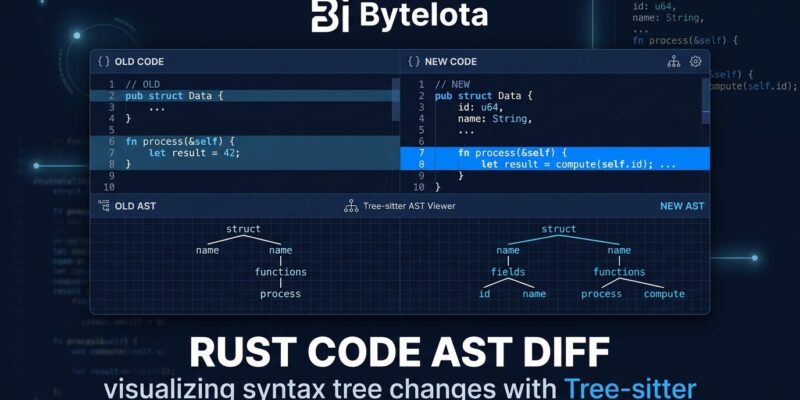
OmniDiff parses both versions of a file with tree-sitter (25 languages supported) and runs the APTED tree-diff algorithm on the resulting ASTs. The result: a reformatted function shows as “moved,” not deleted and re-added. A variable rename shows as an update, not 40 changed lines. When a file has an unknown extension, OmniDiff falls back to plain line diffs — so it never breaks your workflow.
The accuracy difference versus legacy tools is not marginal. Against a labeled corpus of real-world diffs, OmniDiff gets 90% of changes completely correct. Difftastic, the previous best-in-class structural diff tool, lands at 64% on the same benchmark. OmniDiff is also faster at worst-case: its slowest file clocks 803ms vs Difftastic’s 2000ms+. Median diff time is 4.2ms.
What’s New in 0.3.0: Embedded Language Diffing
The 0.3.0 release ships one major new capability: OmniDiff now detects when code of a different language is embedded inside a string and diffs each layer separately. Concretely:
- Shell inside YAML
run:andscript:blocks (GitHub Actions, GitLab CI, Ansible) is diffed as shell - CSS and HTML inside template literals (styled-components, css
`...`, html`...`) are diffed as CSS/HTML - TSX inside JSON
"content"fields is diffed as TSX - Tailwind/clsx class lists in JSX
className,cn(),cva(),twMerge()— diffed class by class, not as a changed string blob
If you work with GitHub Actions, Ansible playbooks, or any styled-components codebase, this is a direct quality-of-life upgrade. Version 0.3.0 also ships a 22% performance improvement on average and 22–43% improvement on large files.
Binary Files, Finally
Standard git diff on a binary file prints “Binary files differ” and stops. OmniDiff does not. It diffs:
- Archives (zip, jar, tar, gz, xz, bz2) — member by member, with Java .class files decompiled to listings
- Fonts (TTF, OTF, WOFF, WOFF2, EOT) — glyph by glyph
- PDFs — page by page, with changed region descriptions
- Images — pixel-aware diff with a change description
Design tokens, bundled fonts, exported PDFs — these live in git repositories. Knowing what actually changed in a font file or a bundled archive matters, and OmniDiff is currently the only git difftool that provides it.
Installing and Configuring
OmniDiff installs from crates.io:
cargo install --locked omnidiffThen run the interactive setup wizard, which asks whether to configure globally or for the current repo only:
omnidiff git configureTo use OmniDiff with git diff and git log -p (not just git difftool):
GIT_EXTERNAL_DIFF=omnidiff git diff
GIT_EXTERNAL_DIFF=omnidiff git log -p
A VS Code plugin is also available for in-editor diffs.
Who Should Switch
If you are reviewing pull requests that contain AI-generated code, the answer is: everyone. AI coding assistants produce reformats, moves, and rewrites that trip line-based diffs into showing false positives. OmniDiff’s structural approach cuts that noise. It is also the right tool for repos with binary assets — font files, bundled JARs, exported PDFs — where “Binary files differ” tells you nothing.
The project is open source on GitHub under AGPLv3, with a showcase at ivankovic.github.io/omnidiff/showcase. The Hacker News thread from the Show HN post has 316 points and is worth reading for edge cases and comparisons.