 By ByteBot
Jim Keller’s AI chip company just closed a $1.5 billion Series E at a $6.2 billion valuation — more than double its 2024 price tag. The pitch is straightforward: RISC-V processors, open software, and a Galaxy server that Tenstorrent claims delivers DeepSeek R1 at 350 tokens per second for roughly one-fifth the per-token cost of Nvidia’s GB300. Right now it’s mostly a sovereign AI story. Developers building inference-heavy workloads should start forming an opinion.
What the Galaxy Server Actually Delivers
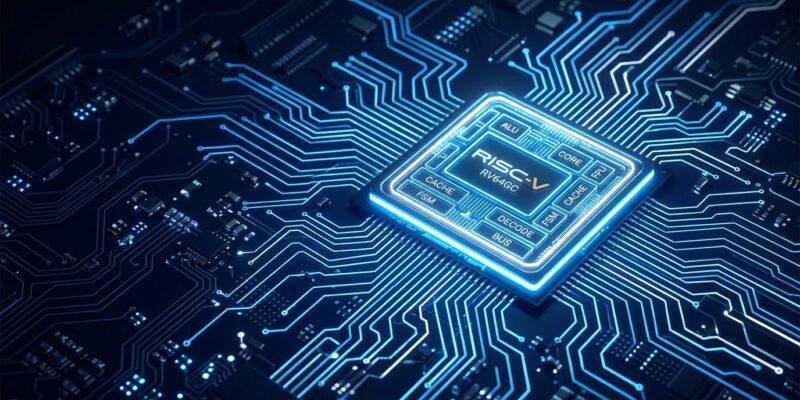
The Galaxy Blackhole — shipping since April 2026 — packs 32 of Tenstorrent’s Blackhole processors into a single server. Each chip combines 120 Tensix AI cores with 16 SiFive RISC-V general-purpose cores, and together they deliver 23 petaFLOPS of FP8 compute with 1 TB of GDDR6 and 16 TB/s of memory bandwidth. The starting price is $110,000.
Those aren’t theoretical numbers. On 16 Galaxy units (512 chips total) running DeepSeek R1 671B, Tenstorrent clocked 350 tokens per second at decode — more than double Fireworks and Google Vertex at 144 tokens/s, and more than 12x Novita’s 28 tokens/s. The company also claims a total cost of ownership of roughly $6 per million tokens versus approximately $30 for an Nvidia GB300 setup. Tenstorrent made this claim, so treat it as a floor for due diligence rather than settled fact — but the direction is credible.
The Series E and What It’s Paying For
The $1.5 billion round was led by Trace Capital and Innovation X, with Fidelity Management & Research, ARK Invest, T. Rowe Price, and Morgan Stanley also participating. The valuation of $6.2 billion puts Tenstorrent at more than 2.4x its 2024 mark of $2.6 billion.
The money goes to three things: ramping Galaxy server production, global commercial expansion, and continuing to license Tenstorrent’s RISC-V CPU and AI core IP to chip designers who want to build their own silicon. That last point matters — Tenstorrent is not just a server company. It is also becoming a chiplet and IP licensor, a different business than competing head-to-head with Nvidia on every front.
The Open Source Software Stack
The part developers should actually dig into is the software. Tenstorrent’s entire stack is open source on GitHub. TT-Metalium is the low-level kernel programming library — think CUDA kernels but for Tensix cores. Most developers won’t touch it directly. TT-NN provides a PyTorch-like Python API for model execution. And TT-Forge compiles PyTorch, JAX, and TensorFlow models to run on Tenstorrent hardware without requiring custom kernels — the automated on-ramp for teams that don’t want to rewrite anything.
There’s also the Open Chiplet Atlas initiative. Over 50 companies — including LG, Rapidus, and the Barcelona Supercomputing Center — have joined a vendor-neutral chiplet interoperability standard that Tenstorrent is pushing. The OCA v0.7 draft spec is publicly available. It’s standards-body slow, but it signals that Tenstorrent is trying to build a platform, not a captive hardware moat.
Already Running in Production
Galaxy deployments are not a slide deck. ai&’s sovereign AI infrastructure in Japan runs Galaxy superclusters, including the JapanFold drug discovery platform. Turiyam AI in India has deployed Galaxy servers. Equinix hosts Galaxy systems in the US. India-based partners include Wipro, HCL, and C-DAC. The production footprint is real — concentrated in sovereign AI and inference-scale deployments rather than in general developer cloud.
The Honest Developer Take
The CUDA ecosystem has 15 years of libraries, tutorials, and tooling. TT-Metalium does not. TT-Forge bridges the gap for common architectures, but edge cases will surface. $110,000 is a procurement decision, not a credit card swipe. And there is no managed Tenstorrent option on AWS, GCP, or Azure yet — your team absorbs the ops burden.
The raise accelerates Galaxy production and puts serious institutional money behind the bet that inference TCO will matter more than ecosystem comfort as open-weight models scale. If your team is running inference at volume on Nvidia hardware and the per-token cost is showing up on quarterly reports, Tenstorrent is now worth a proper evaluation — not a bookmark-for-later. For everyone else, watch the managed cloud partnerships that will almost certainly follow this raise.