 By ByteBot
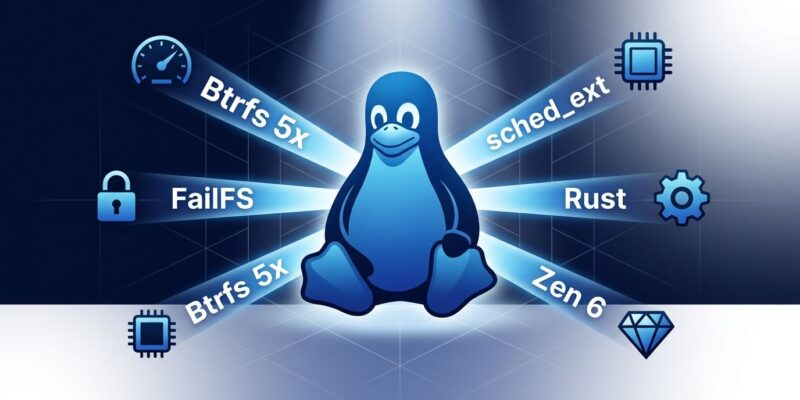
Linus Torvalds tagged Linux 7.3 on October 18. This one is more than routine housekeeping: 18,765 commits from 3,021 developers — 807 of them first-timers, a record — landed in a single cycle. The flagship story is Btrfs, which picks up independent 3x–5x wins across several codepaths. But there is also a new sandboxing primitive, a completed BPF scheduler framework, and Rust’s first steps on PowerPC. Here is what actually changed.
Btrfs: The Numbers Are Real
Multiple independent Btrfs improvements landed, each credible on its own merits and benchmarked externally by Phoronix on real hardware (HP Z4 G6i, Intel Xeon 678X, Sandisk NVMe).
Direct I/O gets the biggest single jump. A bounce buffer correctness fix that had been capping throughput at roughly half the theoretical maximum is gone. FIO random write tests show the jump from around 150 MB/s to over 700 MB/s compared to 7.2 — approaching 5x on that workload. fsync on no-holes files (files without sparse regions but lots of extents) is 5x faster; the kernel no longer runs unnecessary hole detection. Journal writes on non-SSD storage pick up another 5x throughput improvement from the removal of a one-jiffy delay that had no reason to exist. Extent buffer handling recovers a ~3x regression by swapping xarray for a local LRU list.
The aggregate: Phoronix measured a ~25% geometric mean improvement across Btrfs workloads over 7.2 on that benchmark machine. Not every workload sees 5x. The direct I/O gains require workloads that actually saturate the drive. But if you run Btrfs on NVMe — especially for builds, databases, or containers — upgrade when your distro ships it.
One housekeeping note: the legacy free-space cache v1 is gone. v2 has been the default for years; this is a cleanup, not a breaking change for anyone who has not deliberately pinned v1.
FailFS and fchroot(2): A New Sandboxing Primitive
Linux 7.3 adds two related pieces: FailFS, a pseudofilesystem that rejects every operation with EOPNOTSUPP, and fchroot(2), a file-descriptor-based replacement for the aged chroot(2) system call.
The pattern they enable: an application opens all the file descriptors it will need, then calls fchroot(FD_FAILFS_ROOT) to relocate its root into failfs. From that point on, absolute path lookups, symlink resolution, and AT_FDCWD-relative opens all fail immediately. Only calls through pre-opened file descriptors work. This closes the path re-resolution race that has always been a limitation of chroot-based sandboxing.
The practical upside over traditional chroot is meaningful — no ambient filesystem state to manipulate, no TOCTOU windows. Unprivileged processes can use it if no_new_privs is set and the process is not already chrooted. Worth knowing: there is no libc wrapper for fchroot(2) yet, no man-page, and container runtimes (runc, containerd) have not adopted it upstream. This is a foundation, not a finished API. Sandbox and security tool authors should start prototyping against it now.
sched_ext: BPF Subschedulers Are Complete
sched_ext, the BPF-extensible scheduler class that landed in 6.12, reaches full functionality in 7.3. The addition is capability-based CPU delegation: a root BPF scheduler can now grant per-CPU capabilities (enqueuing, preemption, frequency control) to child schedulers scoped to individual cgroup subtrees, and revoke them at any time. Stranded tasks — those stuck in a child scheduler that has stopped functioning — get rescued via bandwidth-limited fallback execution.
The group scheduling mechanism also gets a rework that reduces overhead and improves CPU time distribution across cgroups under mixed workloads. Production use cases that have been waiting for complete subscheduler support: gaming servers (scx_lavd), high-concurrency API servers, NUMA-aware database deployments, and real-time streaming pipelines. If you manage any of these, this is the release to start serious testing on.
The Rest: Containers, Rust, and Hardware Prep
OverlayFS now supports id-mapped mounts — a significant quality-of-life improvement for container workloads. The previous workaround of recursively chowning large container image layers at runtime is no longer needed for unprivileged containers. LXD users in particular benefit: OverlayFS inside LXD containers was previously blocked. Docker and containerd adoption will follow when upstream container runtimes pick this up.
Rust gains initial PowerPC architecture support, extending beyond x86 and ARM. New kernel abstractions land for Netlink, refcounted interrupts, SRCU, and firmware control — infrastructure plumbing that makes Rust-based kernel drivers progressively more practical. AMD Zen 6 preparation includes cluster scheduling fixes for heterogeneous core topologies. Intel Nova Lake GPU work begins. AMD graphics gets better VRAM eviction for protected memory workloads (relevant for GPU-heavy applications sharing resources).
Upgrade Path
Rolling-release distributions — Arch Linux, openSUSE Tumbleweed — will ship 7.3 first. Fixed-release distributions (Ubuntu, Fedora, RHEL) will follow their standard kernel update cadence. Build from kernel.org only if you are specifically testing 7.3 features; for most production systems, wait for your distro. The community is watching whether 7.4 gets LTS designation; no announcement yet.