 By ByteBot
Meta shipped its first frontier model yesterday. Not another open-weight Llama drop — a closed, proprietary competitor to Claude and GPT called Muse Wonder, with its best version locked behind a $50/month subscription. For a company that built its AI reputation by handing out model weights for free, that’s a philosophical U-turn worth examining.
The standard Muse Wonder is available to developers via API today. The stronger Muse Wonder Full requires a Muse Code subscription. That split is generating real friction in the developer community — and the benchmarks suggest that friction might be justified.
Two Models, One Frustrating Gate
Muse Wonder is available through the Meta Model API and OpenRouter at $4 per million input tokens and $20 per million output — the same price as Claude Opus 5.5. It carries a 1-million-token context window, multimodal input (text, images, video, audio, PDF), full tool calling, and computer use for browsers and desktop apps.
Muse Wonder Full is not available as a pay-as-you-go API. It lives exclusively inside Muse Code subscriptions: $50/month for Power Usage, $200/month for Maximum Usage. Theo from t3.gg put it plainly: “Standard Wonder is significantly worse. These are very different models. The naming sucks. The restriction of Full being subscriber-only sucks even more.”
The model Meta is benchmarking to claim frontier status is the one you can’t buy on a per-token basis. That’s worth sitting with before you update your stack.
Active Memory and Active Focus: The Technical Case
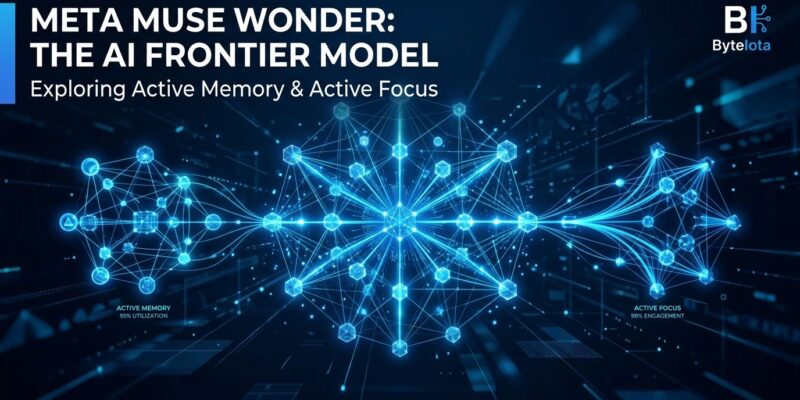
Strip away the marketing and two features define Muse Wonder’s technical positioning: Active Memory and Active Focus.
Active Memory goes beyond a large context window. It retains context across separate conversations — days, weeks, months — and actively retrieves relevant details when they become useful. On MemoryBench, Muse Wonder scores 85.6 versus Opus 5.5’s 81.5. For developers building agents that need persistent project awareness without re-feeding context every session, this gap is meaningful.
Active Focus addresses the other common agentic failure: models that quit mid-task. When Muse Wonder hits a blocker, it tries alternative approaches rather than halting. It checks in before irreversible actions. These aren’t just product promises — they’re direct responses to the top complaints about current agentic systems.
Benchmarks: Strong for Agents, Uneven Elsewhere
The long-horizon coding numbers are real. On Deep SWE 1.1, Muse Wonder scores 78.8% against Opus 5.5’s 74.2%. On SWE-Marathon — a sustained multi-step engineering benchmark — Muse Wonder Full hits 57.5% versus Opus 5.5’s 46.3%.
| Benchmark | Muse Wonder | Muse Wonder Full | Opus 5.5 |
|---|---|---|---|
| Deep SWE 1.1 | 78.8% | 79% | 74.2% |
| SWE-Marathon | — | 57.5% | 46.3% |
| MemoryBench | 85.6 | 85.5 | 81.5 |
| Terminal-Bench 4.0 | 52.0 | — | 59.6 |
The picture gets messier outside agentic tasks. Opus 5.5 leads on Artificial Analysis’s aggregate Intelligence Index. On Terminal-Bench 4.0, Opus scores 59.6 versus Wonder’s 52.0. On ProgramBench: 70.5 versus 50.0.
There is also a transparency gap: Meta published no research paper alongside the launch. The benchmarks come directly from Meta with no independent methodology. Forkast’s headline was pointed: “Meta ships Muse Wonder — and leaves the research blog empty.” The Hacker News thread is 600-plus comments of developers asking for the receipts.
How to Access Muse Wonder Today
The standard model is live on OpenRouter under meta/muse-wonder and directly through the Meta Model API. The 1M context window, tool calling, and computer use are available immediately. Meta says it integrates with existing agentic setups including Claude Code, Codex, and OpenCode.
For Wonder Full, you need a Muse Code subscription. The minimum tier for production agents is $50/month. There is no per-token API option, and Meta has not indicated one is coming.
What the Pivot Actually Means
This is Meta’s first frontier release since Alexandr Wang restructured the AI division in August 2025. The pre-Wang Meta built developer trust through Llama. The post-Wang Meta is building a subscription product. Whether that’s pragmatic or a betrayal of Meta’s AI identity depends on your perspective — but the direction is unambiguous.
Meta told VentureBeat it plans to power the Muse app with Wonder, starting with subscribers. The frontier capability is being used to drive subscription revenue. The gap between what’s API-accessible and what’s genuinely frontier-capable is, by design, your reason to upgrade.
For developers already using Llama-based workflows: the Meta Model API remains a legitimate option at competitive pricing. If you’re building long-horizon agentic systems, the SWE-Marathon and MemoryBench numbers make a real case for adding Wonder to your evaluation list. But if you want the model Meta is actually proud of, that’s now a subscription question — and Meta is betting you’ll pay.