 By ByteBot
JDK 27 hit general availability on September 15th, and unlike a lot of Java releases, several of its improvements take effect the moment you upgrade — no flags, no refactoring required. Four changes are automatic: object headers shrink, G1 becomes the universal GC default, TLS 1.3 gets post-quantum hybrid key exchange, and JDK Flight Recorder starts redacting sensitive data before it leaves your process. For teams running Java at scale, this is a meaningful release even if you are sticking to LTS.
Compact Object Headers: The Free Heap Optimization
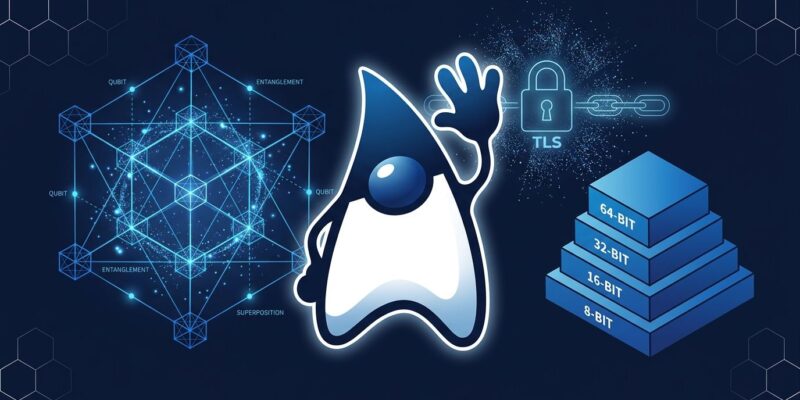
JEP 534 reduces object headers from 96 bits down to 64 bits on 64-bit JVMs — enabled by default with no code changes. That sounds like a footnote until you consider what it means in practice.
Every object in your heap carries a header. Shrink it from 12 bytes to 8 bytes and multiply by the hundreds of millions of Optional, String, and domain object instances in a typical service heap. The SPECjbb2015 benchmark shows 22% less heap usage and 8% less CPU time. Amazon, which has been running compact headers in production across hundreds of services for years (backported to JDK 17 and JDK 21), reports 8–11% throughput gains. Alibaba sees 6–9% gains. This is not synthetic benchmark noise — it is real headroom you get for free.
If you hit problems, you can revert with -XX:-UseCompactObjectHeaders. In practice, that flag should gather dust.
Post-Quantum TLS 1.3: You Already Have It
JEP 527 implements hybrid key exchange for TLS 1.3 by pairing ML-KEM (following NIST FIPS 203) with traditional elliptic-curve algorithms. The default scheme, X25519MLKEM768, is now the preferred group in TLS 1.3 handshakes. Applications using javax.net.ssl get this automatically.
The threat model this addresses is “harvest now, decrypt later” — adversaries capturing your encrypted TLS traffic today with the intention of decrypting it once quantum computers are capable enough. That is not a theoretical concern in 2026 for regulated industries. Teams subject to FedRAMP, HIPAA, or financial compliance frameworks will face increasing pressure to demonstrate post-quantum readiness. JDK 27 gives you a straightforward path.
Two additional hybrid schemes are available if you need different security parameters: SecP256r1MLKEM768 and SecP384r1MLKEM1024. Custom configuration goes through SSLParameters::setNamedGroups.
G1 Default Everywhere and JFR Data Redaction
JEP 523 makes G1 the default garbage collector in all environments — not just server-class JVMs, which is where it was already the default. If you are running server workloads, nothing changes. If you have embedded deployments, CI environments, or lightweight JVM processes that were quietly using the Serial GC, their latency profile will change. Test before you promote.
JEP 536 is a compliance win that requires zero effort. JDK Flight Recorder now redacts command-line arguments, environment variables, and system properties before diagnostic data leaves the process. If your JFR recordings have ever surfaced database passwords or API keys, you know exactly why this matters. It is on by default.
Structured Concurrency: Still in Preview (No, Really)
Structured concurrency arrives in its seventh preview as JEP 533. It has been in preview since JDK 19 in September 2022 — four years of iterative refinement. The API treats related concurrent tasks as a single unit, with automatic cancellation and error propagation that is genuinely cleaner than managing an ExecutorService yourself.
The finalization timeline points toward JDK 28 or JDK 29. Since JDK 29 is the next LTS (September 2027), structured concurrency should be stable and final by the time most teams care about adopting it. Running JDK 27 in a dev or staging environment is a reasonable way to start building familiarity now.
Should You Upgrade?
JDK 27 is not an LTS release. Premier Support runs six months — through March 2027. JDK 25 is the current LTS, supported until 2030. JDK 29 (the next LTS) ships September 2027.
The practical framework:
- Production systems on JDK 25: Stay there. The automatic improvements in JDK 27 — compact headers and post-quantum TLS — will arrive as backports to JDK 25 eventually. There is no reason to take on non-LTS support risk for features you will get anyway.
- Dev and staging environments: JDK 27 is a good candidate. You get to exercise structured concurrency, lazy constants, and PEM encodings in realistic conditions before they finalize in JDK 29 LTS.
- Teams with post-quantum compliance requirements: JDK 27 gives you ML-KEM in TLS 1.3 today. If your compliance deadline is 2027 and you cannot wait for a JDK 25 backport, upgrading now is defensible.
The four automatic improvements — compact headers, post-quantum TLS, G1 universalized, JFR redaction — mean JDK 27 delivers real value without asking anything of you. That alone makes it worth understanding, even if you stay on JDK 25 until next September. Download and release notes are available on jdk.java.net/27.