 By ByteBot
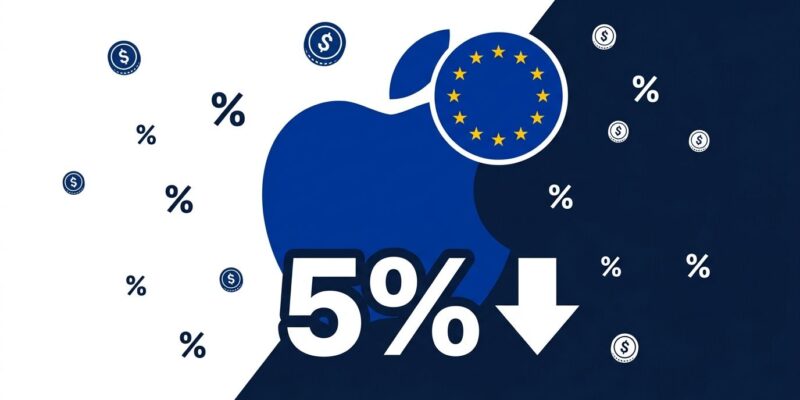
Apple’s new EU App Store business terms take effect October 1, 2026 — five days away. The per-install Core Technology Fee is dead. In its place: a flat 5% Core Technology Commission on digital transactions outside the App Store, a standard App Store rate cut from 30% to 26%, and — for the first time — the ability to mix Apple’s payment system with alternative processors in the same app. Every iOS developer targeting EU users needs to sign Apple’s updated Developer Program License Agreement before October 1 or the new terms won’t apply.
The Real Fee Breakdown (Not the Headline Number)
The “5%” figure getting the most attention applies only to apps distributed entirely outside the App Store — via an alternative marketplace or direct web distribution. If your app stays on the App Store, the math is different. Apple cut the standard In-App Purchase rate from 30% to 26%, with 15% for developers in the Small Business Program, Mini Apps Partner Program, or Video Partner Program. Alternative payment processing inside an App Store app costs 20% standard (10% reduced). Want to link users out to your own web checkout? That’s 15% standard, 10% reduced.
The practical upshot: the 5% rate requires leaving the App Store ecosystem entirely. That’s a user acquisition decision, not just a fee decision. According to Apple’s August announcement, developers must also commit to their chosen payment options for 12 months — so switching to alternative payments locks you in whether or not conversion rates hold up. The old Initial Acquisition Fee and Store Services Fee are gone, which simplifies the math somewhat. However, the 12-month lock-in is the fine print most coverage is skipping.
Who Actually Benefits From Apple’s EU Commission Changes
Here is the number the Apple-vs-Epic narrative tends to bury: 88% of EU developers already pay zero App Store commission, and 75% are already on the Small Business Program paying 15%. For that majority, these changes mean one thing — sign the new DPLA and continue as before. The commission savings Apple is advertising accrue almost entirely to large publishers.
A solo developer building a €2.99 productivity app has little practical incentive to build a custom payment page for a 15-point commission difference that now brings tax remittance liability, monthly EU transaction reporting (within 15 days of each month-end), and fraud prevention overhead. The developer running a gaming platform or subscription service with millions of EU transactions? That 5% CTC versus 26% standard is worth the infrastructure investment. FunnelFox’s analysis of Apple’s EU data found that more than 90% of developers who previously switched to alternative terms did not pass savings to consumers — prices stayed the same or went up. The structural shift favors scale, not indie liberation.
Related: F-Droid 2.0 Ships: Android’s Biggest App Store Overhaul
What EU Developers Must Do Before October 1
Three actions to take immediately if your apps have EU users. First, the Account Holder on your Apple Developer account must accept the updated Developer Program License Agreement in App Store Connect — this is not automatic. Second, if you plan to offer alternative payment processing or web checkout, decide which combination you’ll support and prepare for the 12-month commitment before opting in. Third, if you have apps in the Kids category or serving users under 13 (16+ on some EU storefronts), alternative payment flows require a parental gate. The full requirements are in Apple’s EU developer support documentation.
Developers who do nothing by October 1 stay on the old terms until they opt in. No immediate penalty, but no access to the new reduced rates or expanded alternative marketplace eligibility either. The 2025 alternative terms addendum phases out October 1 — it is not grandfathered forward.
The Controversy That Won’t End
The EU Commission called Apple’s changes a win. Epic Games called them “new junk fees that do nothing to open up the mobile app ecosystem to competition.” Both responses are predictable — and both have a point. The Commission’s position is reasonable: these changes directly address the non-compliance decisions issued in April 2025, and the simplified CTC structure is less hostile than the old per-install CTF. Epic’s argument — that the 20% in-app alternative payment rate is still high enough to make steering economically irrational for most developers — is not wrong either. Apple got the Commission satisfied while preserving enough friction that the majority of developers won’t bother switching payment methods.
Key Takeaways
- The 5% Core Technology Commission applies only to apps distributed outside the App Store entirely — not to App Store apps using alternative payment processors in-app
- 88% of EU developers already pay zero commission; the biggest gains go to large publishers with the infrastructure to support alternative distribution
- All iOS developers with EU apps must sign the updated Developer Program License Agreement before October 1 — it is not automatic
- Opting into alternative payments locks you in for 12 months, so evaluate conversion risk before switching
- Epic’s critique of the 20% in-app alternative payment rate has merit — the DMA’s steering rights remain economically ineffective for most apps