 By ByteBot
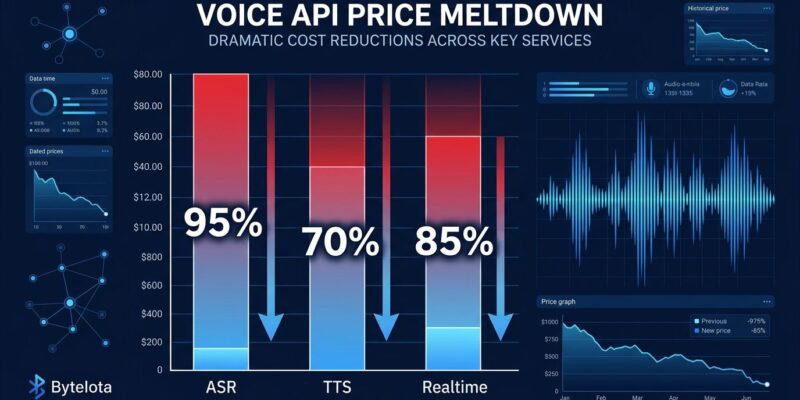
Alibaba’s Qwen team shipped Qwen-Audio 3.1 on September 23 at the Apsara Conference in Hangzhou, and the pricing is not subtle. Speech recognition is down up to 95%. Realtime voice conversation is down 85%. Text-to-speech is down 70%. If your team is paying ElevenLabs roughly $100 per million characters for TTS, a workload generating 20 million characters monthly costs around $2,000. The same workload on Qwen-Audio 3.1 runs to a few hundred dollars. That is not a rounding error.
Five Models, Not a Single Price Cut
The announcement covers five distinct models, each targeting a different part of the voice stack. Two are live now; two are coming soon.
The ASR model handles multilingual transcription across 30 languages and 16 Chinese dialects, with a ~160ms latency to first character and a 4.55% character error rate. It automatically cleans up filler words and repetitions — useful for call transcription at scale. The Realtime Plus model handles full-duplex conversation with a 262,144-token context window, allowing mid-sentence interruption without dropping the thread.
The TTS model supports 16 languages plus 20 Chinese dialect regions and exposes 86 inline tags for nonverbal events — laughter, breathing, coughing — if your product needs that level of control. It also does cross-language voice cloning: one branded voice maintained consistently across Mandarin, Cantonese, English, and Japanese. Western TTS providers do not do this cleanly. Coming next is TTS-Next, which generates speech, sound effects, and ambient audio in a single API call. No chaining. The current announced pricing in China puts TTS-Next at $0.848 per million input tokens. ASR-Next (also coming) adds speaker diarization, emotion detection, and background noise identification on top of transcription.
Related: VoiceBox: Local Voice Cloning and MCP for AI Agents
Where Qwen-Audio 3.1 Wins — and Where It Does Not
The case for switching is straightforward if your workload is Chinese-first or dialect-heavy. No other hosted API matches 20 Chinese dialect regions. Cross-language voice cloning is a real differentiator for multilingual brand deployments. And if volume cost is your primary constraint, the math speaks for itself.
However, the case against switching is equally real. ElevenLabs supports 74 languages; Qwen-Audio 3.1 TTS supports 16. If you are shipping in Portuguese, Arabic, or Hindi, you are not switching today. ElevenLabs Eleven v3 carries a 1,168 Elo score on Artificial Analysis’s Provider Voice Arena — an independent third-party quality benchmark. Qwen-Audio 3.1 has no independent benchmark score yet. Every quality claim in Alibaba’s launch materials is vendor-reported. That does not make them wrong, but it means waiting for independent arena results before committing production traffic.
Deepgram Nova-3 at $0.0043 per minute remains the best option for English-dominant high-speed transcription, where Deepgram’s latency and accuracy on English still have an edge. Regulated industries — healthcare, finance, government — face a harder constraint: Qwen-Audio 3.1 is hosted-only through Alibaba Cloud Model Studio with no private deployment option. Data residency requirements alone may rule it out regardless of price.
Qwen-Audio-Agent: The Open-Source Bonus
At the same event, Alibaba open-sourced Qwen-Audio-Agent under the Apache 2.0 license. The framework separates the voice conversation layer from execution: a lightweight Realtime frontend handles live conversation while a backend agent handles heavier tasks — file work, code changes, long-running processes. Version 1.9.0, released in August, added desktop task cards showing live agent progress and introduced the ACP multi-agent protocol. For teams building voice-controlled coding or productivity agents, this is the most immediately useful part of the Apsara audio stack.
Related: Alibaba Zhenwu V900: No FLOPS, 216GB RAM, and Qwen 5 at 10T
What to Do Right Now
If your team runs a Chinese-first voice workload on ElevenLabs or any other Western TTS provider, pull your monthly character volume, multiply by the price delta, and decide whether a benchmark test is worth your time. The ASR and Realtime Plus models are live now via Alibaba Cloud Model Studio. The TTS open-weight model is available under Apache 2.0 on GitHub for local evaluation before committing to the hosted API.
If you are English-first or shipping globally across many languages, monitor the independent voice arena leaderboards for Qwen-Audio-3.1-TTS results. When those scores land, the decision gets much easier. The price cut is real. Whether the quality holds at parity for your use case is still an open question — and that question has a benchmark, not a press release, as its answer.
Key Takeaways
- Qwen-Audio 3.1 cuts ASR prices up to 95%, TTS 70%, and Realtime 85% — announced September 23, 2026.
- Five models cover transcription, synthesis, full-duplex conversation, and a new TTS-Next that generates speech plus ambient audio in one call.
- Switch if your workload is Chinese-first or dialect-heavy; stay on ElevenLabs if you need 16+ languages or independent quality benchmarks before committing.
- Qwen-Audio 3.1 is hosted-only through Alibaba Cloud — a hard block for regulated industries with data residency requirements.
- Qwen-Audio-Agent (Apache 2.0) is worth evaluating if you are building voice-controlled agents — it ships a production-ready architecture for separating real-time conversation from heavy backend tasks.