 By
By OpenAI shipped the Agents API into public beta on September 10, and it is the most meaningful developer infrastructure release of the year. The Codex agent harness — the same orchestration engine behind enterprise ChatGPT — is now a managed cloud service. You send a task. OpenAI runs the loop. Three early adopters have already reported a 60% cost reduction, 86% fewer failures, and a 4x latency improvement respectively.
What the Agents API Actually Is
The Agents API is not another framework to install. It is managed infrastructure at the orchestration layer. Before this, developers who wanted production-grade, long-running agents faced a choice: build the entire harness on top of the Responses API (loop management, state, context compaction, recovery — all on you), or run the Agents SDK on your own infrastructure. Both require you to operate the plumbing.
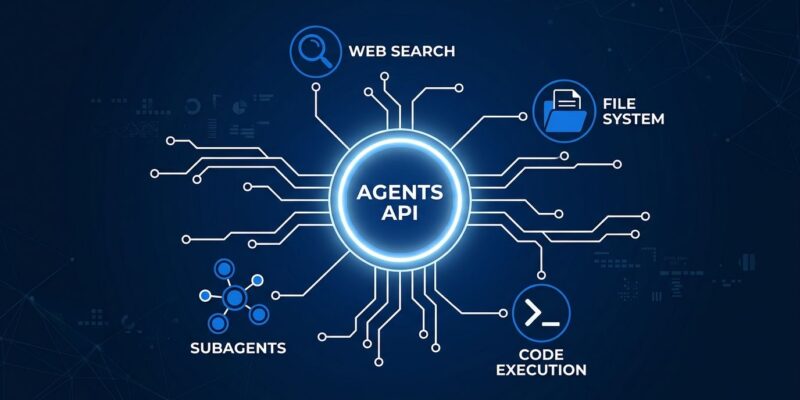
The Agents API removes that burden. Your application sends a task to a session. OpenAI manages the model-tool loop, preserves session state, compacts context automatically as it grows, handles recovery from failures, and coordinates subagents when parallel work is needed. You supply the task, the tools, and the sandbox. OpenAI handles the rest.
Three components are worth understanding. The harness is the OpenAI-hosted Codex instance that runs the model and tool loop and maintains state across turns. The environment is where the agent executes — a sandbox for writing files, running code, and calling tools. The application is your code: submitting tasks, providing function tools, and receiving events via stream.
What You Get
The API surfaces four capabilities that matter for real production workloads:
- Long-running sessions — Tasks that continue for minutes, hours, or days with context preserved across every stage.
- Automatic context compaction — No custom logic required. When a session approaches its context limit, OpenAI compacts earlier context while preserving what the agent needs to continue.
- Subagents — Spawn parallel agents for independent tasks. Each maintains its own context; the main agent coordinates and aggregates results.
- Flexible tool support — MCP servers, custom function tools, and built-in tools including web search, file search, and Code Interpreter.
On the sandbox side, you have three options: an OpenAI-hosted Linux workspace (Python, Node.js, and CLI tools pre-installed), a self-hosted environment (run codex exec-server in your own container or Lambda), or a partner sandbox via Cloudflare, DigitalOcean, E2B, Modal, Vercel, and others. Sandbox choice is per-session, not account-level lock-in.
Pricing: Three Buckets, No Flat Fee
There is no Agents API surcharge during the current public beta. You pay for three things:
- Model tokens — Billed at your chosen model’s standard API rates. The cheapest capable option is gpt-5.6-luna at $0.20 input / $1.20 output per million tokens.
- Tools — Web search runs $10 per 1,000 calls. File search is $2.50 per 1,000 calls plus $0.10/GB/day for storage. Code Interpreter is $0.03 to $1.92 per 20-minute container session.
- Sandbox (if OpenAI-hosted) — Container rates from $0.03 to $1.92 per 20 minutes, depending on memory tier.
For most use cases, model tokens will dominate the bill. Sandbox and tool costs are secondary unless your agent is running heavy compute or doing large-scale web search.
Agents API vs Agents SDK: Which One?
This is the question most developers will ask first. The answer is straightforward: if you want OpenAI to manage the orchestration loop, use the API. If you need to control every branch, approval step, and state transition yourself, use the SDK.
The Agents SDK is open-source and runs on your infrastructure against the Responses API. You own the loop. The Agents API is OpenAI managing the loop in the cloud. You own the task definition and the tools. The practical tradeoff is control versus operational overhead — the API trades some visibility into orchestration decisions for not having to build and maintain that orchestration yourself.
One thing worth knowing: you do not have to choose globally. Several teams already run the Agents SDK for workflows that need custom branching and call the Agents API for standard long-running tasks. Both coexist in the same application.
Early Results
OpenAI published three case studies from teams with early access. SafetyKit, which builds fraud and risk detection agents for marketplaces and fintechs, cut its cost per case by 60% after migrating to the Agents API. Hypha saw 86% fewer failed agent responses after separating the harness from the sandbox. Cirridae’s evaluation score improved from 0.71 to 0.85 with a 4x latency reduction on subagent flows.
These are cherry-picked numbers from a launch announcement, so treat them as directional rather than representative. The failure rate reduction is the more interesting signal — it suggests the managed harness is meaningfully more reliable than typical DIY setups.
How to Get Started
The Agents API is available now in public beta. No waitlist — access requires an OpenAI API key with sufficient tier. The quickstart guide gets you to a running session in under 15 minutes. Review the official announcement for architecture details, migration notes from the SDK, and the full list of partner sandbox providers.