 By ByteBot
Factory just raised $200M at a $5 billion valuation — tripling from $1.5B in April, in five months. Khosla Ventures, Blackstone, and Sequoia led the round. Marc Benioff and Brad Gerstner came in as angels. That is not hedge money chasing a trend. That is people who read engineering org charts for a living making a concentrated bet: autonomous AI agents are becoming core infrastructure for software delivery.
What Factory Droids Actually Do
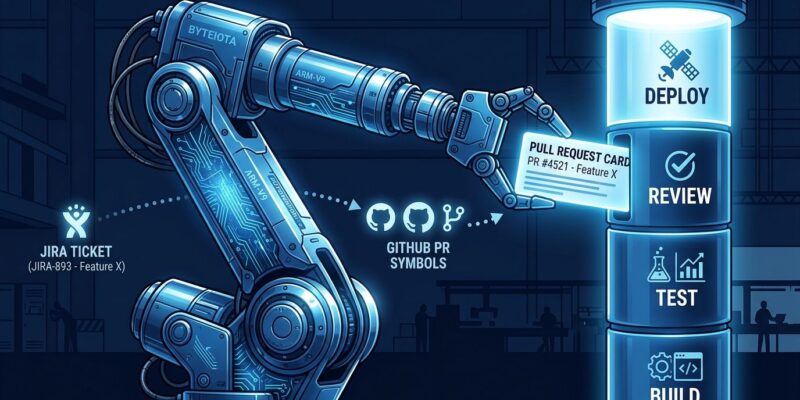
Factory’s product is not an IDE plugin. Droids are AI agents that take a Jira ticket — or a Linear issue, a Slack message, a GitHub alert — and handle the work end to end, producing a mergeable pull request without a human writing a single line of code in between.
Three specialized types do the heavy lifting. The Code Droid handles feature development, codebase migrations, and modernization tasks. The Reliability Droid triages PagerDuty alerts, runs root cause analysis in minutes, and proposes patches before an engineer has acknowledged the page. The Knowledge Droid writes and maintains technical documentation directly from live codebase context — the kind of work that always falls to the bottom of the sprint.
The framing Factory uses is deliberate: engineers own the outer loop — architecture decisions, requirements, customer conversations. Droids own the inner loop — writing code, running tests, reviewing PRs, deploying. This is delegation, not collaboration. You are not pairing with a Droid. You are assigning work to one.
Factory Router: The Technical Story Behind the Headline
Buried under the funding news is the more interesting technical story: Factory Router, which the company shipped alongside Factory 2.0 in April. Router automatically assigns the right model to each task. Routine code generation goes to smaller, cheaper models. Hard reasoning — complex refactors, incident analysis — routes to frontier models from Anthropic or OpenAI. If a provider endpoint degrades, Router fails over automatically.
The numbers back the claim. On Terminal-Bench 2, Factory Router reached 99% of Opus 4.7’s pass rate at 20% lower cost per session. On Legacy-Bench, 96% of pass rate at 25% lower cost. Combined with prompt caching and request batching, Factory reports 60% token cost reduction in production workloads. For an enterprise routing millions of requests per month, that arithmetic changes the budget conversation.
Who Is Already Using It
Factory’s customer list skews toward organizations where shipping speed and regulatory compliance coexist uncomfortably: RBC, Adobe, Nvidia, T-Mobile, and Palo Alto Networks. That RBC is running Droids in a regulated banking environment is significant. Factory supports on-premises and air-gapped deployments — the deployment modes that matter when FINRA, OCC, and SEC regulations dictate where your data can go. Customers can also run Factory through their own LLM gateway, keeping model traffic inside their perimeter.
The company claims hundreds of thousands of developers on the platform and reports 3x to 5x throughput gains on well-scoped engineering tasks. The qualifier matters: well-scoped. Droids work from what you give them. A vague ticket produces a mediocre PR. The leverage here rewards teams that already write clear, complete requirements — and exposes teams that do not.
Why the Timing Works
Cursor’s acquisition by SpaceX (closed August 14, $60 billion) and OpenAI’s announced model cutoff for Cursor (effective November 12) have given enterprise procurement teams a concrete reason to rethink IDE tool vendor lock-in. Factory’s model-agnostic architecture — routing across Anthropic, OpenAI, and others, with BYOK supported — is a pitch that lands differently after watching Cursor’s model access unravel in public.
Factory’s raise also lands during a period of compressed infrastructure investment: Temporal raised $550M for durable execution last week, Pion went GA for autonomous business operations, and OpenAI’s Agents API just opened to the public. The VC consensus forming around agentic infrastructure is not subtle. The inner loop of software development is being automated. The only open question is how quickly your organization adapts to managing agents rather than writing all the code yourself.
Factory is a bet that enterprise engineering teams will adapt, and adapt fast. Given who just wrote the checks, it is hard to argue they are wrong.