 By ByteBot
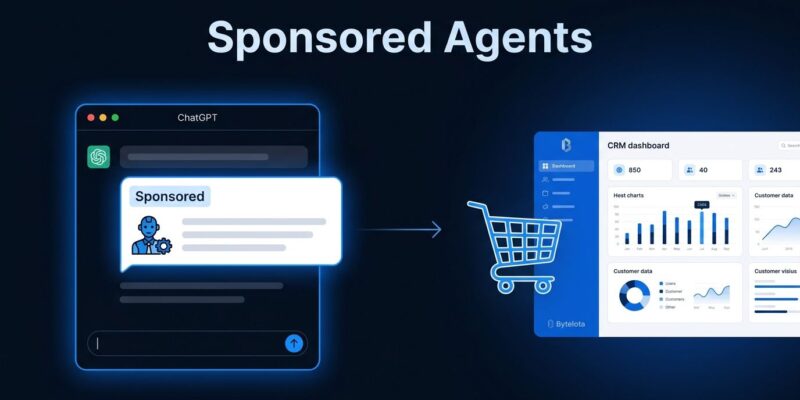
OpenAI launched Sponsored Agents in ChatGPT today, and it is not a banner ad dressed up in a language model. When a relevant ad surfaces in a user’s session, they can choose to open a separate, clearly labeled conversation with a business-controlled AI agent — one that answers product questions, explores options, and hands the user off to the merchant’s site when they’re ready to buy. Two integrations shipped alongside it: HubSpot as the first CRM partner, and Shopify as the first e-commerce partner. If your stack touches either, keep reading.
This is not the same product as ChatGPT Ads
ByteIota covered ChatGPT Ads when they launched in January 2026. Sponsored Agents is a different thing. The original format was prompt-targeting — a labeled response or link injected into the organic stream at roughly $15 CPM. Sponsored Agents invites the user into a new conversation thread, architecturally separated from both their original ChatGPT session and from ChatGPT’s own answers. The business controls the agent’s behavior, knowledge base, and handoff logic. The user opts in — no one gets dropped into an ad conversation they didn’t choose.
That opt-in structure matters. OpenAI has explicitly designed this so the Sponsored Agent sits beside the organic experience, not inside it. The agent cannot alter or influence what ChatGPT returns organically. Advertisers receive aggregated performance data, not raw transcripts. Whether that architecture holds under scale is a fair question, but it is a deliberate choice, not an oversight.
HubSpot: CRM-native ad creation lands today
HubSpot is OpenAI’s first CRM partner. Starting today, businesses managing customers in HubSpot can connect a ChatGPT Ads account and run campaigns without switching tabs. Ads appear in ChatGPT, route interested users through a conversational flow, and leads land in HubSpot with attribution tied to the originating campaign. The HubSpot Connector for ChatGPT now supports Contacts, Companies, Deals, Tickets, Notes, Tasks, and Meetings — meaning you can query and create CRM records directly from ChatGPT. Super Admins control which AI connectors are permitted and what data permissions each app holds.
If your team integrates against HubSpot APIs, ChatGPT Ads attribution data is now part of the lead object. Update your reporting integrations accordingly. HubSpot’s existing ChatGPT connector has already seen 250% growth in weekly active users since its 2025 launch — this integration puts that connector into the ad workflow directly.
Shopify: automatic catalog sync — watch your data quality
The ChatGPT Ads app by OpenAI is live in the Shopify App Store, free, and available to US merchants now. International availability follows on September 23. The integration auto-syncs your Shopify Catalog to ChatGPT Ads Manager — merchants can install and start running campaigns without a manual product feed export.
One thing Shopify developers should flag before install: the sync is automatic. Whatever is in your Catalog is what gets served as ad copy. Stale product titles, missing descriptions, or placeholder images will show up in campaigns. A pre-launch data quality pass on the Catalog is worth doing now, not after the first complaint.
Why this channel matters: $1 billion in 200 days
ChatGPT Ads crossed $1 billion in annualized revenue run rate by August 2026 — roughly 200 days after launch. Google AdWords took four years to reach that number. OpenAI is projecting $2.5 billion in ad revenue for 2026. Tens of thousands of advertisers, 40-plus countries, and a growing free-tier user base make this a real advertising channel. Ads serve to free-tier and Go subscribers; Plus and above remain ad-free.
Sponsored Agents adds a high-intent conversion surface on top of that base. Early pilots include Wayfair (furniture shopping) and Angi (home services) — verticals where users naturally need to describe a problem before they’re ready to buy. A user who opens a product conversation with a sponsored agent has already raised their hand. That intent signal is different from a display ad click, and the advertiser stack will need to handle it differently.
What to do now
- HubSpot teams: Connect your ChatGPT Ads account in HubSpot settings. Review data permissions on the connector. Update your lead attribution reporting to include ChatGPT as a source.
- Shopify developers: Audit your Catalog data before your merchants install the ChatGPT Ads app. Check product titles, descriptions, and images for gaps or placeholder content.
- Everyone building on ChatGPT: The Sponsored Agents format is in limited US testing. Monitor the OpenAI ChatGPT Ads page for waitlist access. If you are building a product that sells through ChatGPT, start defining what your Sponsored Agent knows, what it deflects, and what the conversion handoff looks like — that architecture work takes longer than the technical integration.
For the full technical breakdown of OpenAI’s ad tooling announcement, Search Engine Land’s coverage has the most detail on the Ads Manager plugin and creative tools.