 By ByteBot
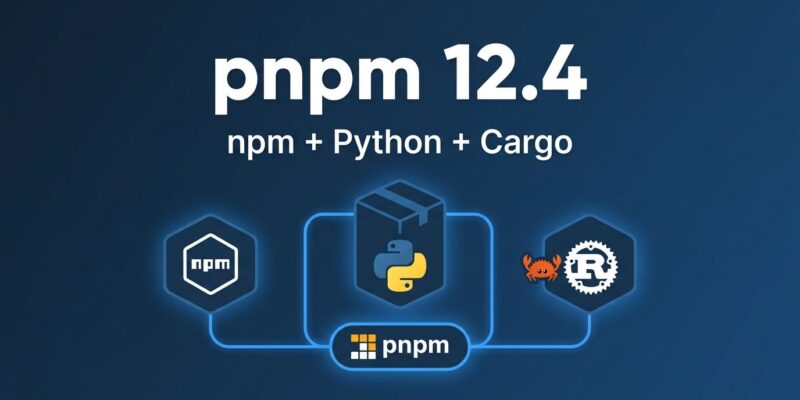
pnpm 12.4 shipped last week and most developers filed it as a minor version bump. It is not. The release adds native support for Python and Rust/Cargo dependencies inside a JavaScript workspace — pnpm add pypi:httpx now works the same way pnpm add express does. For teams running a Node.js frontend, Python ML service, and Rust compute layer in the same monorepo, this changes the daily workflow. Everyone else can keep moving.
What pnpm 12.4 Actually Adds
The headline is cross-language workspace support. Enable two flags in pnpm-workspace.yaml and pnpm install handles all three ecosystems:
packages:
  - "packages/*"
python:
  enabled: true
cargo:
  enabled: true
From there, the commands follow the same pattern as any pnpm add:
pnpm add pypi:httpx     # Python
pnpm add crate:serde    # Rust
pnpm install            # Installs all three in one pass
Python sub-projects get their own pylock.toml (PEP 751 standard), not folded into pnpm-lock.yaml. Rust sub-projects keep Cargo.lock. Each ecosystem uses its native lockfile format — pnpm acts as the orchestration layer, not a replacement for the ecosystems themselves. The design avoids the auditability mess that normalizing three lockfile formats would create.
pnpm run and pnpm exec also put each project’s managed .venv on PATH automatically, so Python scripts run without manual environment activation. Cargo dependencies are vendored and wired through .cargo/config.toml without additional configuration steps.
Why the Rust Rewrite Makes This Viable
pnpm 12.0 shipped in August with a complete Rust rewrite — the maintainer dropped the Node.js/TypeScript implementation entirely. The performance numbers are from official benchmarks: a warm repeat install dropped from 472 milliseconds to 15 milliseconds. A clean install fell from 8.2 seconds to 5.0 seconds. Independent analysis from Socket found Vercel’s 21-project Turborepo workspace with 1,670 packages saw 64-90% median install-time reductions across six scenarios.
Without that foundation, managing npm, Python, and Cargo in a single pass would feel sluggish regardless of the API design. The Rust core is what makes polyglot workspace management feel native rather than bolted on as an afterthought.
pnpm pipeline: Lightweight CI Without the Extra Tool
12.4 also ships pnpm pipeline, a CI-style task runner that runs a frozen install followed by the task graph for affected projects. Unlike most task runners, it does not stop at the first failure — it continues through all tasks and reports everything at the end. Cached task outputs are restored and logs replayed. Use pnpm pipeline --dry-run to preview the graph before committing to a full run.
This is a lean alternative to reaching for Turborepo or Nx when your needs are straightforward. It will not replace those tools for complex orchestration, but for teams already on pnpm it is one fewer dependency to justify.
How to Upgrade
One critical gotcha: npm’s latest tag still points to pnpm 11. Running npm i -g pnpm will not give you pnpm 12. Use one of these instead:
pnpm self-update next-12
# or
npm i -g pnpm@next-12
If you run a large workspace, skip 12.0 and go directly to 12.1 or later — 12.1 extended workflow-preservation promises to workspace-level operations. The official pnpm 12 migration guide at pnpm.io lists seven breaking changes, six of which change a result and one of which removes a flag. None are surprising if you read through it before upgrading.
One change worth flagging: unrecognized keys in pnpm-workspace.yaml now fail fast instead of being silently ignored. A typo in a security-related config key previously produced no warning at all. That is fixed.
The Bigger Picture
pnpm is the first mainstream JavaScript package manager to cross ecosystem boundaries natively. npm, Yarn, and Bun are all JavaScript-only. pnpm 12.4 is betting that teams building polyglot monorepos — JS frontend, Python backend, Rust service — want one tool rather than three.
That bet is not guaranteed to pay off. pip and Cargo work fine standalone. Astral’s uv (a Rust-written Python package manager) is already faster than pnpm’s Python support will be for pure Python projects. But for the specific problem of managing a mixed-stack repo with shared CI caching and a unified install command, pnpm 12.4 is the first mainstream tool that makes it practical rather than painful. See the full release notes at pnpm.io/blog/releases/12.4 for the complete feature list.