 By ByteBot
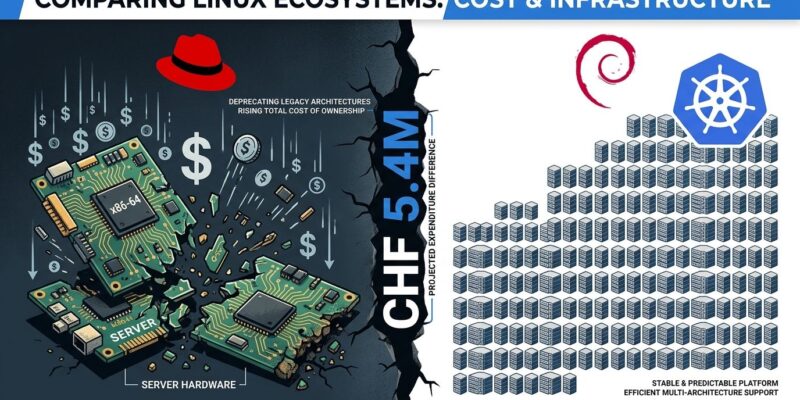
CERN is moving 2,200+ accelerator-control computers from Red Hat Enterprise Linux to Debian 13 by the end of 2026. Not because RHEL broke. Because staying with Red Hat would cost CHF 5.4 million just to keep existing, functional hardware alive. When the invoice for vendor loyalty arrives at that size, even CERN’s procurement office sits up straight.
One Compiler Flag, One Very Large Bill
The proximate cause is Red Hat’s CPU baseline escalation. RHEL 9 requires x86-64-v2 — adding SSE4.2 and POPCNT, which means anything pre-Nehalem is out. RHEL 10 raises the floor again to x86-64-v3, requiring AVX/AVX2, which excludes anything before Intel Haswell or AMD Excavator.
For most enterprises, this is a minor footnote. For CERN’s accelerator-control estate — custom VME crates, embedded boards, and specialist hardware that sits inside 43 kilometers of tunnel — it’s a forced hardware refresh. CERN’s analysis found that x86-64-v2 alone would obsolete 47% of their embedded control computers. Add the x86-64-v3 jump, and another 17% would follow. That’s the majority of a fleet that still works perfectly well, running real-time control of the world’s largest particle accelerator.
The math was blunt: staying on Red Hat required redesigning roughly 11 specialized hardware boards and hiring two electronic engineers, two software engineers, and two technicians to do it. Total estimated cost: CHF 5.4 million. The phrase “forced obsolescence” keeps appearing in CERN’s own documentation. It’s an accurate description.
What’s Actually Moving (and What Isn’t)
This is not CERN abandoning Red Hat across the board. The Tier-0 compute grid and mass storage infrastructure stays on AlmaLinux and RHEL. What’s migrating is the accelerator control layer — the front-end computers that interface directly with beam equipment, talking to roughly 17,000 connected devices across the tunnel complex.
These machines don’t run Kubernetes workloads or host web services. They run real-time control loops for some of the most sensitive scientific hardware on the planet. Replacing their OS is not a casual decision, and CERN didn’t treat it as one.
The Boot Stack Got a Full Rebuild
The old provisioning model ran on NFS and tftpd — a bootserver design that traced back to around 2005. CERN used the migration as an opportunity to replace it entirely. The new stack decouples the bootloader, kernel, init RAM disk, and userspace into separate components, delivered via Kubernetes. A reconciler controller monitors desired state against actual state and redeploys automatically when they diverge. No more pushing files over NFS by hand.
That’s a meaningful infrastructure upgrade embedded inside what most people will read as “CERN switched distros.”
Debian Isn’t Perfect Here Either
CERN’s engineers were candid about the gaps they found on the Debian side. Automated package building and publishing tooling is less mature than what the RPM ecosystem offers. Side-by-side versioning of the same package isn’t consistently supported across the toolchain. Device drivers for custom hardware had to be reworked to strip out distribution-specific assumptions that had accumulated over years on RHEL.
To address long-term support concerns, CERN has started sponsoring Freexian — the company behind Debian’s Extended Long-Term Support program. Plan A is Bookworm now, Trixie (Debian 14) from 2026 through 2030, then Debian 15 “Duke.” Plan B stays on Trixie under Freexian ELTS through 2033 if the team decides another distro jump carries too much risk. Either way, CERN now has commercial skin in Debian’s support ecosystem.
What This Means for Your Infrastructure
This story is directly relevant to any organization still running hardware from 2010–2015. RHEL 10’s x86-64-v3 requirement is already causing concrete failures — Broadcom has documented RHEL 10 install failures on VMware EVC Sandy Bridge clusters. The hardware cliff is real, and it arrives when your next OS upgrade does.
AlmaLinux 10 has positioned x86-64-v2 support as an explicit differentiator, which tells you where the demand is. Organizations that went AlmaLinux after the CentOS EOL upheaval in 2024 have more runway than those still on RHEL — but they’re not immune to the same architectural progression eventually.
CERN’s decision wasn’t about ideology. It was about running a cost-benefit analysis, finding that Red Hat’s roadmap had become incompatible with their hardware reality, and choosing the path that cost less and lasted longer. Forty percent of the largest enterprises are still running end-of-life CentOS. For those teams, this case study is worth reading carefully. The invoice for vendor loyalty is coming. CERN just showed what it can look like.