 By ByteBot
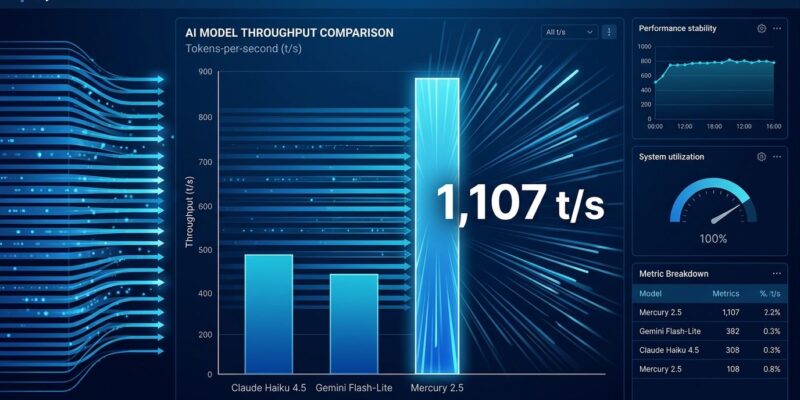
Inception Labs shipped Mercury 2.5 on September 8 — a diffusion language model generating 1,107 tokens per second on commodity NVIDIA GPUs at $0.04 per million input tokens. For teams running voice agents, real-time search, or high-volume RAG pipelines, that combination breaks what developers have accepted as the speed-quality tradeoff in the budget LLM tier.
What Mercury 2.5 Actually Does Differently
Most LLMs — GPT-6, Claude Fable, Llama — are autoregressive: they generate one token at a time, left to right, each token dependent on the one before it. That sequential dependency is the fundamental throughput ceiling, regardless of how much hardware you throw at it.
Mercury 2.5 is not autoregressive. It is a diffusion language model (dLLM): it starts with a fully masked draft of the entire response, then refines all tokens simultaneously across multiple iterative passes. Bidirectional attention means the model sees both what came before and what comes after at every step. It can correct early errors mid-generation — something autoregressive models physically cannot do once a token is committed.
The result is throughput that is architecturally unreachable for sequential models at the same quality tier. This is not a quantization trick or speculative decoding tweak. It is a different generation paradigm — one that 2026 research shows outperforms autoregressive models on reasoning tasks requiring global constraints.
The Production Numbers Worth Watching
Inception reports two concrete production results from their Mercury 2.5 announcement:
- OpenCall (voice agents): P99 response time dropped from several minutes to one second after migrating to Mercury
- Augment Code (coding assistant): context compaction latency dropped 82% — from 150 seconds to 27 seconds
These are vendor-reported numbers, not independently verified — a fair caveat worth naming. Hacker News commenters have already flagged that Inception’s speed comparisons reference 2-3 version old competitor models. However, at 1,107 tokens per second on standard hardware, you can serve roughly 10x more concurrent users per GPU than comparable autoregressive models. That number matters at scale regardless of which exact competitor is in the comparison.
What Mercury 2.5 Is Good For — and What It Is Not
Mercury 2.5 hits quality parity with Claude Haiku 4.5, Gemini 3.5 Flash-Lite, and GPT-5.6 Luna (Low) — the right tier for most high-volume inference tasks. It supports a 260K token context window, tunable reasoning, parallel tool calls, and schema-aligned JSON output, with an OpenAI-compatible API.
The honest limitations: Mercury 2.5 is not a drop-in replacement for complex agentic coding, multi-step reasoning chains, or long-form writing requiring sustained coherence. The community has noted the model underperforms on custom agentic harnesses. Tooling maturity also lags behind established autoregressive ecosystems by years.
The routing pattern that makes sense: send latency-critical, high-volume work — query rewriting, RAG summarization, voice agent responses, autocomplete — through Mercury. Keep reasoning-heavy, long-horizon work on frontier models. Stop paying frontier rates for everything. (ByteIota covered a similar inference-cost story with Perplexity Lily last week.)
Pricing and API Access
At launch: $0.04 per million input tokens, $0.15 per million output tokens — an 80% discount from standard rates of $0.20/$0.75. Inception is offering 100 million free tokens at signup. The API uses OpenAI-compatible endpoints available on the Inception API, OpenRouter, and Baseten — making integration low-friction for teams already on the standard SDK:
from openai import OpenAI

client = OpenAI(
    base_url="https://api.inceptionlabs.ai/v1",
    api_key="YOUR_INCEPTION_KEY"
)

response = client.chat.completions.create(
    model="mercury-coder-small",
    messages=[{"role": "user", "content": "Summarize this document"}]
)
The Bigger Signal
Mercury 2.5 is the first time a diffusion LLM ships at both production quality and production speed simultaneously. The architecture is not new — Inception has been building toward this for two years — but this release is when it stops being a research curiosity and starts appearing as a line item on inference budgets.
In short: the fast model tier has needed an architectural answer, not just smaller autoregressive models with degraded quality. Mercury 2.5 is a credible answer. Whether the ecosystem, tooling, and third-party validation catch up quickly enough to make it the default choice for latency-sensitive pipelines is the real question to watch over the next two quarters.