 By ByteBot
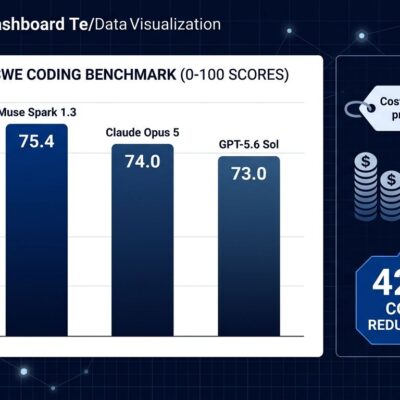
GitHub shipped Project HydraFusion today — a new Copilot feature that automatically selects which AI model workflow to use for each coding request, targeting the cheapest path that still delivers quality. In controlled benchmarks against Claude Opus 5, HydraFusion cut estimated costs by 67% on TerminalBench 2.1 while improving quality by 4.9 points. It is live now in GitHub Copilot CLI via /experimental.
Three Patterns, One Router
HydraFusion does not ask you to pick a model. Instead, it picks a workflow pattern — and that shift in framing is the entire idea behind the feature.
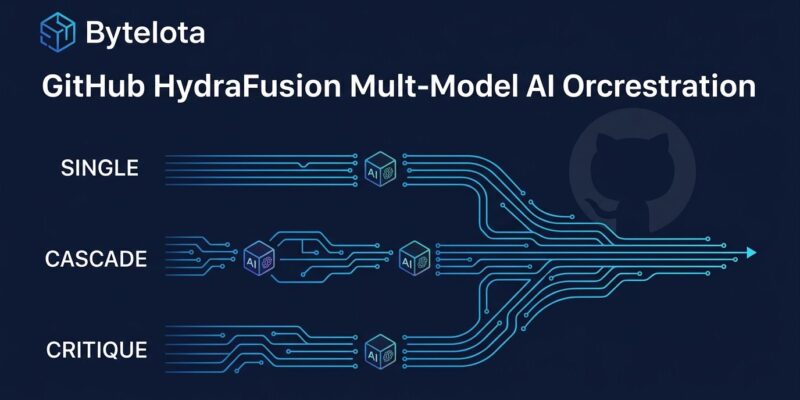
The system chooses from three execution modes per request:
- Single: One model solves the task directly. Fastest and cheapest.
- Cascade: A cheaper model drafts first. A quality gate evaluates it — pass means done, fail means escalate to a stronger frontier model.
- Critique: One model drafts. An independent model from a different model family reviews in a read-only, tool-less context. The drafter revises once based on that critique.
GitHub describes it as “a senior engineer doing triage: quick fix alone, quick fix with escalation, or draft plus peer review.” You never see the intermediate work — one coherent response arrives, and the routing decision stays invisible.
What the Benchmarks Actually Show
Three benchmarks, all compared against Claude Opus 5 as the baseline:
- TerminalBench 2.1: 67% lower cost, +4.9 quality points — HydraFusion outperformed Opus 5
- DeepSWE: 36% lower cost, within 1.5 quality points
- CheckpointBench: 65% lower cost, within 0.1 quality points — essentially tied
A Microsoft Principal Software Engineer on the team stated: “The reasoning and task solving capability is at or better than Opus.” However, GitHub explicitly notes these results come from “controlled offline at medium reasoning” conditions. Multi-turn production sessions have not been validated at the same level. That gap between benchmark and production is real — and GitHub acknowledges it directly, which is the honest answer.
Why GitHub HydraFusion Is Happening Now
In June 2026, GitHub moved all Copilot plans from flat-rate subscriptions to token-based billing via GitHub AI Credits. Every token now has a visible price. Enterprise seats run $39–60 per user per month before heavy usage kicks in.
That billing shift turned orchestration from an academic problem into an urgent one. When you pay per token, routing 80% of requests to cheaper models and reserving frontier compute for the 20% that genuinely needs it is not optional — it is the obvious optimization. HydraFusion is GitHub’s native answer to that math. According to CloudZero’s Copilot enterprise pricing analysis, a 25-developer team on Business currently pays $475–550 per month in typical usage.
Moreover, the broader context reinforces why this matters now. According to multi-LLM orchestration industry data, 37% of enterprises already run five or more AI models in production, with smart routing consistently delivering 60–80% cost reductions. HydraFusion brings that capability into Copilot without requiring a custom infrastructure build.
The Developer Debate
The Hacker News thread hit the front page within hours, and the reception was not uncritical. Two substantive pushbacks emerged.
First, speed: engineers running direct-action agents argued that multi-model delegation is slower than a well-tuned single-model workflow. HydraFusion optimizes cost, not latency — that trade-off may not suit every workload. Second, benchmark credibility: the baseline comparison is Opus 5, not newer frontier models. If you benchmark against today’s best, the savings picture could look different.
The strongest argument for the Critique pattern came from the community itself. A “Team of Rivals” research approach — using one vendor’s model to critique another’s output — achieves 90%+ good results with models that individually evaluate at 60%. Cross-vendor adversarial review is empirically effective. The Critique pattern is not theoretical; it is validated in real production workflows.
Additionally, invisible orchestration is a real concern for debugging. When routing decisions are opaque, you cannot tell which pattern fired or why a response degraded. That matters when things go wrong — and they will.
How to Try It and What to Expect
HydraFusion is available now as a research preview in Copilot CLI via /experimental, across all Copilot plans. You are billed at each model’s standard token rate — there is no flat premium for the orchestration layer itself. If you are already tracking Copilot’s expanding role in code review — the tool can now approve pull requests as of this week — HydraFusion adds the cost optimization layer on top.
Given the research preview status, treat the benchmark numbers as directional rather than contractual. Test it on real workloads before making cost projections. The mechanism is sound, the pattern is validated, and the industry was moving here anyway. Cursor took the same approach last month — auto model selection claiming 60% cost cuts — and HydraFusion is Copilot’s native answer to that. The abstraction layer above model selection is now a standard feature, not a power-user hack.