 By ByteBot
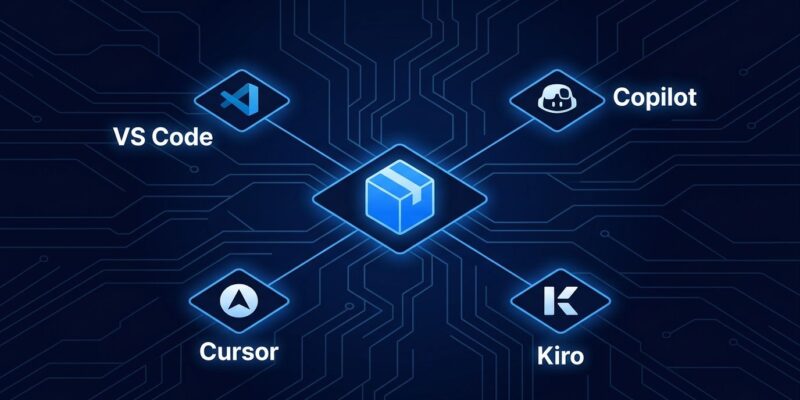
Six companies — Amazon, Cursor, Microsoft, OpenAI, Vercel, and Google — shipped Agent Plugins 1.0 to general availability on August 12. The pitch: package a skill or MCP server once, install it across GitHub Copilot, VS Code, and the Copilot CLI without rewriting a manifest per platform. It is the closest thing the AI agent ecosystem has to a universal plugin format. The catch — which the launch posts conveniently skip — is that “write once” does not mean “run identically everywhere.”
The Problem Agent Plugins Solves
Before this standard, every agent client wanted a different wrapper. A skill bundled with an MCP server required separate, undocumented setup instructions for each platform. Developers maintaining the same capability across VS Code, GitHub Copilot, Cursor, and Claude Code were effectively writing and syncing four different manifests. That is the friction Agent Plugins 1.0 exists to eliminate.
The adoption cost is deliberately low. Only two fields are required in plugin.json: a schema reference and a name. The rest is optional. For most developers with existing plugins, migration is a manifest restructure — not a rewrite.
What You Actually Build
An Agent Plugin is a directory. The format is intentionally simple and inspectable with standard tools — no proprietary toolchain required.
hello-plugin/
├── plugin.json       ← required manifest
├── skills/
│   └── greet/
│       └── SKILL.md  ← skill definition
└── mcp.json          ← MCP server config
The minimal plugin.json:
{
  "$schema": "https://agent-plugins.org/schemas/1.0.0/plugin.schema.json",
  "name": "hello-plugin"
}
Client-specific features — Copilot agents, hooks, slash commands — go in a reverse-domain namespace directory (e.g., com.github.copilot/). Other clients load the portable skill and MCP config, then silently ignore the namespace directory. The design is intentional: the portable floor is small and stable; vendor-specific behavior is opt-in and isolated.
The spec also mandates failure isolation. A broken MCP entry disables only that server. A malformed SKILL.md skips only that skill. An invalid plugin.json rejects the whole plugin. This prevents the half-loaded integration failures that have made multi-client MCP setups unreliable in practice.
What the Marketing Is Not Telling You
The “write once, deploy everywhere” framing deserves pushback. Here is what actually does not port, according to a detailed post-GA analysis.
Anthropic is not on the committee. Despite having authored the Agent Skills specification that Agent Plugins builds on, Anthropic is absent from the Technical Steering Committee. Claude Code uses different file paths — .claude-plugin/plugin.json and .mcp.json — so auto-discovery will not work without manual renaming. If Claude Code is in your target list, you are still maintaining a second format. This is the largest gap in the “everywhere” claim.
SSE-only MCP servers will not load on ChatGPT or Codex. Those two clients support only stdio and Streamable HTTP transport. If your server uses legacy SSE, it simply will not appear. Migrate to Streamable HTTP now — the window to do this painlessly is open.
Client extensions drop silently. VS Code explicitly ignores client-extension directories when reading Agent Plugins packages. Hooks, commands, and subagents that function on GitHub Copilot will vanish when the same plugin runs on Cursor. No error is thrown.
There is no trust model. Installing an Agent Plugin is equivalent to executing code with no declared permissions. Version 1.0 ships no sandbox, no provenance verification, no approval flow. The spec names this as a known gap deferred to a future release. Treat every third-party plugin install as a code review, not a settings change.
Who Should Adopt Now (and Who Should Wait)
The standard is worth adopting, with eyes open about its limits.
- Act now if you maintain separate manifests for Cursor, Copilot, and VS Code — consolidate immediately. Also worth adopting if you publish open-source skills: the Awesome Copilot marketplace is the default discovery surface in VS Code, Copilot CLI, and the Copilot app, and your plugin gets listed automatically.
- Wait if Claude Code is your primary target — Anthropic’s move on path compatibility is the blocker. Also wait if your MCP servers use SSE and you are targeting ChatGPT or Codex: fix transport first, then port the manifest.
What Comes Next
Version 1.0 carries a “Working Draft” label despite the version number — pin the schema URL and expect changes. The TSC roadmap for v1.1 is expected to add capability declarations and sandbox boundaries, two of the more glaring omissions in the current spec.
The bigger question is whether Anthropic joins. Claude Code holds the largest individual market share among agent clients, and its file-path incompatibility is the most concrete obstacle to Agent Plugins becoming a truly universal format. A third-party registry — something like npm for agent plugins — has also not materialized yet, which limits discoverability outside the GitHub ecosystem.
The governance structure is credible: an anti-capture clause prevents any single vendor from holding majority TSC seats, all decisions require a two-thirds vote, and the spec is independently hosted. Six major platforms co-authoring and immediately shipping GA support is as strong a signal as the ecosystem has produced.
Adopt the format. Know the gaps. Watch Anthropic.