 By ByteBot
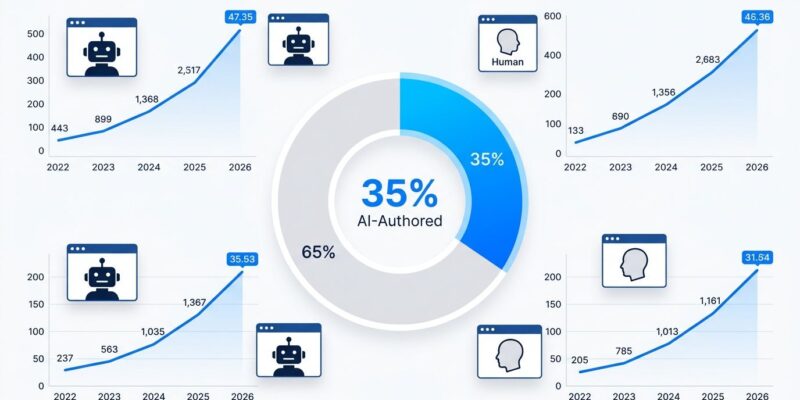
Pew Research dropped the number developers have been sensing but couldn’t pin down: 35% of web pages published since ChatGPT launched in November 2022 show significant signs of AI authorship. That’s not a vendor estimate or a blogger’s guess — that’s 490,000 web pages pulled from the Common Crawl archive and run through Open Pangram’s detection model, published August 20, 2026. The internet changed. Now there’s a number attached to it.
What the Data Actually Shows
The headline figure needs context or it misleads. Pew Research Center’s full study found that 10% of all web pages sampled in July 2026 show significant AI authorship markers. The 35% applies specifically to pages published after ChatGPT’s release in late 2022. Commercial domains drive most of it: roughly one in ten .com pages carries AI authorship signals, versus 4.6% for .org, and about 1% each for .edu and .gov.
The fingerprints are measurable. Em dashes doubled in frequency since 2022. The word “delve” more than doubled. Phrases like “it’s not just X, it’s Y” nearly tripled. Oxford comma usage jumped 63%. These are not subjective judgments — they’re statistical drift that Open Pangram’s EditLens model, published at ICLR 2026, was trained to detect. Whether you find that reassuring or alarming probably depends on what you’re building.
The Audience Problem Nobody Wants to Name
Here’s where it gets uncomfortable. In June 2026, Cloudflare CEO Matthew Prince confirmed that bot traffic now exceeds human traffic — 57% bots, 43% humans — roughly 18 months ahead of projections. AI agents specifically drove 8,000% traffic growth throughout 2025. These agents browse pages, fill forms, and complete purchases. They don’t subscribe to your newsletter.
So the picture is this: a significant portion of new web content is AI-generated, and a majority of the things consuming that content are AI agents. ClaudeBot crawls nearly 24,000 pages per referral, compared to Google’s 4.9-page ratio. That’s enormous content extraction with almost no traffic returned to publishers. The “bots writing content for bots to read” loop is not a hypothetical. It’s the current state of the commercial web. As ByteIota noted last week, GitHub’s commit volume doubled in four months — AI agents are generating a substantial share of that code, too.
What This Does to Search Traffic
Pew tracked 68,879 Google queries in a parallel study. On queries that triggered an AI Overview, only 8% of users clicked through to any website. Without an AI Overview, 15% clicked — nearly double. A quarter of users stopped browsing entirely after reading the summary. Google’s AI layer is functioning as a content endpoint, not a discovery engine.
This is not just a publisher problem. If you build a SaaS product, documentation site, or any content-driven web property, this is your traffic model now. Traditional SEO — keywords, backlinks, meta descriptions — was optimized for humans scanning a list of blue links. That surface is shrinking. Pages that get cited inside AI summaries share a pattern: they answer directly in the first two sentences, contain original data, use clean semantic structure, and have named expert authorship. That’s a different optimization target entirely.
What Developers Should Do Now
Given this shift, a few concrete adjustments matter. According to WorkOS research on what developers need to change, the biggest gaps are in measurement and structure:
- Segment AI agent traffic in analytics. Traditional session metrics are meaningless for machine visitors. Google has stated Gemini agent sessions will be identifiable through user-agent strings and request headers. Use that separation now.
- Audit forms and UIs for agent compatibility. Agents interact through the DOM, not visually. Forms requiring hover states, unlabeled inputs, or JavaScript-only buttons will fail silently for agent traffic. A Lighthouse accessibility audit is a reasonable proxy check.
- Add JSON-LD and schema.org markup. Agents parse structured data more reliably than visual layouts. If you’re not marking up your content, you’re invisible to this traffic category.
- Revise robots.txt deliberately. Training crawlers account for 51.8% of AI bot traffic. Search crawlers are a different category. Blanket blocks punish the wrong bots; deliberate allowlists serve you better.
- For publishers specifically: named authorship, visible credentials, and original data correlate with AI summary citation. Anonymous content gets consumed and discarded. Put a byline on it.
The Uncomfortable Takeaway
The Pew study doesn’t prove the web is broken. What it shows is that the web’s composition shifted faster than most institutions measured — and the primary audience for new commercial web content is increasingly not human. Developers who build for the web are, whether they intend it or not, building for an audience of machines. The sooner that’s treated as a design constraint rather than a footnote, the better the outcomes.
Pew’s methodology is public, Open Pangram’s detection model is open-weights, and the data is from Common Crawl. If you want to check your own content, the tools exist. The question is whether the number you find changes what you build next.