 By ByteBot
Google’s DiffusionGemma technical report landed on arXiv at the end of July, and it tells a more useful story than the June launch announcement did. The headline from that launch: 4x faster text generation. The headline from the paper: 4x faster, with a real quality cost that depends entirely on what you’re building. If you deploy LLMs and throughput is the constraint, DiffusionGemma is worth your attention. If complex reasoning is your core use case, the benchmark numbers say stay on autoregressive for now.
What Text Diffusion Actually Does
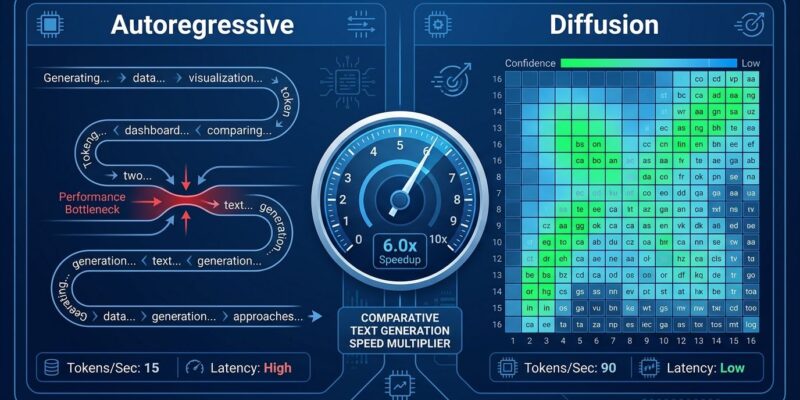
Every LLM in production today is autoregressive. It generates one token, then uses that token to predict the next — a sequential chain that creates a hard latency floor. DiffusionGemma breaks that pattern by generating 256 tokens simultaneously.
Instead of building left to right, it starts with a block of masked or random tokens and iteratively refines the entire block in parallel. High-confidence tokens get accepted in each denoising pass; uncertain positions get resampled. The model uses bidirectional attention during this phase — every position can see every other position, the opposite of the causal attention that keeps autoregressive models sequential.
The practical upshot: at low batch sizes, AR models are bottlenecked by sequential KV cache reads. DiffusionGemma saturates compute instead. On an H200, it hits 1,288 tokens per second — roughly 6x a standard autoregressive baseline on the same hardware, and about 3x an AR model running speculative decoding.
The Speed Numbers
For GPU-constrained inference at low concurrency, the throughput gains are real:
| Hardware | DiffusionGemma | vs Standard AR |
|---|---|---|
| H200 (FP8) | 1,288 tokens/sec | ~6x faster |
| H100 (FP8) | 1,008 tokens/sec | ~6x faster |
| RTX 5090 | 700+ tokens/sec | ~4x faster |
| Apple Silicon / RTX 3060 | Similar to AR | No advantage |
The model uses Gemma 4’s MoE architecture — 25.2 billion total parameters, 3.8 billion activated — which means it fits in 18GB of VRAM when quantized. The weights are Apache 2.0 licensed on Hugging Face and integrate with vLLM out of the box.
One caveat buried in the integration notes: the speed advantage is compute-bound, not memory-bandwidth-bound. On Apple Silicon and lower-end GPUs where memory bandwidth is less of a bottleneck, the advantage can disappear entirely.
The Quality Cost the Launch Didn’t Mention
The technical report includes benchmark comparisons the June marketing didn’t surface. Against standard Gemma 4 at the same model size:
| Benchmark | DiffusionGemma | Gemma 4 AR | Gap |
|---|---|---|---|
| MMLU Pro | 77.6% | 82.6% | −5 pts |
| AIME 2026 (math) | 69.1% | 88.3% | −19 pts |
| GPQA Diamond | 73.2% | 82.3% | −9 pts |
| Codeforces ELO | −289 pts | Baseline | Significant |
The pattern is clear: a 5–15% quality penalty across general tasks, widening sharply on anything requiring a long sequential reasoning chain. The model’s bidirectional “parallel guessing” breaks down when step N genuinely depends on having step N-1 correct. Complex math proofs, algorithmic coding, multi-step logical deduction — these are exactly where autoregressive generation earns its latency cost.
Where It Fits (and Where It Doesn’t)
The technical report and Google’s developer guide are consistent: DiffusionGemma is built for speed-critical, interactive workflows where latency is the primary metric and external validation is available. Think in-line code completion with a compiler catching mistakes, rapid-iteration autocomplete, or constraint-satisfaction tasks fine-tuned for a specific domain. The Sudoku fine-tuning example is telling: the base model hit 0% success; after supervised fine-tuning, 80%.
Skip it for production reasoning tasks where the quality gap is unacceptable, high-QPS serving at scale where speculative decoding closes AR’s throughput gap, or any deployment on Apple Silicon or budget consumer GPUs.
What Comes Next
The most interesting line in the technical report: DiffusionGemma can still generate autoregressively with only minor quality degradation. That suggests this isn’t a full AR replacement — it’s a mode. Future models may switch dynamically: diffusion for throughput-heavy tasks, autoregressive for the reasoning chains that need sequential causal structure.
DiffusionGemma is the first production-quality open-weight diffusion LLM, and the field barely existed two years ago. The technical report is doing its job — showing where the model works and where it doesn’t, which is exactly what developers need to make the call. The June announcement left that part out. The paper put it back in.