 By ByteBot
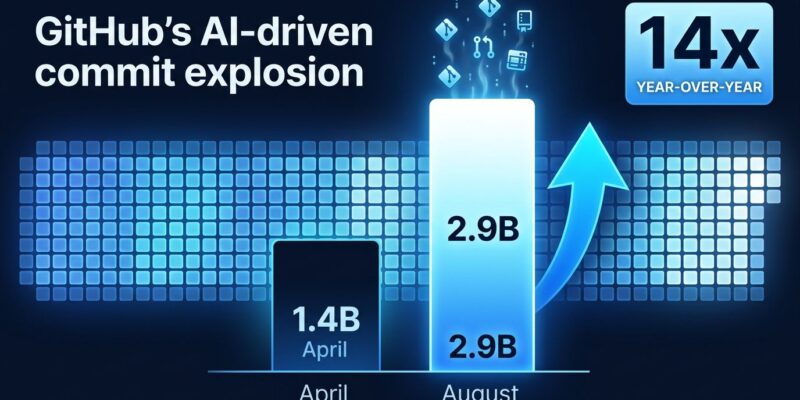
GitHub’s August 17 outage postmortem wasn’t supposed to be a bombshell. It read like a standard incident report — capacity failure in Central US, seven-hour-forty-seven-minute recovery, lots of infrastructure remediation. Then you hit the growth metrics. Monthly commits on GitHub went from 1.4 billion in April to 2.9 billion in August. Not over a year. In four months. That number didn’t come from a product announcement. It came from GitHub’s outage postmortem, which is exactly the kind of place you find numbers that haven’t been spun yet.
This Is What Machine-Speed Code Generation Looks Like
For context: GitHub processed roughly 1 billion commits in all of 2025. In 2026, the platform is on pace for 14 billion — a 14x year-over-year jump. GitHub Actions compute went from 500 million minutes per week in 2023 to 2.1 billion minutes per week today. AI-generated pull requests went from 4 million in September 2025 to 17 million in March 2026, a 4x increase in six months.
Claude Code is driving a significant share of this. As of mid-2026, it accounts for roughly 9.7% of all public GitHub commits — approximately 2.6 million commits per week. Claude Code launched in May 2025. It went from zero to nearly 10% of public commits in under twelve months. SemiAnalysis analyst Dylan Patel put it bluntly in February: “While you blinked, AI consumed all of software development.” That was at 4%. It has been accelerating since.
GitHub Copilot adds to this: 4.7 million paid subscribers as of January 2026, contributing roughly 46% of active users’ code. The numbers compound. Humans using AI tools write more code, faster. Agents running autonomously write code continuously. The commit volume reflects both.
GitHub Planned for 10x Growth. Reality Demanded 30x.
In October 2025, GitHub launched a capacity initiative designed to handle 10x growth. By February 2026, actual demand had approached 30x. That gap — the distance between the most optimistic infrastructure projection and what actually arrived — is where the August 17 outage was born.
The outage itself followed a predictable cascade. Traffic peaked. A critical component in GitHub’s Central US data center couldn’t scale with it. Authentication failed. Services went down. During recovery, Copilot’s client-side retry logic amplified traffic instead of backing off, delaying full restoration. The outage lasted nearly eight hours and hit github.com, authentication, GitHub Actions, pull requests, issues, and Copilot simultaneously.
GitHub’s response has been aggressive. The company added more than 3 million CPU cores and 120 petabytes of high-speed storage. Azure’s share of platform load went from 12% in May to 58% in August. GitHub also routed workloads to AWS on June 16 — a move that would have been inconceivable two years ago and tells you something about how severely capacity was stretched. Engadget’s coverage of the commit surge puts the scale in perspective: GitHub is now processing more commits in a single month than it did in all of 2024.
The Bottleneck Has Moved
Here’s the part most teams haven’t processed: writing code is no longer the constraint. The bottlenecks are now review, testing, and governance. AI-generated pull requests reached 17 million per month. No human review process, unchanged from the manual-commit era, can handle that volume. Xavier Portilla Edo’s observation is worth noting: only about one in ten AI-generated PRs is legitimate. The other nine are noise that someone — or something — has to filter.
Most engineering organizations haven’t restructured their workflows for this reality. Risk-based code review — where AI-authored changes get triaged by risk level rather than reviewed universally — is no longer an optimization. It is a requirement. The same is true for CI/CD pipelines: architectures sized for human commit cadence will run expensive and slow at agent commit rates. Vectrel’s analysis of the infrastructure crisis frames the core problem well: “most organizations have not rebalanced” their systems for sustained machine-generated output.
Four Adjustments Worth Making Now
This isn’t theoretical. GitHub’s infrastructure problems flow downstream to developers as failed Actions runs, degraded Copilot sessions, and reliability gaps at the worst moments. A few practical adjustments help:
- Schedule CI pipelines during off-peak hours. Agent-generated commits cluster during business hours. Night and early-morning runs hit significantly less contention.
- Run local validation before pushing. Lint, type checks, and quick unit tests locally eliminate a class of wasted Actions compute — compute that is getting more expensive to waste.
- Batch commits when it makes sense. Incremental pushes multiply Actions minutes and platform load. One logical commit beats five micro-pushes on pipeline economics.
- Adopt risk-based review for AI-generated changes. Universal human approval of every AI PR is already unworkable at 17 million per month. Triage by risk, automate low-stakes merges, focus human review where it matters.
GitHub has handled worse and recovered. But the August 17 postmortem is worth reading not as an incident report, but as a leading indicator. Every organization running AI coding agents at scale is building toward the same infrastructure pressure point. GitHub hit it first. The rest of the industry is a few months behind.