 By
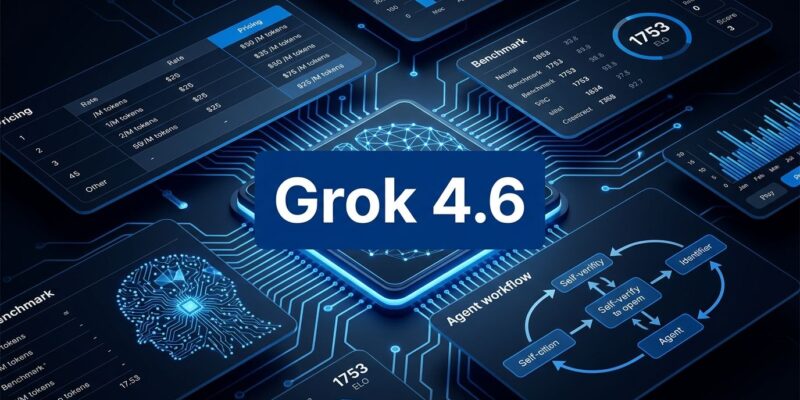
By xAI shipped Grok 4.6 on August 12 — just 35 days after Grok 4.5 — and the real story isn’t the benchmark leaderboard position. It’s the cost. At $2 per million input tokens and $6 per million output tokens, Grok 4.6 runs 2.5x to 5x cheaper than GPT-5.6 Sol and Claude Opus 5 at comparable intelligence. For developers running agents at scale, that gap matters. Here’s what actually changed, and when it’s worth switching.
What Changed from 4.5
Grok 4.6 runs on the same 1.5 trillion parameter foundation as Grok 4.5. xAI didn’t rebuild the architecture — they significantly improved the supervised fine-tuning (SFT) and reinforcement learning (RL) training. The result is a model that handles longer, more complex tasks without losing the thread, and one that now actively verifies its own work before moving forward.
That last part is worth lingering on. On multi-step agent tasks, Grok 4.6 now runs self-verification checks at key steps: it reruns tests it just wrote, re-reads files it modified, and checks intermediate results before continuing. xAI didn’t train this behavior explicitly — it emerged from better RL. The practical implication is that agent loops front-load computation but require significantly fewer error-recovery passes. Artificial Analysis measured Grok 4.6 completing tasks in roughly 53 turns compared to Claude Opus 5’s 103 turns, consuming about 4x fewer input tokens per completed task.
The 200K Toll Booth
Most coverage of Grok 4.6 leads with the 500K context window. That’s the wrong frame. The more important number is 200,000 tokens — because that’s where the pricing changes, and not in the way you’d expect.
Grok 4.6 has two pricing bands:
- Under 200K tokens: $2.00 input / $0.50 cached input / $6.00 output (per million)
- 200K tokens and above: $4.00 input / $1.00 cached / $12.00 output (per million)
The catch: when you cross 200K, xAI prices all tokens in the request at the higher rate — not just the tokens above the threshold. A 201K-token prompt is twice as expensive as a 199K-token prompt. If you’re building agents with large context windows, naively stuffing in everything you have can quietly double your bill.
The practical guidance: design your prompts to stay under 200K through caching and context compaction. Put your stable system prompt and instructions first — they get cached at $0.50/M — and keep the variable user input lean. For multi-turn agents, use the prompt_cache_key parameter with the Responses API or the x-grok-conv-id header with Chat Completions to maximize cache hits across turns. See the official xAI API docs for implementation details.
Benchmarks: The Honest Version
Grok 4.6 is genuinely at the frontier. The numbers:
- GDPVal-AA v2 Elo: 1753 (up from 1526 in Grok 4.5 — a +227 point jump in one release)
- CursorBench v3.2: 69.9% (Fable 5 Max leads at 70.5%)
- DeepSWE v1.1: 65.9% (GPT-5.6 Sol Max leads at 73%)
- Artificial Analysis Intelligence Index: 61 (matches GPT-5.6 Sol Max; Claude Opus 5 at 63)
Grok 4.6 doesn’t top every benchmark — Sol leads on pure coding evals, Opus 5 on the composite index — but it’s close enough on all of them that cost becomes the deciding factor for most production workloads. That +227 ELO jump on GDPVal in a single version is the number to watch. It suggests xAI’s RL improvements are compounding fast.
What It Costs vs. the Competition
For a single request with 150K input tokens and 10K output tokens:
| Model | Input (per M) | Output (per M) | Est. task cost |
|---|---|---|---|
| Grok 4.6 | $2.00 | $6.00 | ~$0.84 |
| Claude Opus 5 | $5.00 | $25.00 | ~$2.03 |
| GPT-5.6 Sol | $5.00 | $30.00 | ~$2.50 (est.) |
At agent scale — say, 1,000 tasks per day — that gap compounds to tens of thousands of dollars monthly. Artificial Analysis put the number on agentic benchmarks: Grok 4.6 costs roughly $0.84 per completed task; Opus 5 costs $2.03. For most use cases, the performance difference doesn’t justify a 2.4x cost premium.
Availability and Integration
Grok 4.6 launched with unusually broad day-one coverage. It’s in Cursor on all plans (with 2x included usage during launch week), available through the xAI API as grok-4.6, and live on Vercel, OpenRouter, and Cloudflare’s AI Gateway. The API supports function calling, structured outputs, web search, X search, and code execution via both the Responses API and Chat Completions.
If you’re already on Cursor, it’s already there — just select it. If you’re hitting the API directly, update your model string to grok-4.6. No new authentication, no new SDK changes required.
Who Should Switch Now
Switch to Grok 4.6 if you’re running cost-sensitive agent pipelines, multi-step coding workflows, or research loops where you’re currently on GPT-5.6 Sol or Opus-tier models. The cost reduction at comparable intelligence is large enough to make it the obvious default for scale.
Stay on Opus 5 or Sol for the hardest debugging sessions and critical production code review where maximum success rate matters more than cost. Grok 4.6’s self-verification improves reliability meaningfully, but Opus 5 still edges it on task success rate at the top difficulty tier.
The pattern xAI is establishing — major model updates every 30-35 days — suggests Grok 4.7 is already close. If the RL improvements keep compounding at this rate, the cost-performance balance is only going to improve from here.