 By
By Supabase’s August 2026 developer update (v1.26.08) ships four features that collectively push it well past “Firebase alternative” territory. Managed CDC pipelines to BigQuery, a ChatGPT sign-in integration, unified cross-service logs, and one-click Grafana observability are the headline items — and one of them is free on every plan.
Pipelines: Managed CDC Without the Kafka Nightmare
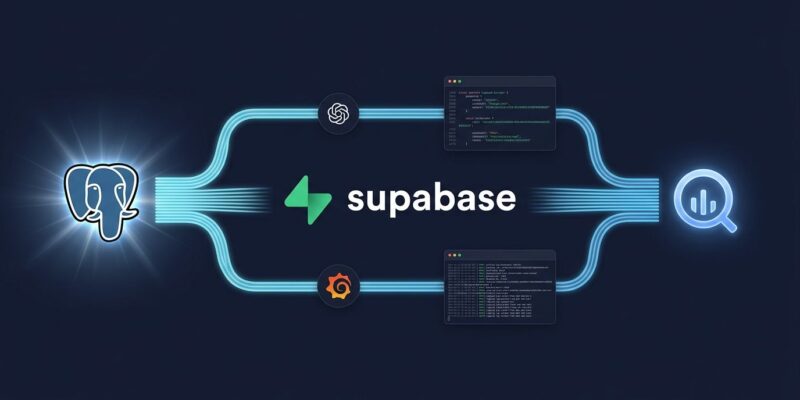
The headline feature is Supabase Pipelines, now available on all paid plans. If you run analytics on your Supabase data, you’ve probably hit the same wall: batch exports that are slow and break on schema changes, or you spin up Debezium and spend two weeks arguing with Kafka Connect connectors. Pipelines is the managed way out.
It uses Postgres logical replication to stream row-level changes — INSERT, UPDATE, DELETE, TRUNCATE — to analytical destinations in near real-time. BigQuery is the first fully-supported destination. ClickHouse, Snowflake, and DuckLake are in early access.
Setup is in the Dashboard under Database → Replication. Before enabling it, create a Postgres publication:
-- Define which tables Pipelines will replicate
CREATE PUBLICATION my_pipeline FOR TABLE orders, users, events;
Tables must have primary keys — a Postgres logical replication requirement, not a Supabase quirk. After the initial full-table copy, Pipelines continuously applies ongoing changes. Monitor lag, table state, and errors from the Dashboard, with no connectors or offset files to manage.
Pricing is $0.053 per hour per active pipeline, $0.60/GB for the initial table copy, and $3/GB for replicated data after that. BigQuery charges from Google are separate. For a mid-size SaaS operation replicating a few tables, this is meaningfully cheaper than Fivetran and far less operationally costly than running Debezium yourself. See the BigQuery destination docs for full setup details.
Sign in with ChatGPT: AI Agents Get a Login
On August 2, OpenAI launched Sign in with ChatGPT in beta, and Supabase is one of only six launch partners — alongside Airtable, GitLab, HubSpot, Notion, and Vercel. You can now log into Supabase using your ChatGPT account, the same way you’d sign in with GitHub. The integration is live on the Supabase login page and inside the Supabase plugin in ChatGPT on desktop, web, and mobile.
The practical use case: if you build with ChatGPT Work or Codex, this removes the account friction between where you prompt and where your backend lives. One thing worth flagging — unlike Apple Sign-In, Sign in with ChatGPT shares your real email with partner apps by default. Not a problem for developer tooling, but worth knowing if you’re considering this flow for end users in a consumer product.
The bigger signal here is that AI agents are becoming first-class principals in developer platforms. If Codex provisions your Supabase database, it needs auth to already be in place. This integration is a step toward that pattern.
Unified Logs: Finally, One Place to Look
Unified Logs is now in open beta. If you’ve ever tried to debug an RLS policy issue that cascades through Auth, triggers an Edge Function, and surfaces as a Storage error, you know exactly why this matters. Previously, each Supabase service had its own log view. Unified Logs consolidates all of them — Auth, Database, Edge Functions, Storage, Realtime — into a single searchable interface with live tail, filtering, and a timeline.
It’s the obvious thing that should have existed from the beginning, and it’s better late than never.
Grafana Cloud: Observability on the Free Plan
The one-click Grafana Cloud integration is available on every Supabase plan, including free. Connect from the Dashboard and get a pre-built observability setup monitoring 200+ metrics: Postgres and PgBouncer health, active connections, disk usage, and query and transaction activity. No agents to install. Log drains to Grafana Cloud are in progress.
For indie developers and small teams that previously had zero observability into their Supabase project, this is a meaningful default available without paying for it.
The Bigger Picture
The pattern across this update is clear. Pipelines is the analytics bridge from OLTP to OLAP. Grafana is the observability layer. Unified Logs is the ops interface. ChatGPT Sign-In is the AI-agent auth layer. Supabase has been the most capable Postgres-backed BaaS for a while, but this release makes it harder to dismiss as just a Firebase alternative. It’s becoming a full data platform — and it’s shipping the boring infrastructure pieces that production teams actually need.
Pipelines is available now on paid plans. Unified Logs and Grafana integration are rolling out to all plans. Full release notes and setup guides are in the Supabase changelog.