 By ByteBot
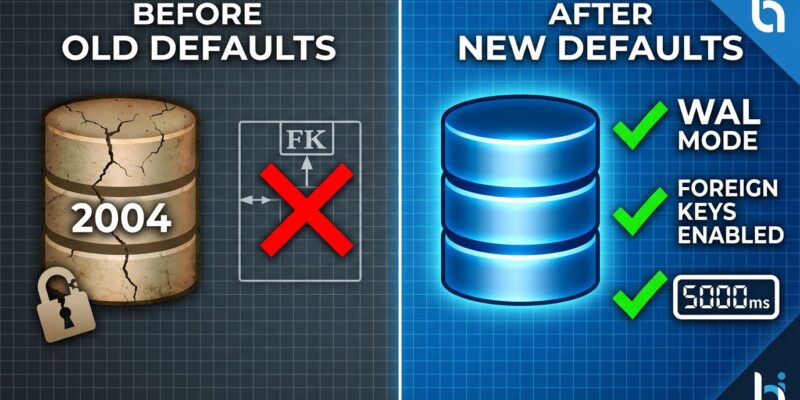
A developer proposal published this week argues that SQLite — the world’s most deployed database, running on over one trillion active databases — ships with defaults that would embarrass any system designed after 2004. Foreign key enforcement is off. WAL mode is off. The busy timeout is zero, meaning two concurrent writers crash immediately instead of waiting. The proposal: borrow Rust’s edition system and bundle a set of sane modern defaults behind a single pragma, opt-in, with zero impact on existing code. It hit Hacker News front page on July 16 with 241 points and split the community cleanly in half.
SQLite’s Default Settings Are a Decade-Old Copy-Paste Problem
The same four-pragma block has appeared in virtually every SQLite production setup guide for the better part of a decade:
PRAGMA foreign_keys = ON;
PRAGMA journal_mode = WAL;
PRAGMA synchronous = NORMAL;
PRAGMA busy_timeout = 5000;
That block exists because SQLite’s out-of-the-box settings are wrong for most real workloads. Foreign key constraints are silently ignored by default — SQLite’s own documentation noted in 2009 that the default “might change in a future release.” Seventeen years later, it hasn’t. WAL mode, which allows readers and writers to work simultaneously and cuts p99 write latency by 30-60% in concurrent workloads, is also off by default. A busy timeout of zero means the first SQLITE_BUSY error you encounter isn’t a warning — it’s a crash.
A 2024 Rails conference talk captured it bluntly: “SQLite is configured for 2004 hardware by default.” That framing stuck because it’s accurate. The defaults aren’t wrong in a theoretical sense — they were sane for the constraints of 2004. They’re just no longer appropriate for a database powering production web apps, mobile backends, and aircraft avionics in 2026.
Why Rust-Style Editions Are the Right Fix
The SQLite editions proposal suggests adding a PRAGMA edition = 2026 directive that bundles sensible defaults without touching existing behavior. Opt in and you get foreign keys enabled, WAL mode, a 5-second busy timeout, and STRICT type enforcement as the default for new tables. Don’t opt in and nothing changes. Existing databases, existing apps, existing tooling — all unaffected.
-- Instead of copying the four-pragma boilerplate every time
PRAGMA edition = 2026;
-- Equivalent to: foreign_keys ON, WAL, synchronous NORMAL, busy_timeout 5000, STRICT tables
The analogy to Rust editions is apt. Rust releases a new edition every three years — 2015, 2018, 2021, 2024 — each bundling semantic changes that would otherwise break backward compatibility. Crates that haven’t opted in continue to compile and link against crates that have. For SQLite, the same principle applies: a 2026-edition database co-exists with applications using the old defaults.
The Counter-Arguments Don’t Hold Up
The most popular objection on HN: “SQLite competes with fopen. Not Postgres.” It’s a clean line, and it’s wrong. The argument implies that silent data corruption (disabled foreign keys) and production crashes (zero busy timeout) are somehow features of a minimalist design philosophy. They’re not. They’re defaults that made sense when SQLite was primarily a file format for single-writer local applications. That era ended years ago.
Here’s the tell: the platforms built on top of SQLite — Turso, Cloudflare D1, LibSQL — all override these defaults themselves. Every fork and production wrapper enables WAL and foreign keys. When the entire ecosystem works around your defaults, your defaults are wrong. The “fopen not Postgres” camp is defending an abstraction that the market has already rejected in practice.
A more legitimate objection came from the Lobsters thread: some pragmas are per-connection (foreign_keys, busy_timeout) while others are per-file (journal_mode = WAL). A single edition pragma spanning both scopes is architecturally awkward. There’s also a known rough edge where STRICT mode breaks DATETIME columns. These are real implementation challenges — but they’re arguments for careful design, not for abandoning the proposal.
Related: dbt Core v2: Rust Engine, 30x Faster Parsing, Upgrade Guide
What You Should Do Right Now
The SQLite core team hasn’t responded to the proposal yet, and “editions” as a formal feature may be years away, if it happens at all. SQLite’s development process is famously conservative. However, that doesn’t change the immediate situation: if you’re using SQLite in production and you haven’t set those four pragmas, you have a bug waiting to happen.
Enable PRAGMA foreign_keys = ON and you prevent silent data corruption from dangling references. Enable WAL mode and concurrent reads stop blocking writes. Set busy_timeout = 5000 and you eliminate a class of production crashes that would otherwise require manual retry logic. None of this requires editions — it just requires that you stop trusting SQLite’s defaults.
Key Takeaways
- SQLite’s default settings are a 2004-era artifact: foreign keys off, no WAL, zero busy timeout. They cause silent data corruption and production crashes in any multi-writer or integrity-sensitive workload.
- The SQLite editions proposal borrows from Rust’s edition system — a single opt-in pragma bundles modern defaults without breaking any existing code or database.
- The “SQLite competes with fopen” counterargument collapses under scrutiny: Turso, Cloudflare D1, and LibSQL all override these defaults because the ecosystem already agrees they’re wrong.
- The implementation has real challenges (connection vs. file-level pragmas, STRICT mode and DATETIME), but those are engineering problems, not reasons to reject the concept.
- Don’t wait for editions: enable
PRAGMA foreign_keys = ON,PRAGMA journal_mode = WAL, andPRAGMA busy_timeout = 5000in every SQLite application you ship today.