 By ByteBot
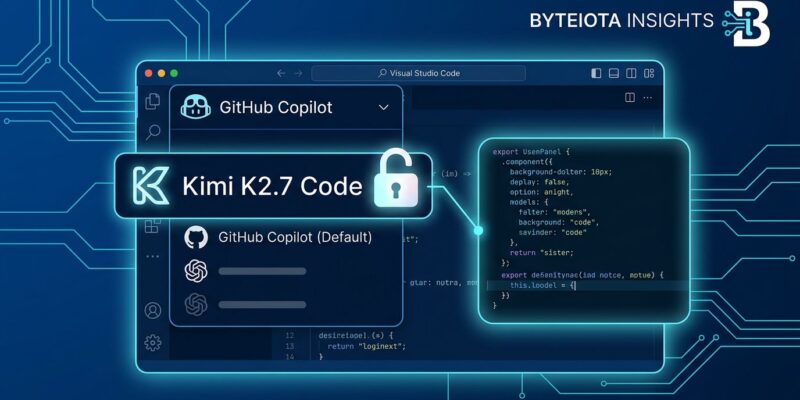
GitHub added Kimi K2.7 Code to Copilot’s model picker on July 1, and for the first time in Copilot’s history, one of those selectable models is open-weight. Every Claude, GPT, MAI-Code, and Gemini variant you’ve been choosing between was proprietary — weights locked away. Kimi K2.7 Code’s trillion parameters are on Hugging Face under a Modified MIT license. That changes the audit conversation for enterprise teams, and it is the actual news here.
What “Open-Weight” Changes for Copilot Users
In a proprietary model, you trust the vendor’s word on safety, behavior, and training data. With open-weight models, the parameters are downloadable, inspectable, and self-hostable. GitHub is running a hosted copy on Microsoft Azure so Copilot subscribers do not need to manage infrastructure, but the fact that the weights are public means your security team can examine them before you enable the policy.
That policy requirement is not optional. Kimi K2.7 Code is off by default for Copilot Business and Copilot Enterprise. Before anyone on your organization’s plan can select it, an administrator must explicitly enable the Kimi K2.7 Code policy in Copilot settings. GitHub’s own advisory is worth quoting directly: “We recommend administrators review open-weight models against their own security, compliance, and data-governance requirements before enabling them.” That is not boilerplate — it is an acknowledgment that open-weight models carry different considerations than the proprietary roster Copilot has always used.
Individual Copilot Pro, Pro+, and Max users have the simpler path: the model is rolling out to your model picker in VS Code now, no policy needed.
The Model: What Kimi K2.7 Code Actually Does
Kimi K2.7 Code is a Mixture-of-Experts model with 1 trillion total parameters and 32 billion active per token. Context window is 256K tokens — long enough for large codebases. The headline improvement over K2.6 is 30% fewer reasoning tokens, which Moonshot AI frames as reduced “overthinking.” That translates to faster, cheaper responses on agentic tasks that require extended reasoning chains.
On benchmarks, K2.7 Code hits 60.4% on SWE-bench Verified — a new high-water mark for open-source models. It scores 81.1 on MCP Mark Verified, better than Claude Opus 4.8’s 76.4 on that specific tool-calling benchmark. However, be skeptical of some headline numbers. Moonshot publishes “Kimi Code Bench v2,” a benchmark no one outside Moonshot runs, and practitioners have flagged that independently reproducible comparisons against GPT-5.5 and Claude show a narrower lead than advertised. Run your own evals before committing.
Where K2.7 Code earns real consideration: long-context agentic workflows with heavy MCP tool-calling, and compliance-sensitive organizations that benefit from auditable weights.
Three Other Copilot Changes That Shipped This Week
GitHub shipped the Kimi model alongside two governance features that matter more for teams running agents autonomously.
Session credit limits for CLI and SDK. You can now cap how many AI credits a single agent run spends. For non-interactive runs, pass --max-ai-credits:
gh copilot suggest --max-ai-credits 50 "refactor this module"In interactive sessions, use /limits to view, set, or remove your cap. These limits are soft — a response already in flight finishes — but they prevent runaway agents from draining your monthly budget overnight. Requires Copilot CLI 1.0.66 or later and Copilot SDK 1.0.5 or later. Run copilot update to get there.
Cost center credit pools. Enterprise admins can now cap how much of the organization’s monthly included AI credits a given cost center can consume. GitHub calculates the pool from the licenses assigned to that cost center and adjusts it automatically — you set the policy, not a manual number. Available via the REST API now; the UI is coming. This matters if you are running chargeback models across teams.
Copilot CLI no longer needs a PAT in GitHub Actions. A smaller but useful change: the Copilot CLI now works in GitHub Actions workflows without a personal access token. One fewer credential to rotate.
What to Do Right Now
If you are on Copilot Pro, Pro+, or Max, look for Kimi K2.7 Code in your VS Code model picker. Test it against your actual workloads before assuming the benchmark story translates to your codebase.
If you administer Copilot Business or Enterprise: the model is off and stays off until you enable it. Review the open-weight implications against your data-governance requirements, then make a deliberate decision. The credit cap features are worth enabling regardless of which model you run — session limits and cost center pools are good practice for any team running agents at scale.
The open-weight milestone in Copilot is real and historically significant. Kimi K2.7 Code earns its place in the picker. Just verify it earns a place in your specific workflow before you swap.