 By
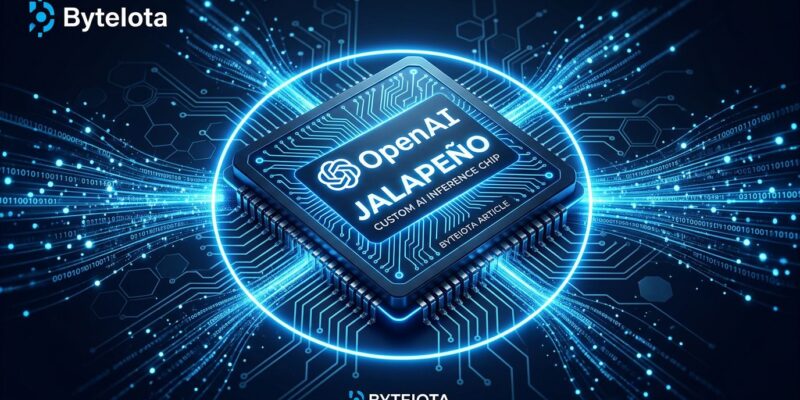
By On June 24, OpenAI and Broadcom unveiled Jalapeño — OpenAI’s first custom inference chip — with a headline claim of 50% lower cost per token versus current Nvidia GPUs. If that holds in production, your API bills get cut significantly. But “if that holds” is doing a lot of work in that sentence. Here is what the announcement actually means, what the timeline looks like, and what you should watch for as a developer building on the OpenAI API.
What Jalapeño Is (Without the Spec Sheet)
Jalapeño is a purpose-built ASIC designed exclusively for LLM inference — not training, not general compute, inference only. It runs on TSMC’s 3nm process, uses a reticle-sized die (the largest physically possible per wafer), and packs eight HBM stacks for memory bandwidth. Broadcom handles the silicon implementation; Celestica handles rack integration at scale. OpenAI built the architecture from scratch in nine months, accelerating hardware design with their own AI models.
The chip is inference-specific because that is where GPUs waste the most cycles on LLM workloads. GPUs are general-purpose; they carry overhead that inference does not need. Jalapeño targets the actual bottleneck — memory bandwidth and data movement — and eliminates the rest. That is why the cost claims are at least plausible, even before independent benchmarks arrive.
About That 50% Cost Claim
Broadcom CEO Hock Tan stated roughly 50% lower inference cost per token versus current Nvidia Blackwell-generation GPUs. OpenAI confirmed this directionally. Neither has published independent benchmark results or full architecture diagrams. Treat “50% cheaper” as a stated target backed by early lab data — not a confirmed production outcome. The Hacker News discussion was appropriately skeptical: Google’s TPUs took years of production iteration to reach their efficiency claims. OpenAI’s first-generation ASIC will have its own learning curve.
That said, the architecture makes the claim structurally plausible. When you build a chip specifically around the memory access patterns of transformer inference, you get meaningfully better utilization than a general GPU. The question is not whether the savings are real — they probably are — it is how much of that lab efficiency survives production conditions, system overhead, and real workload variance.
Plan for a 30–50% reduction in per-token inference costs over the next two years. Not zero savings, but not “50% off your next invoice” either.
What Developers Actually Get
Jalapeño is infrastructure-internal to OpenAI. There is no hardware selector in the OpenAI API. The chip is not available on AWS, Azure, or any cloud you can access directly. OpenAI runs this inside their own data centers, starting with Microsoft’s infrastructure at gigawatt scale in H2 2026.
The developer benefit flows through indirectly: lower API pricing, faster latency, more capacity, and higher rate limits. The question is when. Here is the realistic timeline:
- H2 2026: Initial deployment at gigawatt scale. This is the prototype phase in Microsoft data centers.
- 2027: Full production ramp. Cost savings start materializing at scale.
- Mid-2027: Earliest meaningful API price impact for developers.
- 2028: Substantial per-token cost reductions, compounded by competitive pressure from Google, Amazon, and Microsoft custom silicon.
Jalapeño will not change your AI budget in Q3 2026. It will change it meaningfully by mid-2027. Watch the leading indicators: rate limit expansions usually arrive before price cuts, and rate limit expansions signal that capacity — meaning Jalapeño at scale — is coming online.
The NVIDIA Story Everyone Gets Wrong
This is not a NVIDIA-killer story. OpenAI still has a $100 billion commitment to NVIDIA for the Vera Rubin platform, with H2 2026 first deployments. Training remains on NVIDIA — their ecosystem advantage in training workloads is untouched by a first-generation inference ASIC. According to VentureBeat’s infrastructure coverage, Jalapeño represents diversification at the inference layer, not a wholesale departure from Nvidia’s stack.
What Jalapeño actually represents: OpenAI building its own software stack for inference, bypassing CUDA entirely on those workloads, and controlling the unit economics of serving their models. That is a strategic win regardless of the performance numbers. Compute strategy is product strategy, margin strategy, and supply-chain strategy simultaneously — and OpenAI just took a major step toward owning all three for inference.
What to Watch For
If you are building on the OpenAI API, three signals indicate Jalapeño is delivering in production:
- API price cuts — the most direct signal. Watch OpenAI’s official announcement page and the pricing documentation for changes.
- Rate limit expansions — usually arrive before price cuts as capacity grows. An increase in your default rate limits is a leading indicator.
- New model tiers at lower price points — more throughput capacity means OpenAI can offer capable models at lower cost brackets.
For budget planning: do not anchor to today’s per-token rates as a permanent floor. The infrastructure shift underway — custom silicon at scale across all major AI providers — means inference costs are heading down structurally. The direction is clear. The pace is 2027, not 2026. Per the TechCrunch report, OpenAI aims for gigawatt-scale deployment by end of year, but the full production benefits take longer to reach the API layer.
Jalapeño is real, the cost savings are structurally plausible, and the hype is outrunning the deployment timeline by about 12 months. Plan accordingly.