 By
By The Flipper Zero team just launched a desk display called the Busy Bar. The productivity timer is not the story. The story is that Flipper Devices shipped with an open HTTP API, official Python, TypeScript, and Go libraries, MQTT support for your own broker, full offline access via USB Virtual LAN, and open firmware on GitHub. After Tidbyt folded and LaMetric locked developers into cloud dependencies, this is what a developer-grade desk gadget looks like when the team building it actually uses the thing.
The API Is the Product
Three connection modes, none of them locked to Flipper’s servers. The HTTP API runs over local Wi-Fi or a USB Virtual LAN interface — full offline operation, no account required. MQTT lets you subscribe to device events (button press, timer end, status change) and publish commands to update the display, using your own broker. The cloud API is optional: use busy.app or run your own MQTT server.
Official SDKs are available for Python, TypeScript, and Go from day one. The source is open. You can push a build status, a queue depth, an on-call rotation, or an alert count to a 72×16 RGB LED matrix with a few API calls. That is the pitch.
Compare that to the Tidbyt situation — acquired by Modal, no new units, community building Tronbyt firmware to keep existing devices alive — or LaMetric’s constrained API that leaves developers building around the product rather than with it. Flipper ships offline-first and self-hosted by design, not as an afterthought bolted on after launch.
Open Firmware, Same as Before
Inside the Busy Bar is an STMicroelectronics STM32U5M microcontroller and a Silicon Labs SiWG917 chip handling Wi-Fi 6 and Bluetooth 5.4 LE. The firmware is open, published on GitHub, and auditable — the same approach that made the Flipper Zero one of the most trusted tools in the security research community. No developer tier, no firmware signing keys blocking custom builds.
That means you can write custom widget types, extend the protocol, or replace the entire software stack. The Flipper Zero community built third-party firmware (Unleashed, Momentum) that added features the official firmware never shipped. Hackster’s teardown confirms the hardware is designed knowing that will happen here too. The USB Virtual LAN interface works without any cloud account — plug in USB, get an API endpoint, start pushing data.
Matter Certification: What It Gets You in Practice
The Busy Bar is Matter-certified through the CSA. That certification means the device works natively with Apple HomeKit, Google Home, and Amazon Alexa without any custom integration code. You can trigger a HomeKit Shortcut when the display switches to BUSY mode, have a Google Routine turn office lights red, or fire an Alexa routine when a focus timer ends. If you already run Home Assistant, Apple Home, or Google Home, the Busy Bar drops in as a native smart home entity — no plugin required.
Hardware Specs
- Front display: 72×16 RGB LED matrix, 400 nits, 16 million colors, auto-brightness sensor
- Back display: 1.54-inch 160×80 monochrome OLED (status, timer, battery, connectivity)
- Battery: 3,250 mAh — 8 hours active, two weeks standby, 1-hour charge at 15W
- Connectivity: USB-C, Wi-Fi 6, Bluetooth 5.4 LE
- Controls: Rotary encoder, oversized mechanical push-button, mode selector
What to Build
The practical integrations are obvious from the API design:
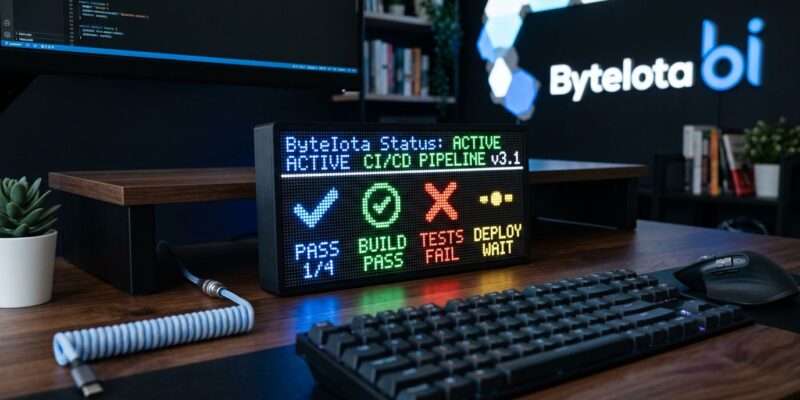
- CI/CD status board — green passing, red failing, one webhook to one HTTP endpoint
- On-call display — who is on right now, updated via MQTT from PagerDuty or OpsGenie
- AI agent output — push status from a monitoring agent to a physical display on your desk
- Build queue depth — show pipeline backlog without opening a browser tab
- Focus timer with app blocking — lock distracting apps on iOS or Android while the timer runs
The 72×16 resolution is enough for short text, icons, and simple animations. It is a status indicator with personality, not a dashboard screen. The question is not what it can display — it is what should always be visible at the edge of your field of view.
Price and Availability
Announced June 29, shipping July 14 to the U.S., EU, U.K., and Canada. First 3,000 units at $199. Standard price is $249. Pre-orders open now at busy.app.
This is the most developer-respecting desk display released in years. It ships with the assumption that you will do something Flipper did not anticipate. That is a design philosophy, not a marketing line.