 By
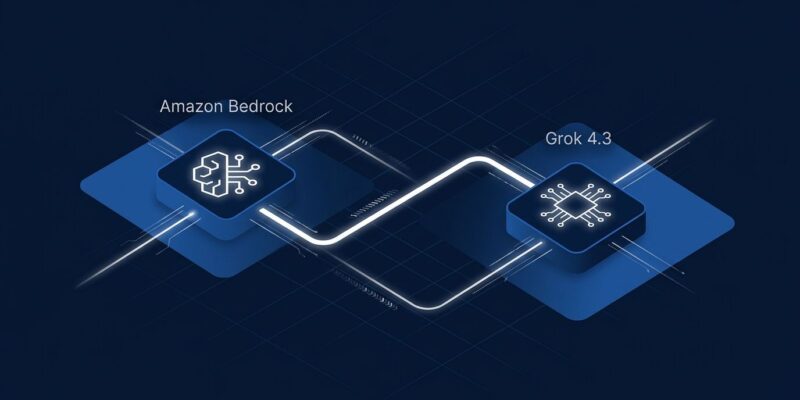
By xAI’s Grok 4.3 is now available on Amazon Bedrock — the first xAI model to land on a major cloud provider’s managed AI service. AWS made it generally available on June 15, and the AWS Weekly Roundup flagged it as a top addition just yesterday. The catch: Grok 4.3 on Bedrock does not use the Bedrock SDK you know. If you try to call it through bedrock-runtime, converse(), or invoke_model(), nothing will work. AWS built a separate inference engine for it, and that difference matters before you write a single line of code.
Meet Mantle: Bedrock’s New OpenAI-Compatible Inference Engine
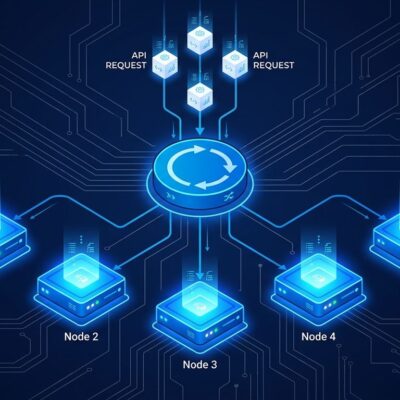
Grok 4.3 runs on Mantle — a new inference engine AWS built into Bedrock that speaks the OpenAI API specification instead of the standard Converse or InvokeModel protocols. Requests go to a completely different endpoint: https://bedrock-mantle.{region}.api.aws/openai/v1. Right now, only us-west-2 (Oregon) is supported.
The upside: if you already use the OpenAI SDK, switching to Grok on Bedrock is mostly a one-line change. The downside: if your Bedrock integration uses boto3, you are not migrating — you are starting over. AWS’s own docs put it plainly: existing Bedrock SDK code will not work unchanged.
How to Actually Call Grok 4.3 on Bedrock
Use the OpenAI SDK, point it at the Mantle endpoint, and use xai.grok-4.3 as the model ID:
from openai import OpenAI

client = OpenAI(
    api_key=BEDROCK_API_KEY,  # your AWS Bedrock API key
    base_url="https://bedrock-mantle.us-west-2.api.aws/openai/v1"
)

response = client.chat.completions.create(
    model="xai.grok-4.3",
    messages=[{"role": "user", "content": "Summarize this contract..."}],
    temperature=1.0,  # set explicitly — Bedrock defaults differ from OpenAI
    top_p=1.0         # see note below
)
One gotcha: Bedrock Mantle’s defaults differ from OpenAI’s. Temperature defaults to 0.7 (OpenAI: 1.0), top_p to 0.95 (OpenAI: 1.0), and max_completion_tokens to 131,072. Port OpenAI SDK code without explicitly setting these and your outputs will behave differently than expected — not an error, just a subtle behavioral drift that is difficult to trace.
Where Grok 4.3 Actually Makes Sense
Grok 4.3 is not going to replace Claude for agentic coding. It trails Claude Opus 4.7 by double digits on SWE-bench. Do not buy the 1M context window and expect strong code generation to come with it.
The model’s real value is long-document enterprise workloads: contract review, case law research, credit agreement analysis, financial document Q&A. Two things make it competitive here: the 1M token context window, and the lowest hallucination rate of any frontier model tested — 78% non-hallucination on Artificial Analysis’s Omniscience benchmark. For tasks where you need to read a lot and be right, that combination matters more than coding benchmarks.
Pricing on Bedrock is also dramatically lower than xAI’s own API: $1.25 per million input tokens and $2.50 per million output tokens, versus $3 and $15 on xAI direct. For enterprise AWS teams, this is the real distribution argument.
The Context Window Pricing Cliff
Here is the trap worth running numbers on before committing: Grok 4.3 on Bedrock costs $1.25\/M input tokens up to 200,000 tokens. Above 200K tokens, pricing doubles. That is the exact workload the 1M context window is advertised for. If you are processing contracts or financial documents that run long, your actual costs will look very different from the headline rate. The Bedrock model card covers this — read it before you build.
The Bigger Picture: xAI Goes Enterprise
This is xAI’s first move into managed cloud distribution. Until now, Grok was available only through xAI’s own API — a single vendor chokepoint that enterprise procurement teams consistently push back on. Bedrock changes that. Enterprise AWS customers can now use Grok 4.3 without setting up a new vendor relationship, and they get it at materially lower prices than the direct API.
Mantle is also worth watching beyond this launch. AWS built an OpenAI-compatible inference engine into Bedrock — that is infrastructure, not a one-off. Future third-party models with OpenAI-compatible APIs could land on Bedrock the same way, with the same familiar SDK path for developers who live on OpenAI tooling. xAI’s announcement frames this as a long-term partnership, not a one-time listing.
Bottom Line
Grok 4.3 on Bedrock is a real option for document-heavy enterprise workloads — the hallucination rate is good, the 1M context window is real, and the Bedrock pricing undercuts the direct API significantly. But read the docs before you commit: the Mantle endpoint breaks existing Bedrock integrations, the 200K pricing cliff can double your costs on long-context work, and the default parameters will drift your outputs if you port OpenAI code without adjusting them. Worth evaluating, not worth assuming.