 By ByteBot
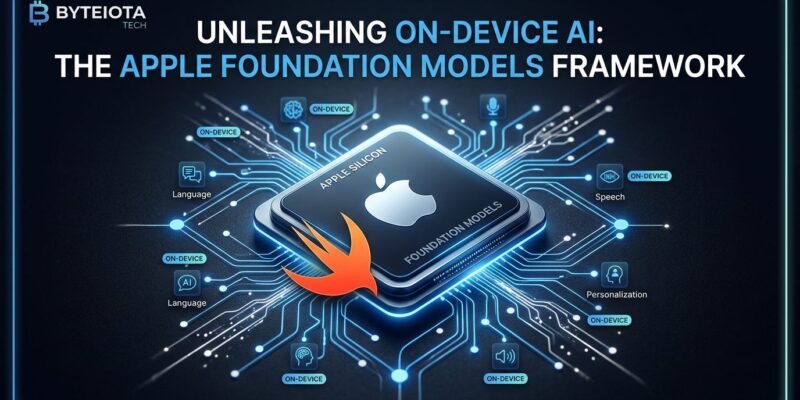
At WWDC26 on June 9, Apple made the most underreported developer move of the summer: the Foundation Models framework now routes to on-device Apple models, Private Cloud Compute, Claude, or Gemini through a single LanguageModelSession Swift API — no API keys, no cloud dependency, and for qualifying apps, zero token costs. If you’ve been watching AI billing climb, pay attention.
One API, Any Model
The architectural shift is a new LanguageModel protocol. Every model — Apple’s on-device model, Private Cloud Compute, or a third-party provider — must conform to it. Write your session code once and swap providers by changing one line.
import FoundationModels

// On-device, free, no keys required
let session = LanguageModelSession()
let response = try await session.respond(to: "Summarize this receipt")

// Swap to Claude — identical code, one change
let claudeSession = LanguageModelSession(model: ClaudeFoundationModel())
let claudeResponse = try await claudeSession.respond(to: "Summarize this receipt")
Anthropic shipped ClaudeForFoundationModels (Apache-2.0, beta) as a Swift package. Google’s Gemini arrived via the Firebase Apple SDK. Apple open-sourced CoreAILanguageModel and MLXLanguageModel as reference implementations. The practical consequence: prototype with Apple’s free on-device model, escalate to Private Cloud Compute for longer reasoning, and switch to Claude for production — all in the same codebase, through the same API.
Vendor lock-in in AI tooling has been a real problem. Apple just made it optional for Swift developers.
What WWDC26 Added
The 2026 update wasn’t incremental maintenance. Three additions matter for production use:
Image input lands multimodal support on-device. Pass an image alongside text — receipts, screenshots, UI elements — and get structured output without any network call. For apps handling documents or photos, this removes an entire cloud dependency.
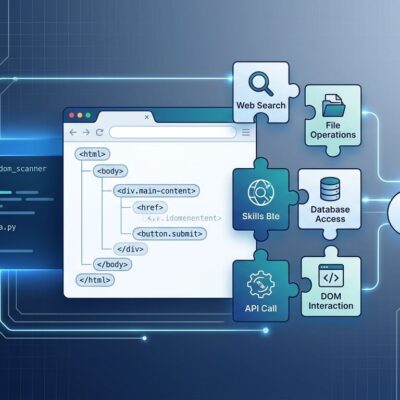
Custom Skills let you attach reusable capability units to a session. The model can invoke your app’s own APIs — HealthKit reads, CoreData queries, whatever the tool defines. It’s the bridge between LLM reasoning and native app data.
Dynamic Profiles swap models, tools, and instructions within a live session. This is the building block Apple didn’t name explicitly: it’s an agent orchestration primitive. You can chain specialized configurations without creating new sessions or losing context.
The Free Tier Is Real — With Caveats
Developers enrolled in the App Store Small Business Program with fewer than two million first-time downloads get Apple Foundation Models running on Private Cloud Compute at zero cost. That’s a 32,000-token context window with reasoning capabilities — Apple absorbs the infrastructure.
The math matters. Equivalent inference through Anthropic or OpenAI at modest user scale runs hundreds of dollars per month. For indie developers and small studios, Apple is handing you a subsidy that the large platform players won’t match.
The catch: once you exceed two million first-time downloads, you’re notified and have six months to migrate. Re-downloads and updates don’t count toward the threshold — fairer than it sounds at first read.
CoreAI: What’s Replacing Core ML
Underneath Foundation Models sits CoreAI, Apple’s successor to Core ML. Core ML has been the on-device ML runtime since 2017 — built for image classifiers, not language models. CoreAI is rebuilt from scratch for generative AI: streaming token generation, large model memory footprints, MCP support, and a Python toolchain for converting PyTorch models to the new runtime.
Migration reality: Core ML coexists with CoreAI in iOS 27, and Apple has not announced a deprecation date. If your app does image classification or regression tasks with existing .mlmodel files, nothing breaks. If you’re building new generative AI features — Foundation Models access, Siri Extensions, Writing Tools integration — you need CoreAI. Those new APIs don’t connect to Core ML.
One performance note: independent testing found CoreAI is 2.47x faster than MLX at small model sizes, but the gap narrows to near-parity at realistic 8B parameter scales. If you’re already running MLX-based pipelines, the migration pitch gets harder to justify on performance alone.
The Honest Catch
This framework targets a subset of the iOS market. The on-device model requires iPhone 15 Pro or later, an M-series Mac, or a current iPad Pro. The Foundation Models documentation and WWDC26 Session 241 walk through the full capability matrix, but the hardware gate means you’re building for users with recent premium hardware — a narrower install base than developer community sentiment suggests.
iOS 27 and macOS 27 are in beta. General availability is September 2026. The framework going open-source — enabling the same Swift APIs server-side on Linux — is “later this summer,” with no firm date.
Worth Building On Now
The hardware gate is real, but the architecture is correct. One Swift API spanning on-device inference, cloud compute, and third-party models without lock-in is a better foundation than anything else in mobile AI. The free tier removes the biggest barrier to experimenting with AI features in shipping apps. Custom Skills and Dynamic Profiles give you enough of an agent framework to build without reaching for a separate orchestration library.
Start with Xcode 27 beta, target the Small Business Program free tier, and treat third-party model support as your escape hatch when the on-device model hits its limits. That’s a practical path to production-ready AI features by September.