 By ByteBot
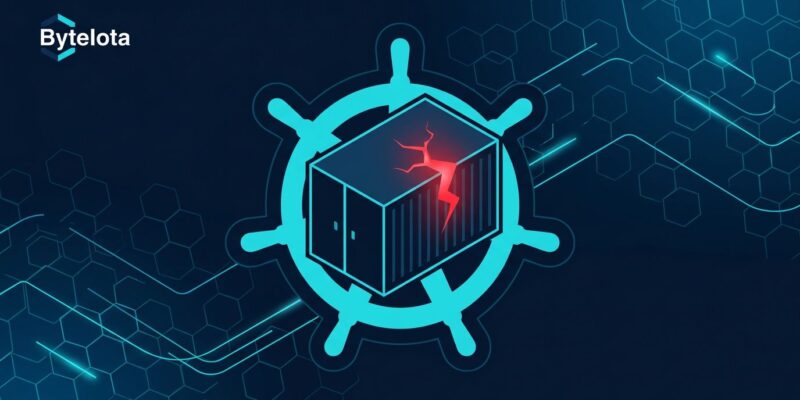
Microsoft’s June 2026 Patch Tuesday fixed 198 vulnerabilities — but one stands apart for AKS operators: CVE-2026-32193, a CVSS 8.8 container-to-host escape in Azure Kubernetes Service. A pod running with hostNetwork: true can send a specially crafted request to a host-level service, break out of its container sandbox, and gain code execution on the AKS worker node. No active exploitation reported yet. But path traversal bugs are well-tooled in attacker arsenals, and this one requires no user interaction. Patch now.
What the Bug Actually Does
This is a path traversal flaw (CWE-22) in a host-level AKS service. The attack chain is three steps:
- A container runs with
hostNetwork: true, sharing the node’s network namespace instead of an isolated one. - Because it’s on the host network, the container can reach services bound to
127.0.0.1on the worker node — including internal AKS agent services that expect only trusted callers. - A specially crafted request exploits the path traversal flaw in one of those services. The path resolves outside its intended directory, and code executes at worker node level.
The CVSS scope metric is Changed (S:C) — a scope change means the impact exits the container security boundary entirely. An attacker who starts in a container can now control the node. From the node, they can access credentials, pod network traffic, and anything mounted to the node’s filesystem. In a shared cluster, that means crossing tenant boundaries.
More Clusters Are Exposed Than You Think
Your instinct might be to check whether your pods use hostNetwork. But nearly every production AKS cluster runs hostNetwork pods by default — you just didn’t write them. CNI plugins (Cilium, Calico, Azure CNI daemonsets), Prometheus node_exporter, Fluentd, Vector, and dozens of common observability agents run as DaemonSets with hostNetwork: true. These pods are owned by the cluster operator, but they run on the same nodes as your application workloads.
The threat model here isn’t just “attacker deploys a malicious pod.” It’s: an attacker compromises a hostNetwork DaemonSet — maybe through a supply chain attack on a third-party operator — and then uses CVE-2026-32193 as the escape vehicle to the node. That’s a realistic attack chain for 2026.
Check Your Exposure First
Run this before anything else:
kubectl get pods --all-namespaces \
  -o jsonpath='{range .items[?(@.spec.hostNetwork==true)]}{.metadata.namespace}{"\t"}{.metadata.name}{"\n"}{end}'
Every pod in that output shares the host network namespace. Review each one: who controls the image? Is it from a trusted registry? When was it last updated? The kube-system namespace will likely have several — that’s expected. Anything in tenant namespaces with hostNetwork: true deserves scrutiny.
How to Patch
The fix is a node image upgrade, not a Kubernetes version bump. You don’t need to drain clusters or change your control plane. Rolling node image upgrades replace the OS image on worker nodes one by one, and if you have Pod Disruption Budgets configured, your workloads stay available throughout.
Upgrade all node pools at once:
az aks upgrade \
  --resource-group $RESOURCE_GROUP \
  --name $CLUSTER_NAME \
  --node-image-only \
  --yes
Or target a specific node pool:
az aks nodepool upgrade \
  --resource-group $RESOURCE_GROUP \
  --cluster-name $CLUSTER_NAME \
  --name $NODEPOOL_NAME \
  --node-image-only
After upgrading, verify the new node image versions are applied:
kubectl get nodes -o jsonpath='{range .items[*]}{.metadata.name}{"\t"}{.metadata.labels.kubernetes\.azure\.com/node-image-version}{"\n"}{end}'The upgrade takes 15–30 minutes per node pool depending on size. Run it today.
If You Cannot Patch Right Now
Don’t let the perfect be the enemy of the good. Two mitigations reduce exposure while you prepare the patch window:
1. Apply Pod Security Standards to untrusted namespaces. The “baseline” profile blocks new pods with hostNetwork: true:
kubectl label namespace $NAMESPACE \
  pod-security.kubernetes.io/enforce=baseline \
  pod-security.kubernetes.io/warn=baseline
2. Deploy OPA Gatekeeper with the K8sPSPHostNetworkingPorts constraint from the gatekeeper-library to block new hostNetwork pods cluster-wide.
One hard limit: these policies only block new pods. Existing hostNetwork pods remain exposed until you patch the nodes. Treat this as a partial control, not a substitute for the node image upgrade.
The Bigger Problem
AKS is “open by default.” Unlike GKE’s Autopilot mode, which blocks hostNetwork pods by default, AKS lets you run whatever pod spec you want unless you explicitly configure policies. That posture made sense when Kubernetes was a tool for platform engineers who owned their clusters completely. It makes less sense in 2026 when AKS runs production workloads from multiple teams, third-party operators, and AI agents that execute arbitrary code.
CVE-2026-32193 is an argument for two changes to how you operate AKS:
- Enable AKS auto-upgrade for node images. Set the node-image auto-upgrade channel so security patches land without a manual trigger. This CVE was patched June 9. Clusters with auto-upgrade already have the fix.
- Audit hostNetwork usage as a standing policy. Treat
hostNetwork: truethe same way you treat privileged containers — something that requires explicit justification, not a checkbox that gets ticked because a Helm chart asked for it.
The MSRC advisory notes no workarounds are available — patching is the only complete fix. The June 2026 Patch Tuesday analysis from CrowdStrike also flagged a critical Remote Desktop Client cluster (11 RCEs) and three actively exploited zero-days. If you haven’t applied this month’s patches, your AKS container escape is one item on a longer list. Start with this one.