 By ByteBot
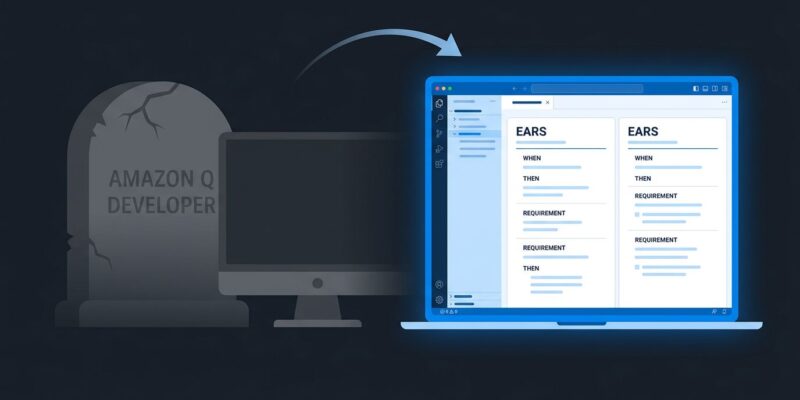
Amazon Q Developer’s IDE plugins are being retired. AWS confirmed it on April 30, 2026: IDE plugins and paid subscriptions reach end of support on April 30, 2027. That 12-month window sounds comfortable — until you realize the first two deadlines have already passed, and enterprise migration timelines don’t work on the 30-day sprint schedule vendors assume.
If you’re still on Q Developer and haven’t moved, you’re not early anymore. You’re running behind.
What’s Actually Being Killed (And What’s Not)
Before panic-migrating, understand the scope. AWS is retiring the IDE plugins and paid subscription tiers only. The Q Developer experience inside the AWS Management Console, documentation, mobile app, and Slack/Teams integrations is staying put.
What’s dead: the VS Code, JetBrains, Eclipse, and Visual Studio plugins, paid Q Developer Pro subscriptions, and — critically — code transformation features. Java language upgrades and .NET porting both run through the IDE plugins and go offline with them. If your team relies on Q Developer’s automated Java modernization or .NET porting to Linux, that’s your highest-priority migration item.
The Three Dates That Actually Matter
The April 30, 2027 EOL date is the headline, but two interim milestones have already landed:
- May 15, 2026: New Q Developer signups blocked. No new Free Tier accounts, no new paid subscriptions. Existing subscriptions can still add users.
- May 29, 2026: Opus 4.6 removed from Q Developer Pro. The latest coding models — including Opus 4.7 — are now exclusive to Kiro. Q Developer Pro users are capped at Opus 4.5.
- April 30, 2027: Full shutdown. IDE plugins go dark. Code transformation features become inaccessible.
The practical problem with “12 months”: enterprise security review, onboarding documentation, team training, and workflow re-architecture don’t happen in the final 60 days. If you’re in a regulated industry or a large org, start this quarter. According to the official AWS end-of-support announcement, the transition window is firm — there’s no extension path mentioned.
Kiro Is Not Q Developer 2.0
The most important thing to know before migrating: Kiro is not a drop-in replacement. It’s a different product with a different philosophy.
Q Developer is a code assistant — you prompt it, it responds. Kiro is built around spec-driven development. Before Kiro writes a single line of code, it walks you through three phases: requirements (written in EARS notation — “WHEN [trigger] the system shall [response]”), a technical design document, and a discrete task list. Each feature becomes a folder with three artifacts: requirements.md, design.md, tasks.md. Kiro’s official introduction frames this as “plan first, code later, ship faster” — and for structured teams, that framing holds.
This isn’t a UI quirk. It’s a fundamentally different workflow. Teams that thrive on structured engineering processes — particularly those building complex AWS infrastructure — will find Kiro’s approach clarifying. Fast-paced agile shops that want to go from prompt to PR quickly may find the spec phase is friction they didn’t sign up for. Be honest about which kind of team you are before committing.
Kiro also comes with genuine AWS integration depth: built-in AWS MCP Server support (GA as of May 2026) for live environment access with IAM-scoped permissions, automatic least-privilege IAM policy generation, CDK and CloudFormation generation following current best practices, and CloudTrail audit logging for compliance. For AWS-heavy teams in regulated industries, that governance stack is a real advantage over third-party alternatives.
Three Migration Paths
Kiro is the official path, but not the only valid one:
- Kiro ($20/mo Pro): Best for teams building on AWS who need governance and audit trails. Spec-driven workflow is a feature, not overhead. Start with the 500 free welcome credits to evaluate properly — it’s enough to run a real feature through the full spec cycle.
- Bedrock direct: For platform teams who want model API access inside VPC/IAM boundaries without an opinionated IDE. Codex on Bedrock is in limited preview; GPT-5.5 and GPT-5.4 are coming. Build your own tooling layer around the models you actually need.
- Third-party tools: Cursor, Claude Code, and Windsurf are all legitimate exits. Claude Code (terminal-based, $20/mo) leads LogRocket’s June 2026 AI dev tool rankings for long-context refactors. Cursor dominates for full-stack TypeScript. Neither has CloudTrail integration, so compliance teams should weigh that gap.
How to Start With Kiro Today
If Kiro is your path: sign up at kiro.dev with an AWS Builder ID (free, no credit card), or use Google or GitHub login. New users get 500 free credits valid for 30 days — enough to run a real feature through the spec workflow and assess fit. Install the IDE, click “Generate Steering Docs,” and let it analyze your project before writing any code. The steering files it creates in .kiro/steering/ are worth reading — they reveal how Kiro interprets your codebase’s conventions and constraints.
Pro is $20/month for 1,000 credits, with a $20 welcome credit on your first paid plan. For most 40-hour-per-week development workflows, that budget holds.
The migration window is real. The spec-driven shift is real. The question isn’t whether to move — it’s which direction makes sense for your team, and whether you start now or scramble in Q1 2027.