 By
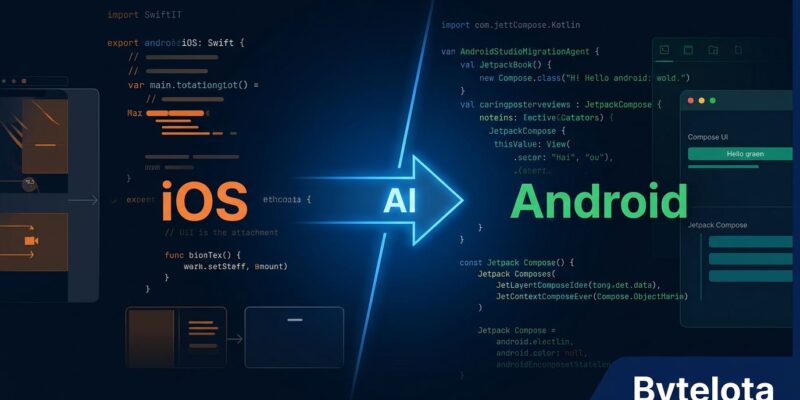
By Migrating an iOS app to native Android has always been a developer tax. Weeks of mapping UIKit patterns to Jetpack Compose, rewriting navigation stacks, hunting down Android equivalents for every iOS-specific SDK call. React Native teams face a different flavor of the same problem whenever a client demands native performance or a regulated industry audit flags JavaScript threading. At Google I/O 2026, Google announced it’s attacking this problem directly: a Migration Assistant built into Android Studio that uses an AI agent to automate the port. The claim is weeks of work cut to hours. Here’s what it actually does — and where you’ll still have to put in the manual effort.
What the Migration Agent Does
The Migration Assistant accepts iOS, React Native, or web framework projects and outputs native Kotlin Android apps. The workflow is agentic: you point the tool at your source project, and the agent takes over — mapping platform-specific features to Android equivalents, converting assets, and implementing Android best practices throughout.
Specifically, the agent handles:
- Feature mapping from iOS/React Native APIs to their Android counterparts
- Asset conversion: iOS storyboards and SVG files become Compose layouts and Android-formatted assets
- UI reconstruction using Jetpack Compose — the standard going forward, since Views are now in maintenance mode
- Architecture wiring using recommended Jetpack libraries: navigation, state management, the full stack
The output is a native Android project that still requires developer review and QA — Google is not claiming the code ships without human eyes. But the scaffolding that would take a senior Android developer weeks to produce comes out of the agent in hours.
Status as of May 2026: previewed at I/O, arriving in a future Android Studio release. Not in stable yet. It is worth setting up a canary channel if this is on your roadmap.
Android CLI 1.0: The Infrastructure Layer
The Migration Agent does not live in isolation. It runs on top of Android CLI, which hit stable 1.0 at the same I/O. This is worth understanding separately because it changes how AI-assisted Android development works regardless of whether you are porting anything.
Android CLI is a lightweight command-line interface for AI agents to drive Android development tasks. The headline numbers: 70% fewer LLM tokens consumed compared to running an agent inside the IDE, and tasks complete three times faster. The efficiency gain comes from giving agents machine-readable interfaces instead of having them parse IDE UIs.
The new android studio command bridges the CLI to Android Studio’s full analysis engine. Agents can call analyze-file to surface errors and warnings, find-usages to trace symbol references, render-compose-preview to validate UI without a device, and version-lookup to fetch current dependency versions automatically.
Notably, Android CLI works with any agent — Claude Code, OpenAI Codex, Google Antigravity. Google built this knowing that most developers have already picked an AI coding tool and are not switching. Installation is straightforward:
brew install android-cli        # macOS
winget install Google.AndroidCLI  # Windows
apt-get install android-cli     # Linux
Who This Actually Helps (And Who It Does Not)
The Android Studio Migration Agent solves a specific problem, not a universal one. Before planning a migration project, be honest about which camp you are in.
This tool makes sense for:
- iOS teams expanding to Android without the budget or headcount for a separate native Android team
- Companies with cross-platform technical debt — specifically in regulated industries where native compliance and performance constraints have become blockers
- Startups that chose React Native for speed and have hit the wall on a feature that genuinely requires native capability
It is not an argument that cross-platform was a mistake. React Native’s 0.84 new architecture eliminated the old JavaScript bridge bottleneck — startup times improved 43%, JS-to-native communication is 40x faster, and most business app use cases are now competitive with native on performance. Kotlin Multiplatform adoption jumped from 7% in 2024 to 23% in 2025. The cross-platform ecosystem is healthy.
What the Migration Agent gives you is an exit ramp with a dramatically lower toll. That is useful when you need it. If you do not, keep building what is working.
Agent Skills: The Extensibility Layer
Beyond porting, Android Studio ships a new Agent Skills system — modular instruction sets that teach AI agents Android-specific workflows. These serve as grounding context for whatever LLM you are using. New skills available now include CameraX migration, Adaptive UI development, Jetpack Compose Styles API, AppFunctions analysis, and Navigation 3 migration. Google open-sourced the skills.
The management interface is three CLI commands:
android init
android skills list
android skills add --skill=compose-migration
The Migration Assistant is effectively the most ambitious skill in the set — a whole-project porting workflow built on the same extensible foundation.
AppFunctions: Where Android Is Actually Headed
The Migration Agent is the most immediately practical announcement from the Android track at I/O. But the more strategically significant one is AppFunctions, arriving in Android 17. The API turns Android apps into on-device MCP servers — Gemini and other agents can call your app’s functions directly, without cloud round-trips, using the user’s live app state. Unlike standard MCP servers that require cloud execution and network calls, AppFunctions run at the OS level on-device. Private preview is now open, with an Early Access Program available for registration.
The direction is clear: Google is building Android as an agent execution substrate. Apps are not just things users open — they are tools that AI agents call. The Migration Agent helps you get your app onto that platform. AppFunctions is what you build once you are there.
How to Get Started
Android CLI 1.0 is available today via Homebrew, winget, or apt-get. Install it, add the skills relevant to your project, and integrate with your existing agent workflow — Claude Code and Codex are both supported out of the box. The Migration Assistant itself will land in a future Android Studio canary. Follow the Android Developers Blog for the release announcement. If you are evaluating whether a migration makes sense, read the Android Skills documentation alongside it — the skills system shows exactly what kinds of Android-specific workflows the agent is capable of handling.