 By ByteBot
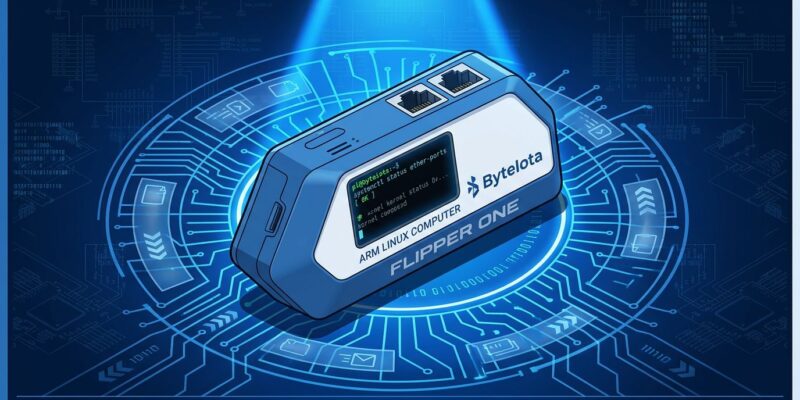
Flipper Devices just announced the Flipper One: a pocket-sized ARM Linux computer built on the Rockchip RK3576 octa-core processor, with 8GB of LPDDR5 RAM, dual Gigabit Ethernet, Wi-Fi 6E, an M.2 expansion slot for 5G modems or SDR modules, and a 6 TOPS AI accelerator onboard. It landed on Hacker News as today’s top story. If you’re expecting a Flipper Zero upgrade, stop — this is a completely different device solving a completely different problem.
Two Different Devices, Two Different Problems
The Flipper Zero built its reputation attacking the radio layer: NFC, RFID, sub-GHz protocols, infrared — the offline, point-to-point wireless world. The Flipper One operates at the IP layer: Ethernet, Wi-Fi 6E, and 5G via the M.2 slot. These are not competing products. Security researchers who work in the field need both: one tool for the radio stack and one for the network stack. The attack surface has evolved, and Flipper is building hardware to match it.
What the Flipper One Actually Delivers
The hardware specs tell a clear story. The RK3576 pairs four Cortex-A72 cores at 2.2GHz with four Cortex-A53 cores at 1.8GHz, landing in Raspberry Pi 5 territory for multi-core workloads. Flipper CEO Pavel Zhovner put it plainly: better than the Pi 5 on multi-core, slightly behind on single-core. On top of that sits 8GB of LPDDR5 and 64GB of UFS 2.2 storage with a MicroSD expansion slot.
The connectivity story is where the Flipper One earns its place in a security researcher’s toolkit. Two built-in Gigabit Ethernet ports mean passive network tapping without extra hardware. The M.2 slot accepts 5G modems, SDR modules, or additional AI accelerators — making this a modular platform rather than a locked-down appliance. The built-in 6 TOPS NPU enables lightweight models to run offline. A Raspberry Pi RP2350 co-processor handles always-on MCU functions independently of the main SoC. The whole device fits in a pocket and runs on battery — no laptop bag required.
The Open-Source Commitment Is the Real Story
Flipper Devices partnered with Collabora to push full RK3576 support into the mainline Linux kernel — no binary blobs, no proprietary drivers, no vendor-locked BSP. According to Collabora’s blog post, they’ve been upstreaming RK3576 support since 2024 and most major components are already working. One binary blob remains: the DDR Trainer in the boot chain. They’re working on it — and they’re saying so publicly rather than papering over it.
This matters more than a spec sheet ever could. The ARM Linux ecosystem runs on vendor forks, downstream patches, and components that stop receiving updates the moment a manufacturer moves on. Flipper’s mainline bet means you won’t be stuck on a three-year-old kernel when the SoC vendor goes quiet. That’s the Raspberry Pi experience Flipper is explicitly trying to avoid, and it’s a bet that requires real engineering commitment — not just a press release. For context on how different this is, see how even Microsoft is still wrestling with its own Linux kernel strategy.
The Honest Ask — No Price, No Ship Date
Here is where the Flipper One announcement gets unusual. Flipper isn’t pretending the device is ready to ship. The team published a direct community call for contributors, acknowledging “technical challenges and financial risks” — including the ongoing RAM chip crisis — and offered no price, no ship date, and no crowdfunding timeline. What there is: a fully public Developer Portal where the entire project — task trackers, architectural debates, mainline kernel status — is visible to anyone.
The areas still in active development include USB-C DisplayPort Alt Mode, hardware video decoding, NPU kernel support, and the FlipCTL UI framework optimized for small-screen Linux. Flipper is asking for kernel developers, firmware engineers, UI contributors, and hardware testers. A working prototype ships to Embedded Recipes next week. This is not vaporware marketing — it is hardware development being done in public, which is rarer and more honest than most product launches manage.
What This Means for Security Researchers
The current option for field network security work is typically “Kali Linux on a Raspberry Pi 4 with a USB adapter, a portable battery pack, and a bag to carry it all.” The Flipper One proposes a purpose-built alternative: a pocket device running Flipper OS — a Debian-based system with a menu UI built for small screens — with profile-based configurations for switching between setups instantly. According to TechCrunch, use cases include portable VPN gateways, passive Ethernet sniffers, and on-device AI-assisted security analysis.
The Flipper One won’t replace the Flipper Zero for RF work — it has no radio capabilities at that layer. It won’t replace a full laptop for deep analysis sessions. However, for field-deployed network monitoring, portable taps, and on-device tooling, there is currently nothing quite like it available. The key word remains available. No price, no date, and a team that says it is “genuinely terrified” of the scope ahead. But the prototype exists, the kernel work is serious, and the community calling has real merit. Follow the Developer Portal if this is your kind of hardware.
Key Takeaways
- Flipper One is a pocket ARM Linux computer — not a Flipper Zero upgrade. It targets IP networking, not RF protocols.
- Hardware: RK3576 octa-core, 8GB RAM, dual Gigabit Ethernet, Wi-Fi 6E, M.2 for 5G, 6 TOPS NPU — all in a battery-powered pocket device.
- Collabora partnership means mainline Linux kernel support — no vendor-locked BSPs or proprietary blobs (except DDR Trainer, in progress).
- No price or ship date yet. The team is in community development phase and openly seeking contributors.
- Follow the Developer Portal at docs.flipper.net/one to track progress and contribute.