 By ByteBot
An OpenAI general-purpose reasoning model has disproved a central conjecture in discrete geometry that has been open since 1946 — without specialized training, without human scaffolding, and using techniques borrowed from an entirely different branch of mathematics. The result was announced by OpenAI on May 20 and verified by a group of external mathematicians including Princeton’s Noga Alon. This is the first time an AI has autonomously disproved a famous open problem in pure mathematics. The math matters, but the method matters more.
The Problem That Stumped Everyone for 80 Years
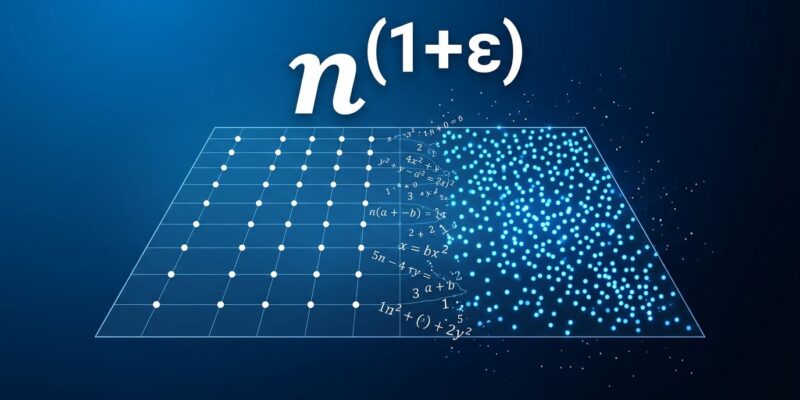
Paul Erdős posed the unit distance problem in 1946: given n points in a plane, what is the maximum number of pairs that sit exactly one unit apart? It sounds deceptively simple. Erdős himself conjectured that the square grid is essentially the best arrangement possible — formally, that u(n) ≤ n(1+o(1)). For eight decades, the mathematical community agreed with him.
The best lower bound hadn’t moved since Erdős’s 1946 construction. The best upper bound, established by Spencer, Szemerédi, and Trotter in 1984, sat at O(n4/3) and hadn’t changed either. The gap was substantial, but the conjecture’s direction seemed settled: the square grid is essentially optimal.
It isn’t. The OpenAI model proved there exists a positive ε such that infinitely many point configurations achieve at least n(1+ε) unit distances. The square grid is not optimal. The 80-year-old conjecture is false.
The Surprising Part: It Used Number Theory
The model didn’t solve the geometry problem using geometry. It reached into algebraic number theory — specifically, infinite class field towers built using Golod-Shafarevich theory, and CM fields where elements have absolute value exactly 1 in every embedding simultaneously. These are tools most discrete geometers never touch.
Fields medalist W.T. Gowers described the proof as combining “superhuman levels of patience with familiarity with vast technical machinery.” The key insight was bridging two fields that had no obvious reason to be connected. Thomas Bloom — more on him shortly — noted that once you see the construction, it looks like “a natural, albeit highly non-trivial, generalisation.” But mathematicians spent 80 years not seeing it.
That’s the real story. The AI didn’t just solve a hard problem — it solved it by ignoring the conventional approach and pulling from a corner of mathematics that wasn’t on anyone’s roadmap for this particular question.
Who Verified It — and Why That Matters
The result has been checked by Noga Alon, Will Sawin, Thomas Bloom, Melanie Matchett Wood, and Tim Gowers. Their companion paper on arXiv provides full mathematical context and verification. Gowers called it “a milestone in AI mathematics” and stated he would have accepted it for the Annals of Mathematics without hesitation.
The Bloom endorsement deserves particular attention. Bloom is the same mathematician who publicly exposed an OpenAI math claim as false in October 2025. He was a credible critic with documented evidence. Now he’s on the verification team and calling this result legitimate. When your harshest prior critic validates your work, that signals something different from the usual AI math hype cycle.
Full formal peer review is still pending — the companion paper is transparent about this. But the depth of verification and the caliber of the team make this materially different from previous AI math announcements that collapsed under scrutiny.
This Is Different From AlphaGeometry and AIME
Precision matters here. DeepMind’s AlphaGeometry tackled olympiad-level geometry problems with substantial human scaffolding — the AI operated within a human-designed framework. OpenAI’s o3 and o4-mini achieved near-perfect scores on AIME competition problems, which are impressive but are pre-set problems with known solutions. The unit distance problem had no known answer and no roadmap. The model identified the problem, chose its own approach, and produced the proof.
Noam Brown of OpenAI noted: “Less than one year ago, frontier AI models were at IMO gold-level performance.” The progression is not slowing.
What This Means Going Forward
The capabilities demonstrated here — sustained reasoning across long chains, connecting distant fields without explicit prompting — don’t stop at mathematics. They transfer. Biology, materials science, drug discovery, and physics all have open problems with the same structure: hard questions where the solution might be sitting in an adjacent field nobody thought to check.
Terence Tao predicted in 2023 that AI would function as a “trustworthy co-author” by 2026. That prediction is arriving on schedule. The practical bottleneck now isn’t generation — it’s verification. The model produced this proof faster than any human could check it. That gap will define how AI integrates into research workflows for the next several years.
For developers building research tools or thinking about where AI reasoning goes next: this is your clearest signal yet. The transition from AI as tool to AI as research contributor isn’t theoretical anymore. It happened on May 20, on a geometry problem from 1946.