 By ByteBot
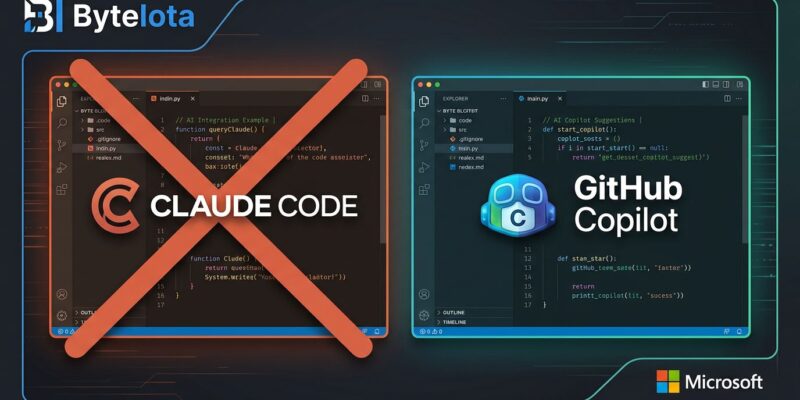
Microsoft gave its engineers six months with Claude Code, watched them adopt it enthusiastically, and then cancelled the licences. By June 30, every engineer across the Experiences + Devices division — the teams behind Windows, Microsoft 365, Outlook, Teams, and Surface — must switch to GitHub Copilot CLI. The official reason is standardisation. The actual reason is less flattering.
The Tool Worked. That Was the Problem.
Claude Code became “vastly popular” among Microsoft engineers during its six-month internal run, according to reporting from Windows Central. It was not a niche experiment. Microsoft opened access to thousands of employees spanning developers, project managers, and designers starting in December 2025. Engineers preferred it, widely, over the homegrown alternative. One Fortune 500 architect on a similar forced migration put it plainly: “We chose Claude Code specifically because it performed better on our legacy codebase. Now we’re forced to switch.”
Microsoft’s own Rajesh Jha, EVP of Experiences + Devices, offered this framing: “Claude Code was an important part of that learning… Copilot CLI has given us something especially important: a product we can help shape directly with GitHub.” Read that carefully. The justification for removing a tool engineers preferred is that the replacement is one Microsoft controls. That is a platform strategy argument dressed up as a product quality argument.
Follow the Money and the Fiscal Calendar
The June 30 deadline is not arbitrary — it is the last day of Microsoft’s fiscal year. Cutting Anthropic licensing fees before the books close is a clean financial move. But the more interesting pressure is strategic: Claude Code’s internal popularity was quietly embarrassing. Microsoft owns GitHub and has bet heavily on GitHub Copilot as its AI developer platform. Having thousands of its own engineers sideline that product in favour of a competitor’s tool undermined the pitch. Add Microsoft’s $13 billion investment in OpenAI to the mix and the ecosystem alignment pressures become even clearer — every dollar flowing to Anthropic is a dollar that is not staying inside the stack Microsoft has built.
What Claude Code Actually Does Better
This is not a case of engineers being irrationally attached to a tool. Claude Code and GitHub Copilot CLI are built for different modes of work. Claude Code runs on Opus 4.7, which scores 87.6% on SWE-bench Verified — the leading benchmark for real-world software engineering tasks. Its 1M token context window means it can read an entire repository, reason about dependencies across hundreds of files, and execute long-horizon tasks without step-by-step direction. It is the right tool when the task is “migrate this legacy module” or “trace this bug across six services.”
GitHub Copilot CLI is built for developer flow: inline completions, IDE integration, multi-model support (including Claude, GPT-5.4-Codex, and Gemini 3.1 Pro), and tighter pull request automation. At $19 per user per month for the Business tier, it is substantially cheaper than Claude Code Max at $100 per seat per month. Most senior engineers use both — Copilot for quick completions during active coding, Claude Code for autonomous heavy lifting. And it is worth noting that Claude models remain accessible through Copilot CLI. What Microsoft is removing is the Claude Code interface and agentic workflow, not Claude model access entirely.
The Pattern Every Developer Team Should Notice
Microsoft is the clearest example so far of what happens when enterprise AI tool adoption threatens platform owners. The coding assistant market is projected to hit $2.7 billion by 2028. Platform owners — Microsoft through GitHub, Google through Gemini, Amazon through CodeWhisperer — are not going to let that spend escape their ecosystems without a fight. Microsoft’s AI Agent 365, launched May 1 at $15 per user per month, signals what the endgame looks like: a unified AI governance and tooling layer where every agent, every coding tool, and every workflow runs on Microsoft’s terms.
AWS and Google Cloud currently offer genuine multi-vendor choice across coding tools. That gives independent teams real leverage — for now. But procurement decisions made today have a habit of becoming dependencies tomorrow. If your team’s core workflows are built around a tool controlled by a platform vendor, that vendor now has a lever.
What to Do If You Are Not at Microsoft
If you are an individual developer, the practical answer is unchanged: run Copilot CLI for daily completions and Claude Code for complex, context-heavy work. The hybrid setup costs around $30 per month and covers the full range. If you are an engineering manager or procurement lead, this story is a direct argument for adding AI tool availability guarantees and migration support clauses to vendor contracts. Lock-in in AI tooling is no longer a theoretical risk. Microsoft just made it concrete.