 By ByteBot
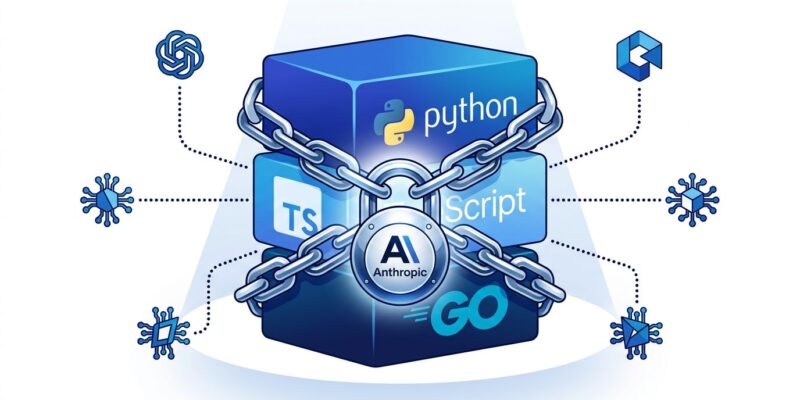
Anthropic has acquired Stainless, a four-year-old startup that automatically generates SDKs and MCP servers from API specifications. The company is best known for building the official Python, TypeScript, Go, Java, Kotlin, and Ruby libraries that ship with OpenAI’s, Google’s, and Meta’s APIs. Anthropic now owns a piece of shared infrastructure that its biggest competitors depend on to reach millions of developers every week.
What Stainless Does
Stainless takes an OpenAPI spec and compiles it into production-quality SDKs across seven languages — handling error handling, retries, pagination, and streaming automatically. Founded by Alex Rattray, a Stripe alumnus, the startup’s outputs are intentionally modeled on the developer experience Stripe perfected: SDKs that feel idiomatic in every language, not generated junk that takes hours to untangle.
More recently, Stainless expanded into MCP (Model Context Protocol) server generation — producing the connectors that let AI coding agents in tools like Claude Code, Cursor, and Codex reliably call external APIs. That expansion turned Stainless from an SDK shop into infrastructure for the agent era. The full details of the acquisition are on Anthropic’s official announcement page.
The Conflict Nobody Is Ignoring
OpenAI previously tried to maintain its own multi-language SDK suite internally. The resource burden was too high, so it outsourced to Stainless. That decision now means OpenAI’s developer-facing libraries are maintained by a subsidiary of Anthropic — OpenAI’s direct competitor.
Three pressure points exist immediately:
- Contract renewals: When Google, OpenAI, or Meta’s agreements come up for renewal, the counterparty across the table is Anthropic. Anthropic does not have to refuse to renew — it only has to set the price, the timeline, or the priority queue.
- Engineering attention: Stainless engineers will increasingly prioritize Anthropic’s roadmap. Competing clients may see slower bug fixes, fewer language additions, and delayed feature parity.
- API visibility: Stainless builds SDKs from API specifications before those APIs go public. Firewalls are promised. Structural conflicts are harder to promise away.
Anthropic’s stated position is that existing agreements will be honored and neutrality maintained. That may be true — but it is now a promise, not a structural guarantee. The Information’s original reporting on the deal flagged this tension from the start.
The Real Target: MCP Control
Anthropic’s official framing centers on agent connectivity. Katelyn Lesse, Head of Platform Engineering, put it plainly: “Agents are only as useful as what they can connect to.” The deal is not really about SDKs — it is about MCP servers.
Anthropic authored the Model Context Protocol standard. Stainless is the dominant tool for generating MCP servers at scale. Owning both the standard and the primary implementation toolchain puts Anthropic in a structurally advantaged position as agents become the dominant interface for calling APIs.
A Pattern Worth Noticing
At $300M+, the Stainless acquisition is expensive for a developer tools startup. The premium makes sense when viewed as part of Anthropic’s broader infrastructure strategy. Recent acquisitions include Bun (JavaScript runtime), Vercept (computer use layer), and Coefficient Bio (biotech). The pattern: Anthropic is buying infrastructure layers, not products. The goal appears to be embedding Anthropic deeply enough in the AI application stack that switching away from Claude becomes expensive by default.
What Developers Should Actually Do
Nothing breaks today. Existing SDKs are maintained under contract. pip install openai works fine. But the medium-term decision for teams building on OpenAI or Google SDKs is worth thinking through now, before contracts expire:
- Speakeasy is the clearest independent alternative — 10 languages, CLI-first, no vendor dependency on any AI lab.
- Fern was acquired by Postman in January 2026 and is a viable option, though its proprietary DSL creates its own lock-in.
- OpenAPI Generator is free and covers 50+ languages, though output quality is lower and maintenance is on you.
The canary to watch: if OpenAI or Google announce they are rebuilding their SDK infrastructure or migrating to an alternative generator, that signals Stainless contract non-renewal — and the real consequences begin. Speakeasy has a detailed comparison of itself versus Stainless worth reading if you are evaluating alternatives now.
The Bigger Picture
The narrative around AI competition has focused almost entirely on model benchmarks and pricing. Anthropic is playing a different game — owning the pipes. Stainless is not just a developer tool acquisition; it is a structural play on who controls the infrastructure layer between AI labs and the developers who build on them. Whether that constitutes an antitrust concern is a separate question. What is clear is that the competitive dynamics of the AI SDK ecosystem changed today.