 By
By On April 20, 2026, GitHub did something unprecedented: it suspended new sign-ups for Copilot Pro, Pro+, and Student plans because agent workflows were costing more than users paid. The company admitted that “it’s now common for a handful of requests to incur costs that exceed the plan price.” This is the first major AI coding tool to publicly hit economic breaking point—and it won’t be the last.
Agent Workflows Consume 10-100x More Resources
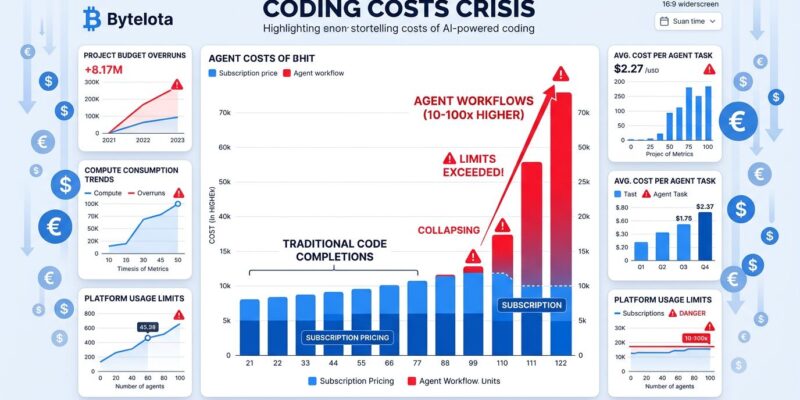
Traditional code completions consume 1,000-5,000 tokens per interaction, costing about a penny. Agent workflows are different. A single agentic task—reading 500,000 tokens of codebase context, generating code across multiple files, running tests, iterating fixes—can burn through 500,000 to 1 million tokens. That’s $5-15 per request, not $0.01.
GitHub’s VP of Product explained it bluntly: “Long-running, parallelized sessions now regularly consume far more resources than the original plan structure was built to support.” The context window arms race drove this crisis. Tools went from 5,000 tokens to over 1 million for microservice-level awareness—a 200x increase. When a single request costs more than a monthly subscription, flat-rate pricing breaks.
Developers report the impact firsthand. Cursor users hit $1,400 monthly bills. Others exhaust $200 quotas by Wednesday afternoon, unable to work the rest of the week. The economics are clear: agent workflows aren’t incrementally more expensive—they’re 10-100x more expensive.
Usage-Based Billing Arrives June 1
GitHub’s solution: kill the subscription model. On June 1, 2026, all Copilot plans transition to usage-based billing with “GitHub AI Credits.” Users get a monthly credit allowance ($10, $39, etc.) and pay overages or hit hard caps when credits run out. No more fallback to free models when limits hit.
Code completions remain free, but agent workflows consume credits based on token usage at published API rates. Copilot code review double-bills users—consuming both AI Credits and GitHub Actions minutes simultaneously. Organizations can pool credits across teams and set budget controls, but the fundamental shift is clear: costs are now unpredictable for users but predictable for GitHub.
This makes budgeting impossible. Developers who relied on “unlimited” agent access will face surprise bills or service cutoffs mid-task. Organizations must budget $200-600 per user per month instead of the $10-20 advertised rates.
Related: Agentic Coding Economics
The $10 Promise vs $200-600 Reality
AI coding tools advertise $10-20 per month. Enterprise data from May 2026 tells a different story: real costs of $200-600 per month for teams using agent workflows. Heavy individual users report $500-2,000 monthly bills. The advertised pricing was always a loss leader that couldn’t scale.
The break-even point reveals the problem: GitHub’s pricing model broke at just 1-2 agent tasks per month. What looked like “3 of 300 premium requests used” in the UI actually cost GitHub $10-15 in compute per request. Per-request billing masked true token costs, hiding the unsustainable economics from users until the collapse.
This creates a two-tier market. The 78% of Fortune 500 companies using AI-assisted development can afford $200-600 per user budgets. Individual developers and small teams can’t. Tools promising 10x productivity are increasingly affordable only to those who need them least.
Opus Removal and Developer Backlash
GitHub removed Opus 4.6 from Pro plans entirely on April 20, with less than 30 days notice. The replacement—Opus 4.7 exclusive to Pro+ ($39/mo)—costs 4x more per request. Developers who paid $10 monthly specifically for Opus access faced a 10x price increase: from a 3x multiplier on the $10 plan to a 7.5x multiplier on the $40 plan.
One developer on Hacker News captured the frustration: “Opus was one of the reasons I had a subscription in the first place. Without it, the service’s value proposition evaporated.” Another drew a broader lesson: “We should not be renting our tools.”
Annual subscribers were trapped with a changed service and limited refund paths. The backlash wasn’t about price alone—it was about the instability of renting AI tools. Pricing models, model availability, and service terms change with little notice, mid-subscription. That’s a lesson developers won’t forget.
What This Means for AI Coding Tools
GitHub isn’t alone. April 2026 brought pricing chaos across AI coding tools: Windsurf raised prices and changed billing models, Anthropic nearly pulled Claude Code from the $20 Pro plan, and multiple tools tightened limits. If GitHub—Microsoft-backed, market leader—can’t make subscriptions work, no one can.
This is an industry-wide crisis, not a GitHub problem. The context window arms race, agentic workflow explosion, and unpredictable compute costs affect every provider. Expect Cursor, Windsurf, and others to follow GitHub’s path within six months.
The future is clear: subscription pricing is dead for agentic AI tools. Usage-based billing makes costs predictable for providers but unpredictable for users. Budget $50-100 per month as the new normal for agent-capable tools, with a two-tier market emerging: cheap autocomplete at $10 versus expensive agents at $100+.
The rental model instability will drive developers toward self-hosted and open-source alternatives. Microsoft’s decision to suspend sign-ups marks the end of an era—and the beginning of a much more expensive one.