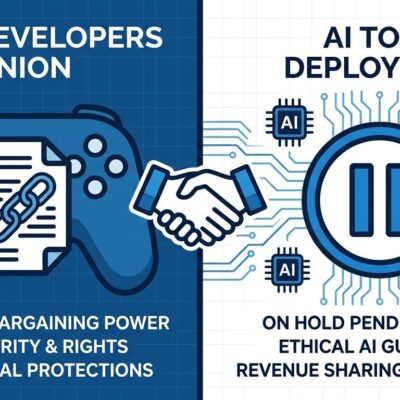
On May 4, 2026, Anthropic and OpenAI both announced competing joint ventures to deploy enterprise AI services—on the same day. Anthropic partnered with Blackstone, Hellman & Friedman, and Goldman Sachs in a $1.5 billion venture targeting mid-sized organizations. Hours later, OpenAI unveiled The Deployment Company, raising $4 billion from 19 investors at a $10 billion valuation. This isn’t about better AI models anymore. It’s about who can embed AI into enterprise workflows faster—and both giants are betting that the real money is in services, not software. Traditional consulting firms should be paying attention. This is the most serious structural threat they’ve faced since offshore outsourcing gutted their costs in the late 1990s.
Why Both Announced on the Same Day
The timing wasn’t coincidence. OpenAI’s announcement came hours after Anthropic’s, suggesting competitive intelligence at work. When you’re racing for a $375 billion consulting market, you don’t let your rival get a head start.
The financial commitments back this up. Anthropic secured $1.5 billion with Blackstone, Hellman & Friedman, and Goldman Sachs each putting in $300 million (Goldman at $150 million), plus backing from Apollo, General Atlantic, Singapore’s GIC, and Sequoia. OpenAI went bigger: $4 billion raised from 19 investors including TPG, Brookfield, Advent, and Bain Capital, valued at $10 billion. More telling: OpenAI is offering a 17.5% guaranteed annual return over five years. That’s not just confidence—that’s a bet these ventures will print money.
The total: $11.5 billion committed to deploying AI into enterprises. The message is clear: the race to deploy is now more important than the race to build better models. Both companies have state-of-the-art AI. The bottleneck isn’t capability—it’s getting it into production.
The Structural Threat to Traditional Consulting
AI-native ventures have three advantages traditional consulting firms can’t match. First: direct model access without markup. When Deloitte or Accenture deploy Claude, they’re reselling it. When Anthropic’s venture deploys Claude, they own it. Lower costs, no intermediary margin. Second: engineers instead of analysts. Traditional consulting sends analysts to assess and PowerPoint. AI-native firms send engineers to integrate and ship. That’s 2-3x faster deployment cycles. Third: equity alignment. The PE firms backing these ventures already pay consulting bills across hundreds of portfolio companies. Now they get direct equity exposure to AI deployment success instead of paying hourly rates.
Here’s the ratio that matters: for every dollar enterprises spend on software, they spend six on services. That’s how consulting became a $375 billion market. AI-native firms are targeting that 6:1 ratio with lower costs and faster timelines. Mid-market consulting is most vulnerable. These firms can’t compete on speed when AI-native competitors embed engineers directly. They can’t compete on cost when they’re reselling AI access instead of owning it. This is offshore outsourcing 2.0—but instead of lower-wage labor, it’s AI.
From Assessment to Deployment
The deployment model is straightforward: small teams assess where AI delivers maximum value, then embed applied AI engineers alongside client staff to build custom solutions. Not replacements—integrations. Anthropic targets community banks, mid-sized manufacturers, and regional health systems. OpenAI focuses on healthcare, logistics, manufacturing, and financial services. Both aim at organizations with AI needs but no internal AI expertise.
Krishna Rao, Anthropic’s CFO, framed it clearly: “Enterprise demand for Claude is significantly outpacing any single delivery model. This new firm brings additional operating capacity to the ecosystem.” Translation: we can’t scale fast enough through traditional partners, so we’re building our own deployment arm. Anthropic’s example: building documentation and coding tools for clinicians that integrate into existing healthcare workflows. Not a new system doctors have to learn—AI embedded into what they already use.
The PE investor pipeline is the unlock. Blackstone, Goldman, and their consortium partners control hundreds of portfolio companies. That’s a built-in customer base where deployment decisions get made at the board level. Fast adoption, guaranteed pipeline, equity upside. Traditional consulting firms compete client by client. These ventures start with hundreds of clients on day one.
Competing with Their Own Partners
Here’s where it gets awkward. Anthropic already partners with Accenture, Deloitte, and PwC through its Claude Partner Network. Now it’s launching a venture that competes directly with them for the same mid-market clients. Fortune’s headline called it what it is: “Anthropic takes shot at consulting industry.” The shot lands because traditional firms are slow to respond. Their business model is billable hours. AI automation cuts hours. Adopt AI aggressively and cannibalize your own revenue. Resist AI and lose market share to AI-native competitors who don’t have that conflict.
The junior consultant role—the industry’s traditional talent pipeline—is at highest risk. Analyst work that used to take teams of recent grads now runs through AI agents. The billable pyramid collapses when the bottom tier automates away. Consulting firms know this. They’re just not sure how to fix it without destroying their economics.
What This Means for Developers
A new role is emerging: the applied AI engineer. It’s not pure ML research and it’s not traditional consulting. It’s the hybrid—engineers who can take foundation models and embed them into enterprise workflows while navigating compliance, legacy systems, and organizational change. LinkedIn reports 1.3 million AI-related jobs created in the past two years. That number is accelerating.
The career shift: traditional consulting was analyst-heavy (PowerPoints, assessments, billable hours). Applied AI engineering is engineering-heavy (integration, deployment, automation). If you’re a developer, the opportunity is positioning yourself as someone who can deploy AI, not just build it. Learn prompt engineering, agent orchestration, workflow automation. Pick an industry vertical—healthcare AI, fintech AI, manufacturing AI—and understand the compliance frameworks. That’s the premium skillset.
Key takeaways for what’s happening:
- AI giants are pivoting from research to commercialization—the money is in deployment, not just models
- Mid-market consulting faces existential threat from AI-native competitors with structural cost and speed advantages
- “Applied AI engineer” is the emerging role—blend of ML expertise and enterprise consulting
- PE firms are racing to deploy AI across portfolios; being slow means falling behind competitors
- Traditional consulting firms face adapt-or-die moment; billable hours model conflicts with AI automation