 By ByteBot
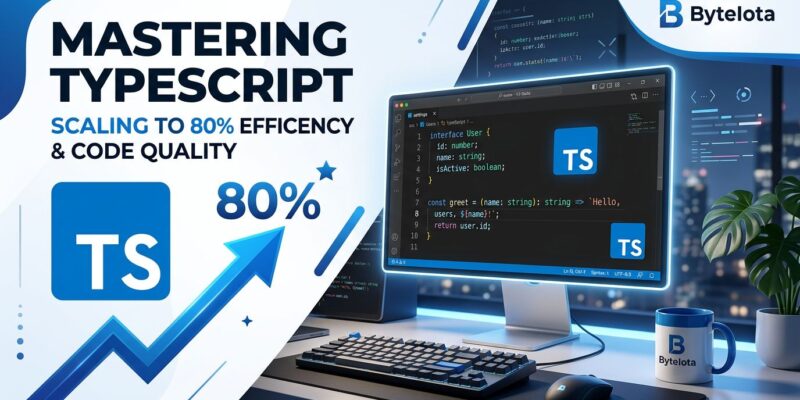
TypeScript crossed 80% adoption among developers at Nitor in 2026, opening a 16-percentage-point lead over vanilla JavaScript. This isn’t just another milestone—it’s the inflection point where TypeScript becomes the default and JavaScript becomes the exception. The shift is backed by hard data: GitHub ranked TypeScript as the #1 language in August 2025 with 2.6 million monthly contributors (66% year-over-year growth), and 78% of job postings now require TypeScript skills. Unlike CoffeeScript and Flow, which died trying to replace JavaScript, TypeScript won by staying compatible with it.
How Frameworks Forced the Shift
TypeScript didn’t win purely on technical merit. When Next.js, Nuxt, and SvelteKit made TypeScript the default choice in their project scaffolding tools, they forced developers’ hands. Running create-next-app prompts “Would you like to use TypeScript?” with “Yes” as the default. Opting OUT requires deliberate action—and that small friction point changed everything.
Framework maintainers made the decision FOR developers, and the ecosystem fell in line. Angular went further: it requires TypeScript as the only officially supported language. This isn’t grassroots adoption—it’s strategic positioning. The controversial truth is that TypeScript succeeded because key gatekeepers chose it, not because millions of developers independently concluded it was superior.
However, the strategy worked because developers didn’t rebel. TypeScript’s JavaScript compatibility meant the transition felt incremental rather than revolutionary. Frameworks could default to TypeScript without breaking existing projects, and developers could gradually adopt type annotations without rewriting entire codebases. That’s the difference between TypeScript’s success and CoffeeScript’s failure.
The Career Gatekeeper Reality
78% of job postings now require TypeScript. Let that sink in: developers who resist TypeScript aren’t making a technical choice—they’re limiting their career opportunities to 22% of the market. This is no longer about whether TypeScript is “better” than JavaScript. It’s about whether you want access to the jobs that actually exist.
The numbers tell the story. Professional developer adoption hit 78% in 2026 (up from 69% in 2024). Furthermore, 40% of developers now write exclusively in TypeScript (up from 34% in 2024), while only 6% use plain JavaScript exclusively, according to the State of JavaScript 2025 survey. These aren’t early adopters experimenting with new tech—they’re the mainstream. TypeScript has crossed the chasm.
The comparison to React is instructive. Five years ago, React became non-negotiable for frontend roles. Today, TypeScript occupies the same gatekeeping position. Bootcamps teach it from day one. Companies list it as a required skill, not a nice-to-have. The market has spoken: learn TypeScript or limit your options.
Java’s Decline Shows No Language Is Safe
While TypeScript rose to 80% at Nitor, Java collapsed from 65% to 38% between 2021 and 2026. Java didn’t just stagnate—it fell behind shell scripting (50%) and Python (47%) to sixth place. The Nitor Developer Survey 2026 shows the language that dominated enterprise development for two decades lost nearly half its developer base in five years.
This isn’t just a Nitor phenomenon. Java’s decline reflects broader industry trends: younger developers choose Python or TypeScript, AI/ML workloads don’t favor Java, and modern frameworks prioritize JavaScript ecosystems over JVM-based stacks. The takeaway isn’t that Java is dead—millions of lines of Java code still power production systems. The takeaway is that language dominance shifts faster than ever before, and no language is immune.
For Java developers, this is a warning sign. For TypeScript developers, it demonstrates momentum. The question isn’t whether TypeScript will remain dominant forever—nothing does. The question is whether TypeScript’s lead will hold for the next five years. Based on current trajectories, the answer is yes.
Why TypeScript Delivers Real Value
Framework defaults explain how TypeScript won, but they don’t explain why developers accepted it. The answer: TypeScript delivers measurable business value. Airbnb’s postmortem analysis revealed 38% of production bugs were preventable with TypeScript—significantly higher than the general research finding of 15% across GitHub repos. That’s not marketing spin; it’s real cost savings.
The AI development angle is newer but equally compelling. Moreover, 94% of errors generated by LLMs in code are type-related, according to a 2025 study. When GitHub Copilot or ChatGPT generates code, TypeScript catches type mismatches immediately. Without TypeScript, those bugs reach runtime. Every major LLM SDK—OpenAI’s Node.js client, Anthropic’s TypeScript SDK, LangChain.js, Vercel’s AI SDK—ships TypeScript-first because AI-generated code needs type safety.
Here’s the practical difference:
// JavaScript - Bug reaches production
function calculateDiscount(price, discountPercent) {
  return price * (1 - discountPercent / 100);
}
calculateDiscount("50", "20"); // Returns NaN
// TypeScript - Error caught at compile time
function calculateDiscount(price: number, discountPercent: number): number {
return price * (1 - discountPercent / 100);
}
calculateDiscount("50", "20");
// Error: Argument of type 'string' is not assignable to parameter of type 'number'Type safety isn’t theoretical. Consequently, it prevents production incidents, reduces debugging time, and catches errors that LLMs introduce. The ROI is clear: Airbnb reduced bugs, developers spend less time debugging, and AI-assisted coding becomes practical rather than risky.
TypeScript Won by Not Replacing JavaScript
The irony of TypeScript’s dominance is that it succeeded by making JavaScript better, not by replacing it. CoffeeScript tried to replace JavaScript with a new syntax and died when ES6 adopted its features. Flow tried to add types but required a compilation step and lacked ecosystem support. Both failed because they broke JavaScript compatibility.
TypeScript took a different path: it’s a superset of JavaScript. Every valid JavaScript program is valid TypeScript. Developers could rename .js files to .ts and gradually add type annotations without rewriting anything. For more on language evolution, see TypeScript’s official documentation. Framework maintainers could add TypeScript support without breaking JavaScript users. The compatibility was strategic brilliance.
The lesson extends beyond TypeScript. Technologies that force breaking changes die. Technologies that offer incremental adoption paths survive. Python 3 took 12 years to displace Python 2 because the transition required breaking changes. TypeScript displaced vanilla JavaScript in 5 years because the transition required nothing—just opt-in type annotations.
The debate about static typing in web development is effectively over. TypeScript won, and it won by not forcing the issue. JavaScript didn’t die; it became TypeScript’s compilation target. That’s how you replace a language without killing it.
Key Takeaways
- TypeScript crossed 80% adoption at Nitor with a 16-point lead over JavaScript, becoming the #1 language on GitHub with 2.6M contributors
- Framework defaults (Next.js, Nuxt, SvelteKit) made TypeScript inevitable by forcing developers to opt OUT rather than opt IN
- 78% of job postings now require TypeScript—it’s no longer optional for web developers, it’s career-essential
- Airbnb’s 38% bug reduction and AI development advantages (94% of LLM errors are type-related) prove TypeScript delivers measurable ROI
- Java’s decline from 65% to 38% (2021-2026) shows language dominance shifts faster than ever—no language is immune to disruption
- TypeScript won by staying JavaScript-compatible, not by replacing it—technologies that force breaking changes die, incremental adoption paths survive
The static typing debate is over. TypeScript is the default. JavaScript is the exception. Developers who haven’t made the transition yet aren’t debating technical merit—they’re delaying career adaptation.