 By ByteBot
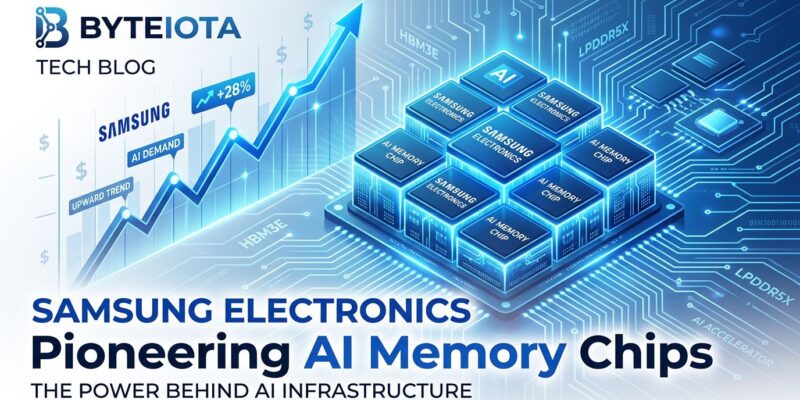
Samsung Electronics hit $1 trillion in market value on May 6 after shares rallied 14% in a single day, making it only the second Asian company after TSMC to cross this milestone. The surge caps a year where Samsung’s stock quadrupled, driven entirely by one product category: memory chips for AI infrastructure. This isn’t just a stock market story. Samsung’s memory chip supply crunch is the same bottleneck slowing GPU availability, raising cloud costs, and limiting developer access to AI infrastructure.
The Numbers Tell an Unprecedented Story
Samsung’s Q1 2026 profit hit $40 billion, an eightfold increase year-over-year. That single quarter’s profit exceeded the company’s entire 2025 earnings combined. Memory chips—specifically the high-bandwidth memory (HBM) used in AI training and inference—accounted for over 90% of operating profit.
The stock price tells the same story. Samsung’s shares reached 270,000 won, up from roughly 67,500 won a year ago. That’s a quadruple in twelve months, fueled by a supply crunch that shows no signs of easing. A Samsung executive said on the Q1 earnings call that “supply is expected to remain far behind customer demand,” and that the gap is expected to widen further in 2027.
Memory vs. Logic: The Misunderstood Distinction
TSMC sits at $2 trillion. Samsung just hit $1 trillion. But they’re not competitors—they’re complements. TSMC makes the logic chips that power AI accelerators (Nvidia’s H100, H200, AMD’s MI300). Samsung makes the memory chips that feed them data.
HBM is the bottleneck. AI training isn’t just compute-bound anymore—it’s memory-bound. Large language models need massive memory bandwidth to shuttle weights and activations between processors. Inference requires fast memory access for real-time responses. Without HBM, GPUs sit idle waiting for data.
The HBM market hit $54.6 billion in 2026, up 58% year-over-year. Demand grew 130% in 2025 and 70% in 2026. AI and ML workloads consume 55% of all HBM production. And it’s sold out through the end of 2026—Samsung, SK Hynix, and Micron are all capacity-constrained.
Market Reaction: KOSPI Breaks 7,000, But Is This Sustainable?
Samsung’s rally lifted South Korea’s KOSPI index past 7,000 for the first time, closing up 6.45% at 7,384. The surge triggered a rare “sidecar” trading curb due to volatility. Foreign investors poured in a record $2.13 billion in a single day. The KOSPI is up 75% year-to-date and 76% in 2025—its best annual performance since 1999.
But the parallels to 1999 aren’t comforting. Chip stocks are now the most stretched relative to their 200-day moving average since the dot-com bubble burst in 2000. BTIG analyst Jonathan Krinsky warned that “the magnitude resembles 1999” and expects a 25-30% correction in semiconductors. Bullish analysts say the KOSPI could hit 10,000 by year-end if AI demand holds. Bearish analysts say it could plummet to 4,500 if the bubble pops.
A National Bureau of Economic Research study from February 2026 found that 90% of firms report no productivity impact from AI, yet executives project only 1.4% productivity gains and 0.8% output increases. That’s the productivity paradox in real time.
Developer Cost Reality: Memory Shortage Means Higher Cloud Prices
HBM shortages directly affect GPU availability. Fewer memory chips mean fewer GPUs reach market, which means higher cloud costs and longer lead times. Major cloud providers cut GPU prices 40-45% in mid-2025, but demand outstripped supply gains. On-demand rates for top-tier AI hardware now run $3-$4 per GPU-hour, and longer-term commitments bring costs below $2 per hour.
For AI startups, GPU compute consumes 40-60% of technical budgets in the first two years. Memory bandwidth optimization is no longer optional—it’s a cost-control requirement. Techniques like LoRA fine-tuning, quantization, and model pruning exist partly because HBM is expensive and scarce.
The Real Question: Sustainable Growth or Peak Bubble?
Samsung’s valuation rests on AI infrastructure demand continuing at record levels. If hyperscalers keep building data centers and agentic AI takes off, Samsung’s supply-demand gap widens and margins stay high. If AI spending slows, or if conventional DRAM cannibalism from HBM production hurts volumes, or if the productivity payoff never materializes, then this looks like 1999 all over again.
For now, Samsung is the world’s 11th most valuable company, second in Asia only to TSMC. The memory supercycle is real. The question is how long it lasts.